


















How is

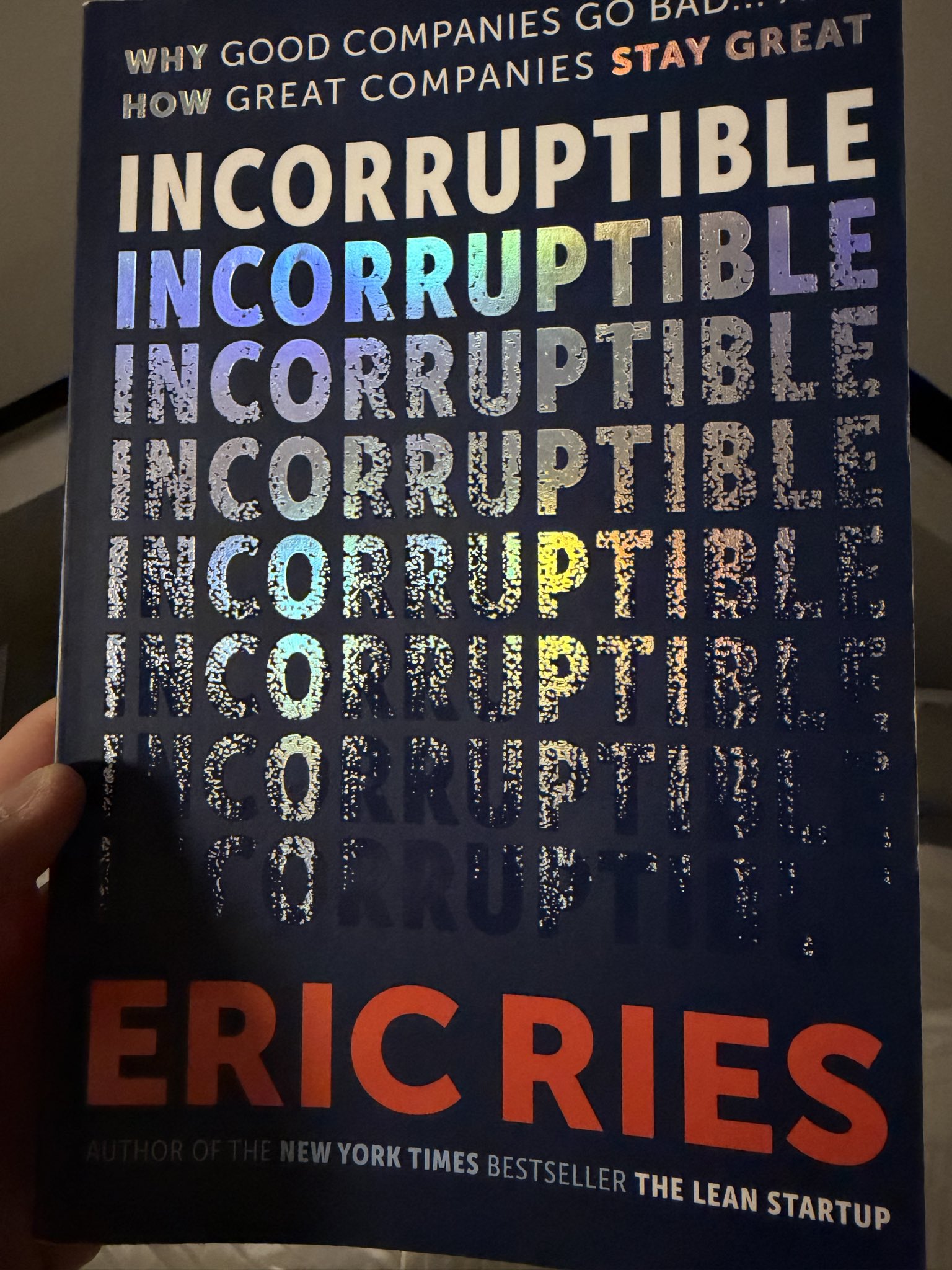
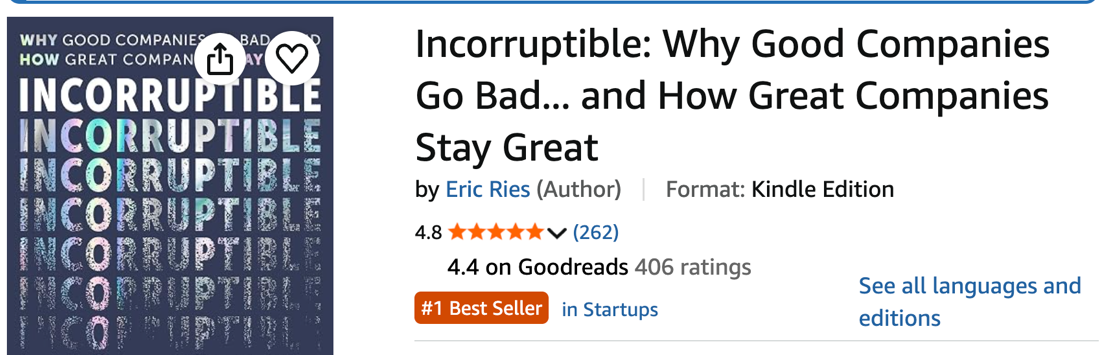
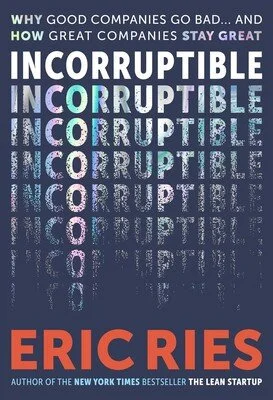
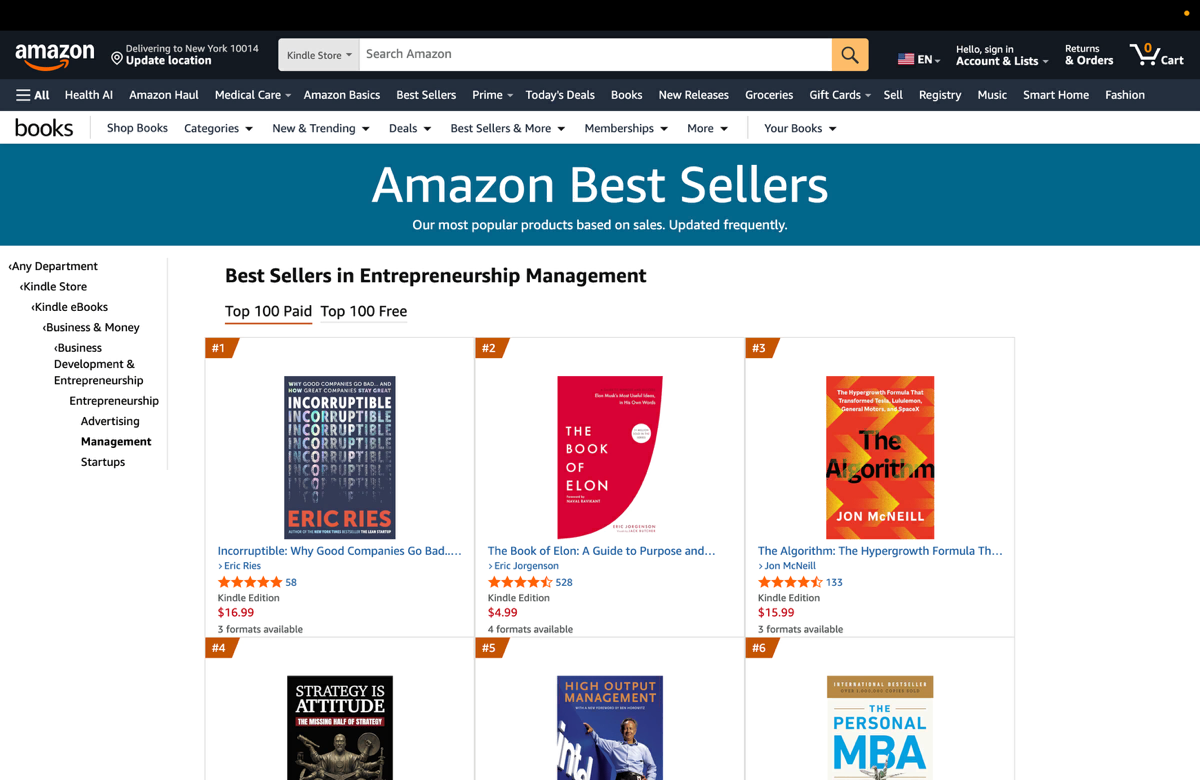
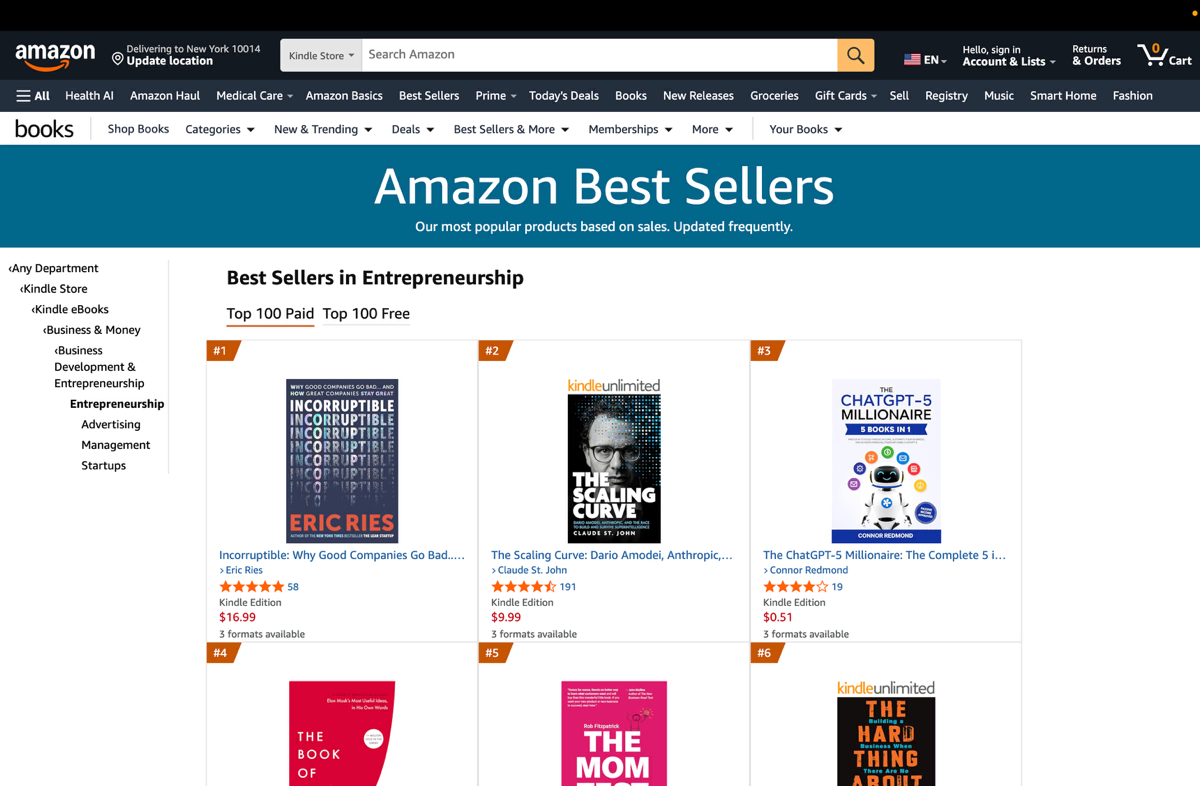
INCORRUPTIBLE

going?

The new book by Eric Ries · May 26, 2026

OUT NOW day 170 since launch
809 moments
191 voices
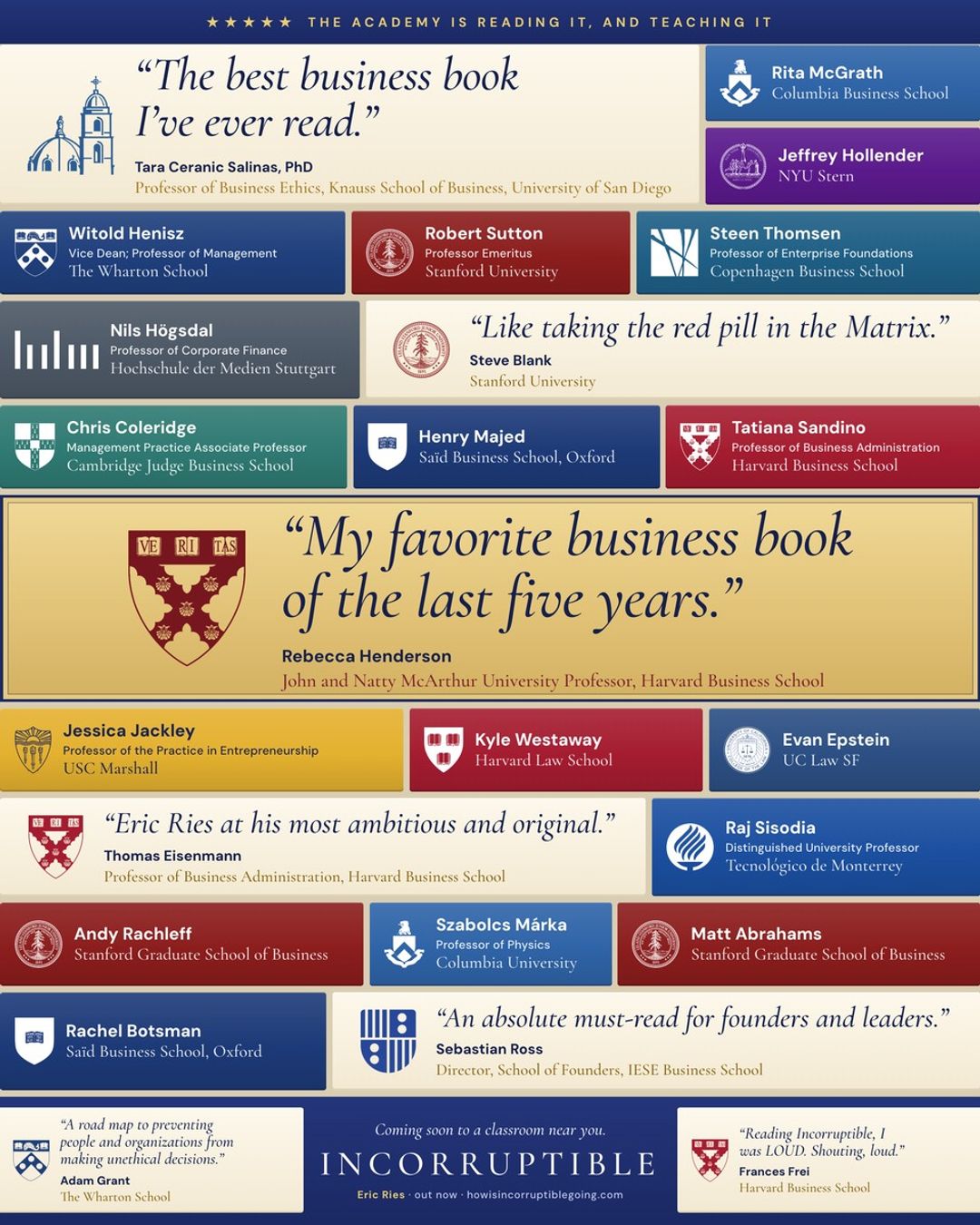
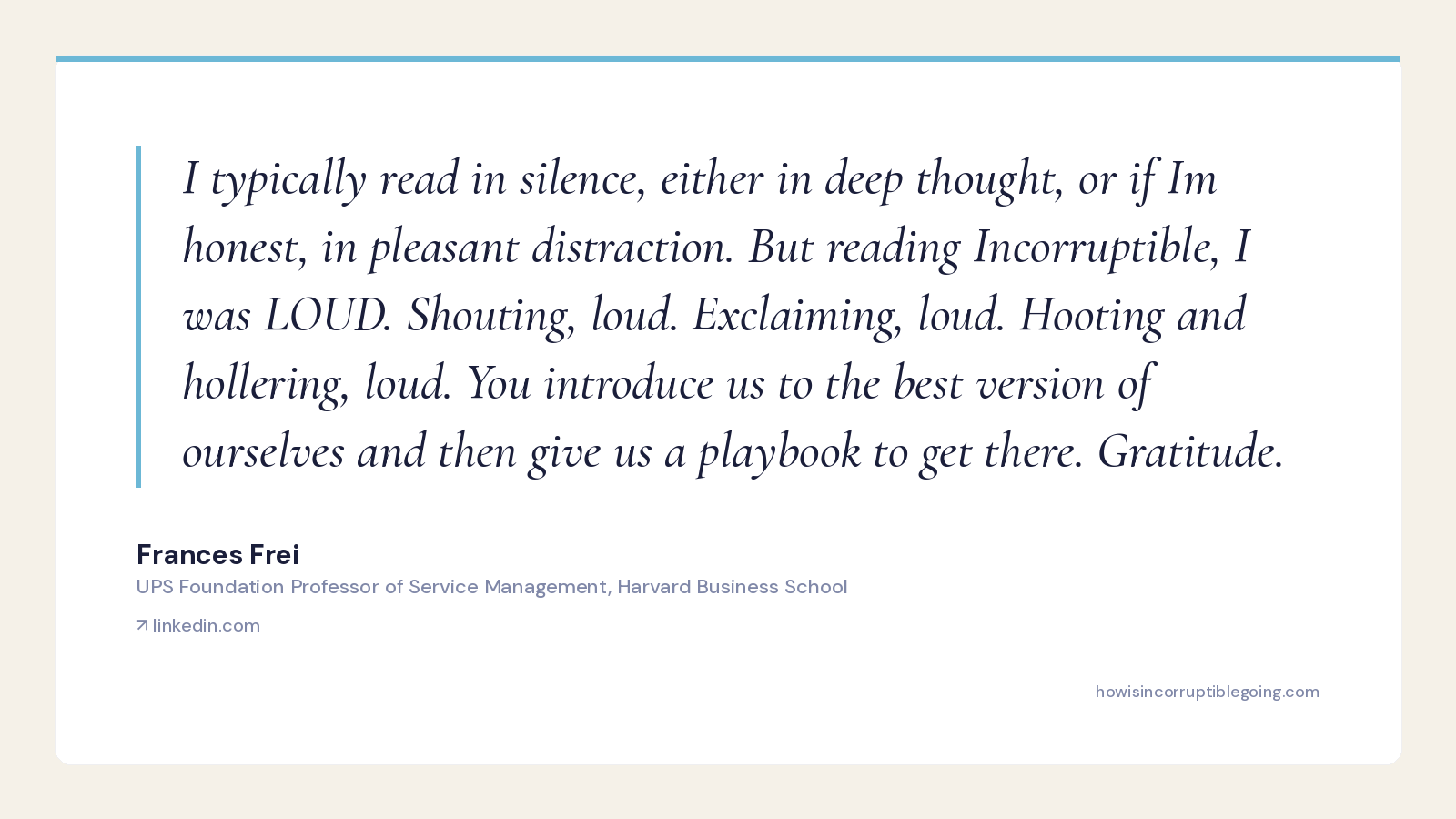
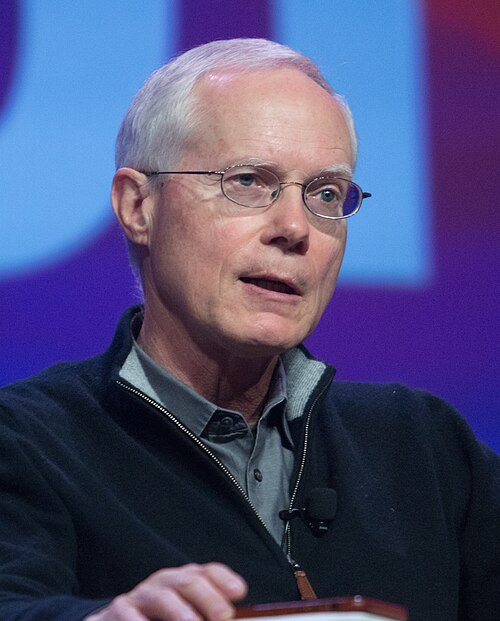
Frances Frei
“I was LOUD. Shouting, loud.”
Frances Frei
Adam Grant
“A road map to preventing people and organizations from making unethical decisions”
Adam Grant
Dan Heath
“The best and most important business book of the year”
Dan Heath
Mark Cuban
“Eric Ries gives founders a playbook to help avoid the inevitable pitfalls”
Mark Cuban
Reid Hoffman
“A must-read for any founder, board member, investor, or consumer”
Reid Hoffman
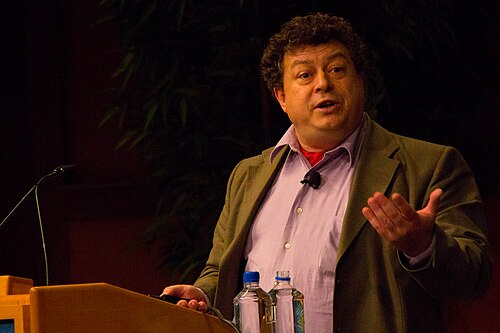
Bob Sutton
“a rare joy to read”
Bob Sutton
Kim Scott
“One of the most important books I've read in the last decade”
Kim Scott
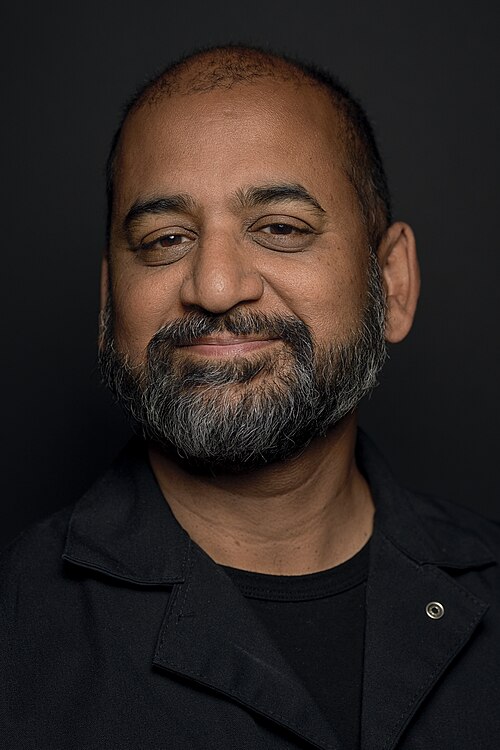
Raj Sisodia
“belongs on the bookshelf of every leader in the world”
Raj Sisodia
Alistair Croll
“An incredibly important reset for startups and capitalism itself”
Alistair Croll
Marty Cagan
“I think it's better than Lean Startup”
Marty Cagan
Lenny Rachitsky
“This month's book club pick is Incorruptible, and the incredible Eric Ries is joining us this week for a Q&A.”
Lenny Rachitsky
Rebecca Henderson
“My favorite business book of the last five years. It is fabulous.”
Rebecca Henderson
Christina Wodtke
“It's been a while since a book helped me understand the world I live in so deeply”
Christina Wodtke
Kim Scott
“Incorruptible explains why shareholder primacy hurts employees–and ultimately shareholders.”
Kim Scott
Paul Graham
“Other leadership books for founders only let you get to third base.”
Paul Graham
Adam Grant
“many people believe [corporate corruption] may be unsolvable — but Eric Ries doesn't think so”
Adam Grant
Kim Scott
“being a good person is necessary but not sufficient. You also have to build great structures and systems.”
Kim Scott
Steve Blank
“Best start up / corporate book of the decade”
Steve Blank
Marty Cagan
“the single most important business book you'll read”
Marty Cagan
Steve Blank
“possibly more important than the Lean Startup ever was”
Steve Blank
Jennifer Pahlka
“This book will make you angry, but it will make you even more hopeful.”
Jennifer Pahlka
Karri Saarinen
“eye-opening”
Karri Saarinen
Rory Sutherland
“this explains a lot”
Rory Sutherland
Sarah Lacy
“his book is the explanation of why and an answer on how to fix' what our generation broke”
Sarah Lacy
Anil Dash
“This book is a big deal”
Anil Dash
Seth Godin
“Gravity is real.”
Seth Godin
Matt Blumberg
“this book will help you walk out with your soul intact”
Matt Blumberg
Jessica Jackley
“This book nearly brought me to tears.”
Jessica Jackley
Nir Eyal
“A thoughtful, timely, and important read”
Nir Eyal
Leah Solivan
“the book I wish I'd had while building”
Leah Solivan
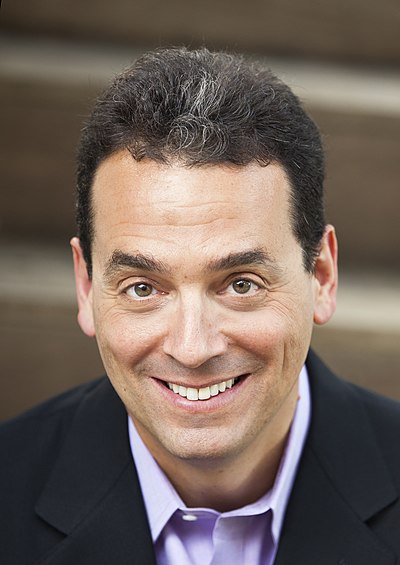
Daniel Pink
“a bracingly practical vision of how companies can stay true and still win”
Daniel Pink
Kieran Snyder
“it would have helped me structure my company better”
Kieran Snyder
Scott Cook
“When will it be seen as founder malpractice to not have read this book?”
Scott Cook
Denise Hearn
“drove home the stakes of not investing in early governance locks”
Denise Hearn
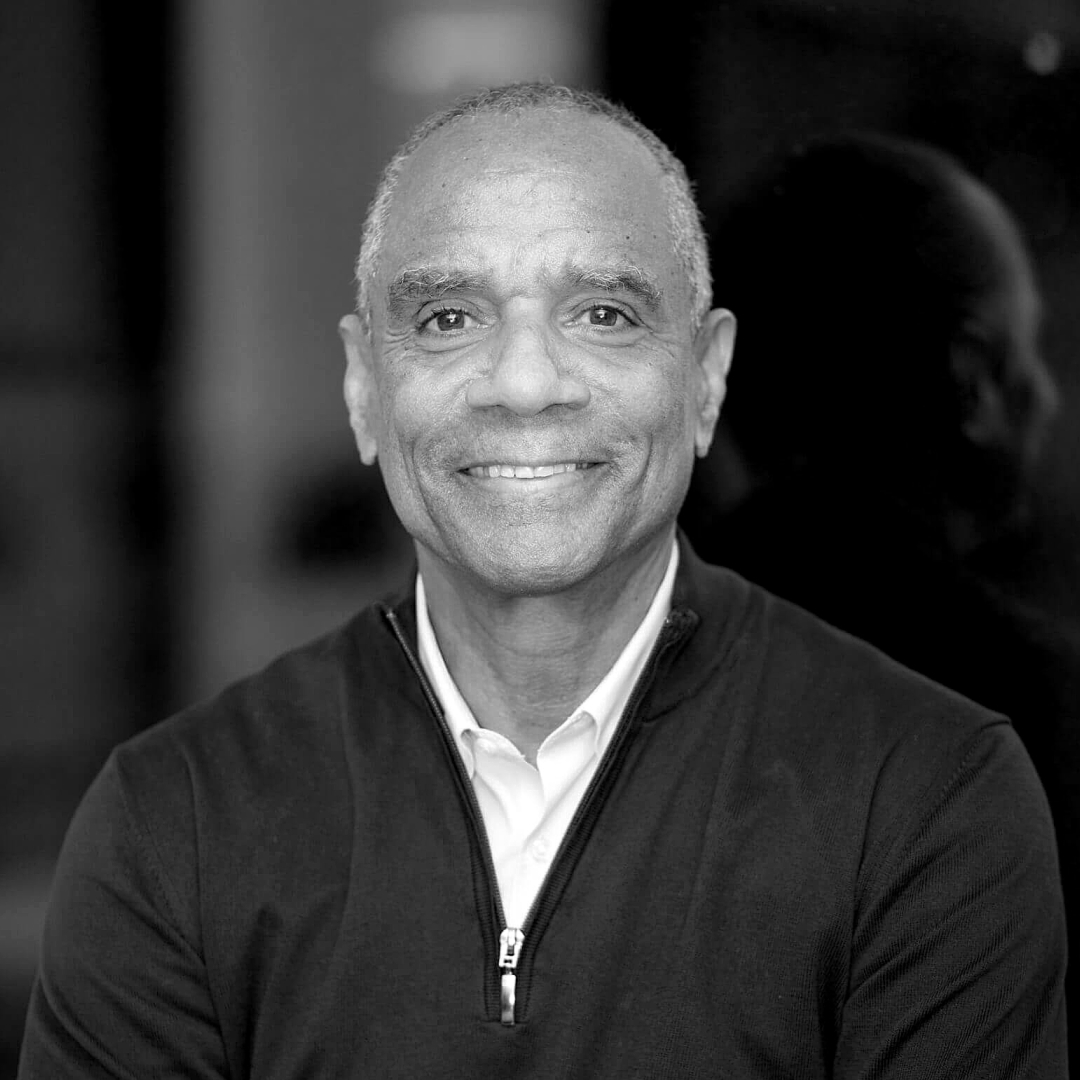
Ken Chenault
“Incorruptible demonstrates the importance of mission-driven leadership and defying the status quo”
Ken Chenault
Vlada Bortnik
“It's permission. It's a blueprint.”
Vlada Bortnik
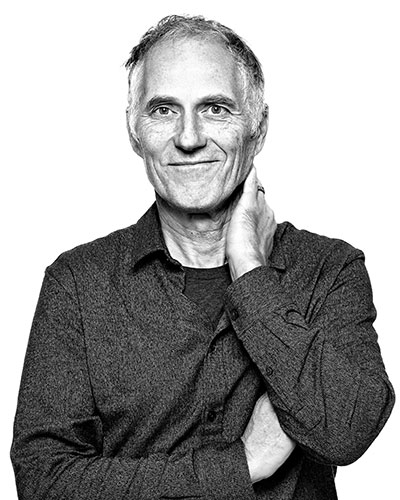
Tim O'Reilly
“If you want the world to be a better place than it is, this book is a good place to start.”
Tim O'Reilly
NOV 25 2026
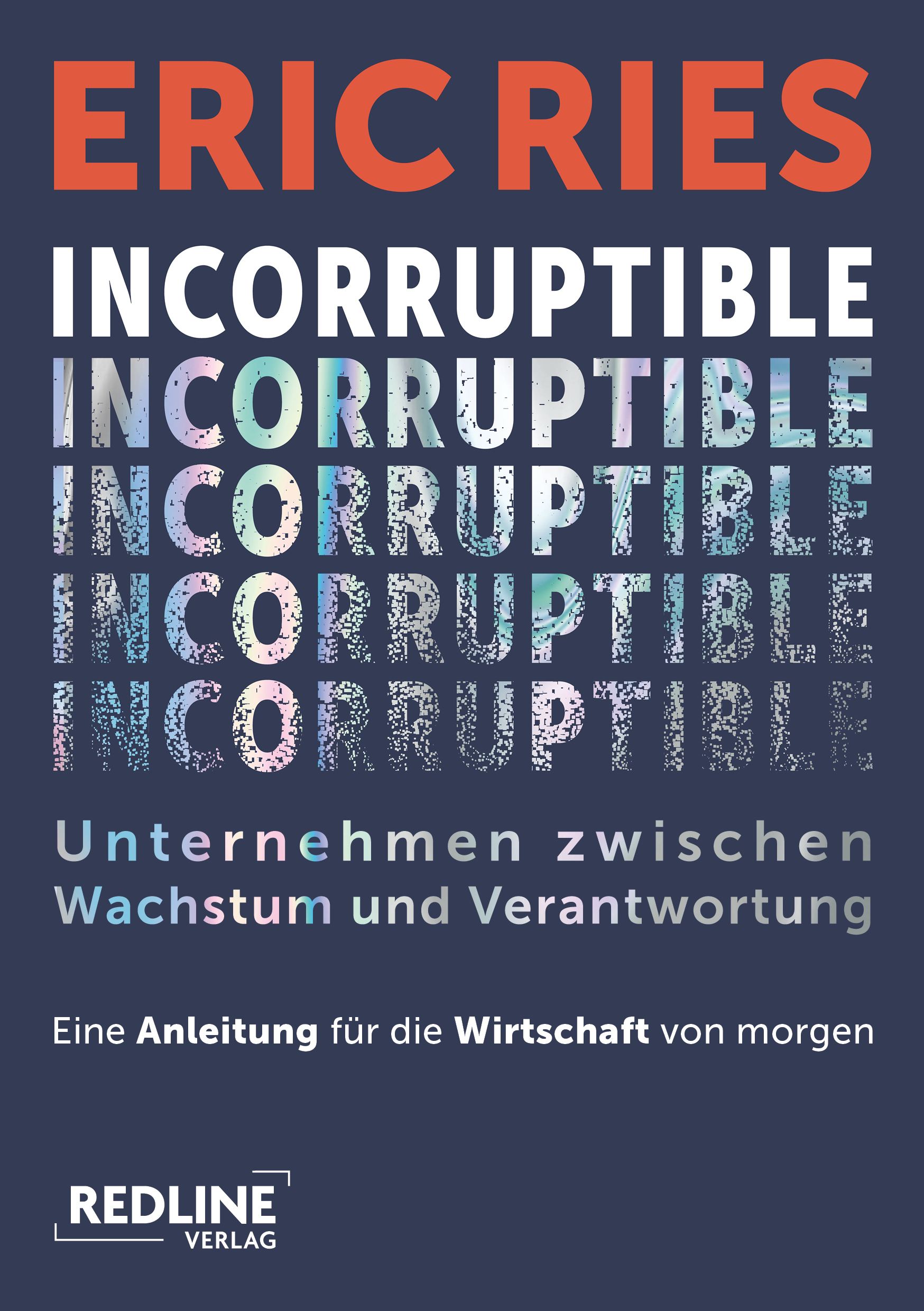
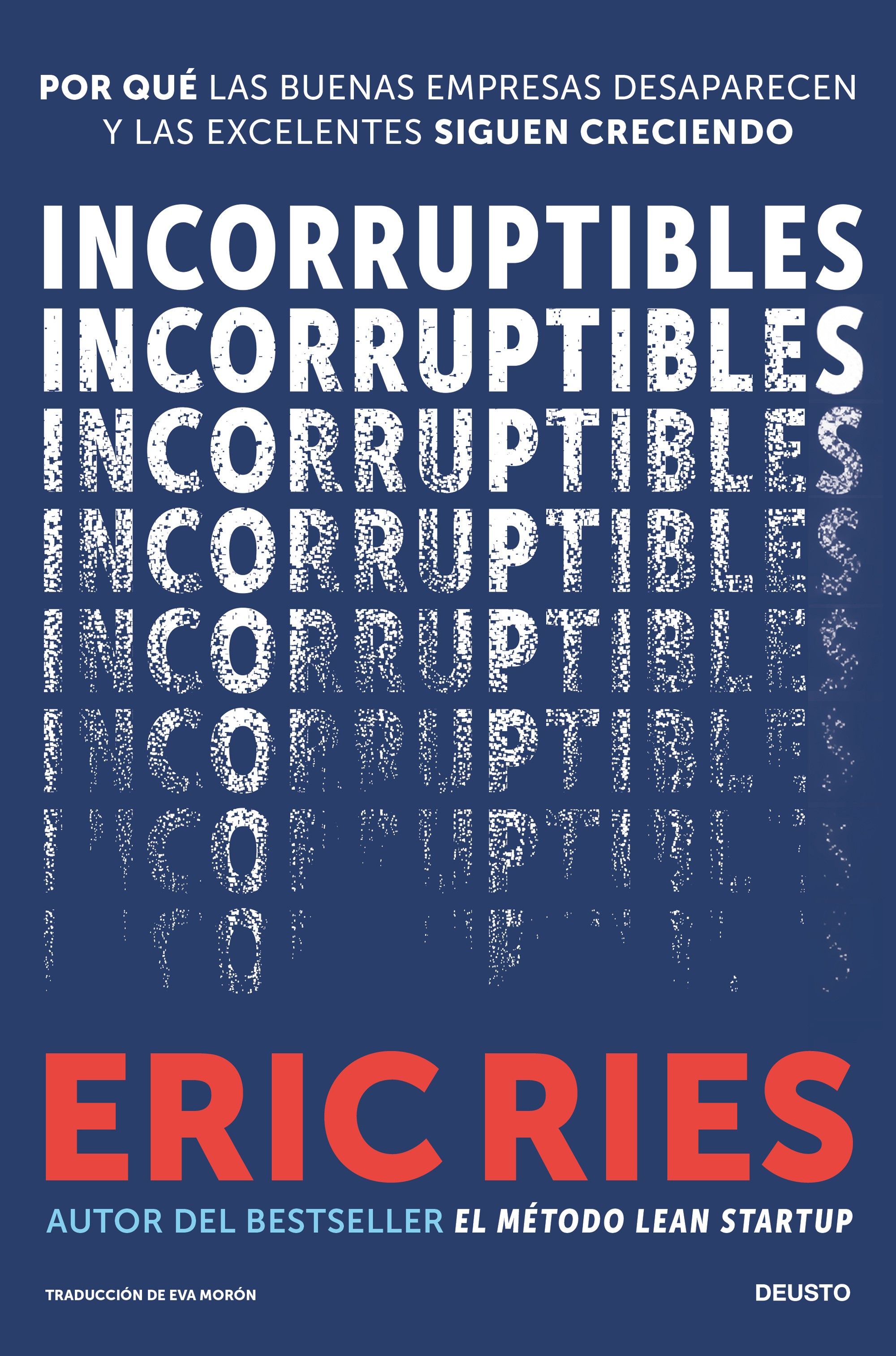
Incorruptible gets a Spanish edition — Deusto publishes 'Incorruptibles' on 25 November, translated by Eva Morón

Incorruptible gets a Spanish edition — Deusto publishes 'Incorruptibles' on 25 November, translated by Eva Morón

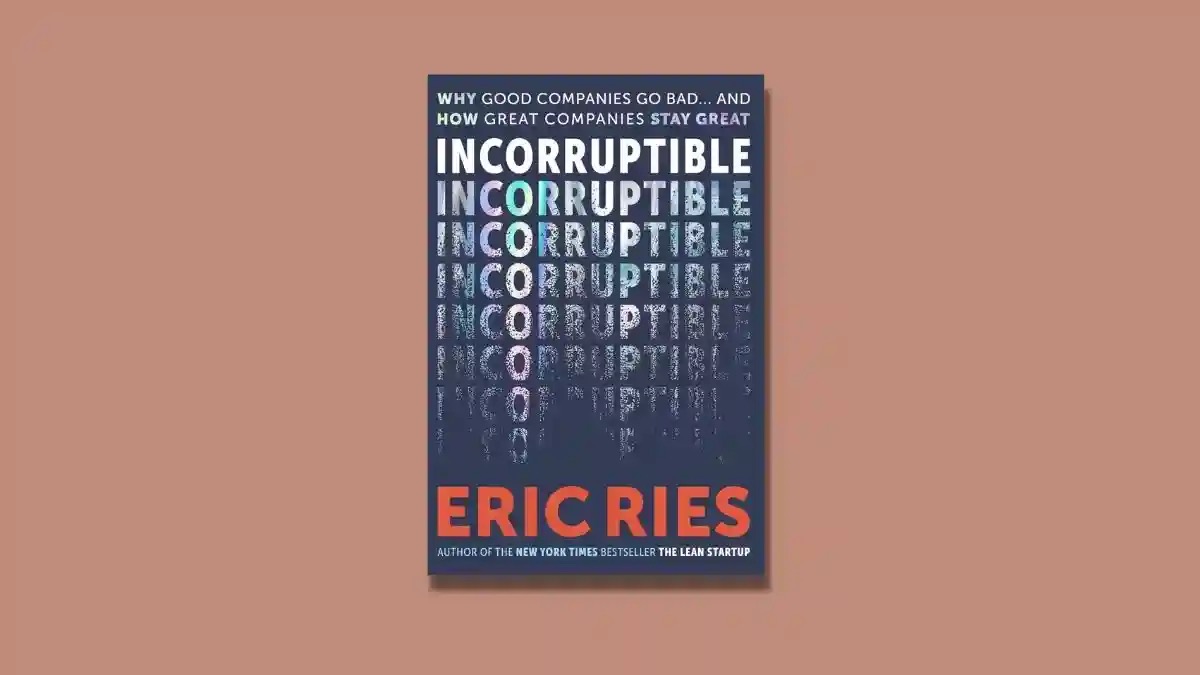
Deusto, the business imprint of Grupo Planeta, publishes the Spanish translation as Incorruptibles on 25 November 2026 — 464 pages, translated by Eva Morón, in paperback and ebook. The cover is its own design rather than the English one, the title repeated down the jacket and degrading line by line.

“En su nuevo libro, el autor bestseller Eric Ries analiza por qué las empresas pierden el rumbo al crecer y propone un modelo para crear organizaciones resilientes, éticas y sostenibles. Con ejemplos reales y herramientas prácticas, ofrece una hoja de ruta para equilibrar innovación, crecimiento y propósito.” Deusto (Grupo Planeta), publisher's synopsis

NOV 19 2026

A panel takes its title from the book's own distinction — 'Mission Driven vs. Mission Controlled: Who Owns Your Purpose When You Raise?'

Aligned hosts the panel on Thursday 19 November with Wefunder president Jonny Price, Spirit Tech Collective founder Eddy Vaisberg, and Taylor Harrison, an attorney at Virgil who is named here as head of its Incorruptible practice. Littke, Aligned's chief executive, sets it up on the book's mission-controlled governance model. Eric is not speaking.

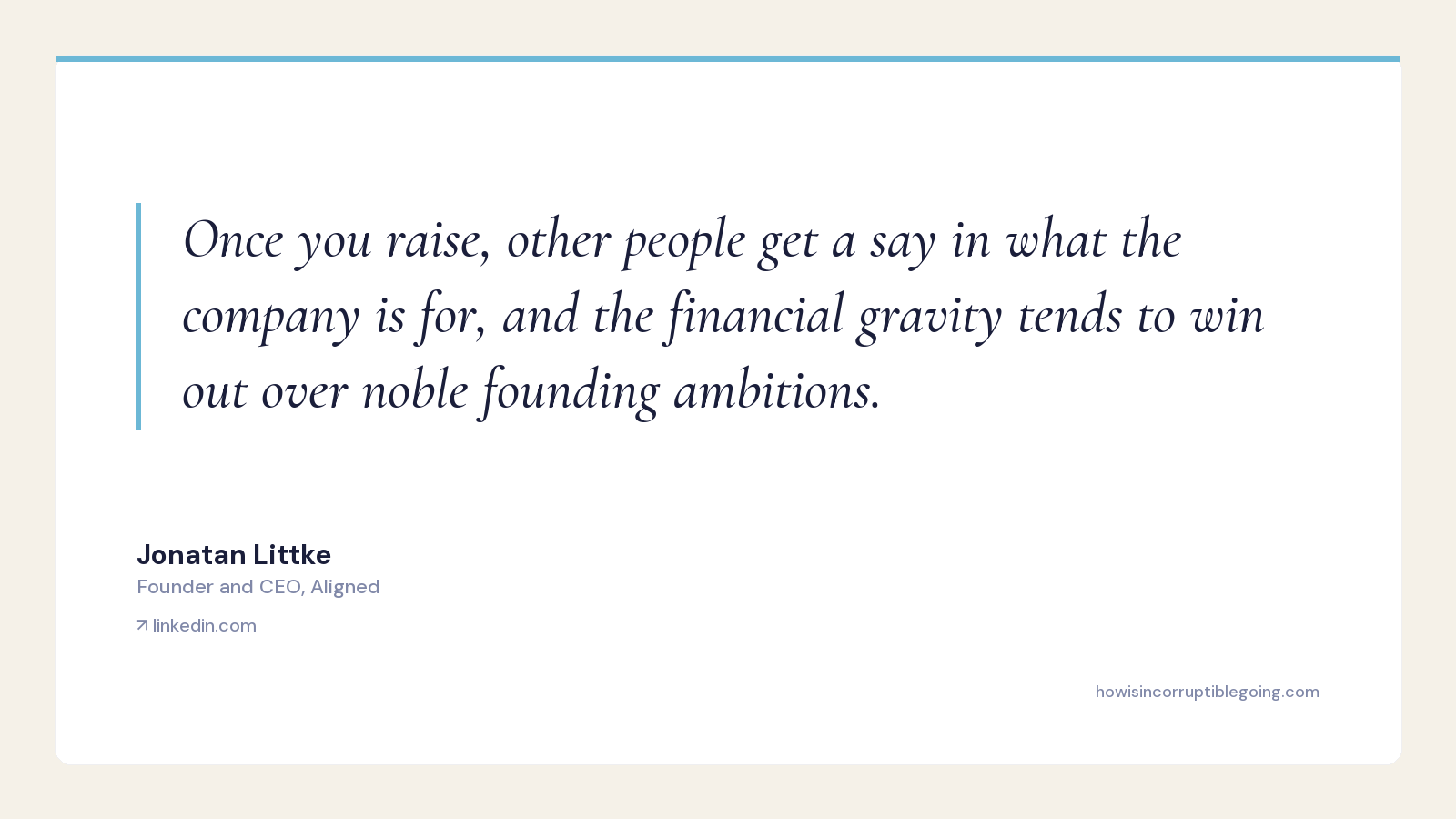
“Once you raise, other people get a say in what the company is for, and the financial gravity tends to win out over noble founding ambitions.” Jonatan Littke, CEO of Aligned, on LinkedIn
NOV 19 2026

Corporate Rebels Summit, Amsterdam — Eric joins Ricardo Semler and Bill Anderson on a lineup the organisers reopened to add him

Corporate Rebels announced on 29 October that they had reopened a completed speaker lineup to add Eric, who will join the Amsterdam summit virtually. The two-day event on 19–20 November brings 350 leaders from more than 30 countries and is members-only; it doubles as the network's ten-year anniversary. Co-founder Pim de Morree frames the booking around ownership structures that protect a mission — the summit's own long-running interest — and what it takes to put that into practice. The day Eric speaks has not been announced, and the public programme page did not yet list him when this entry was written.

“We've fallen in love with ownership structures that protect a company's mission. I'm looking forward to hearing how Eric thinks companies can put this into practice.” Pim de Morree, co-founder of Corporate Rebels
Today
NOV 11 2026

Mark Goyder, who founded Tomorrow's Company, on Arkaro Insights — how agency theory cut the three-legged stool down to one leg

Goyder's 1995 RSA inquiry shaped the enlightened shareholder value clause in the UK Companies Act 2006 and the first investor stewardship code. In a 52-minute episode on why corporate lifespans are collapsing, he reaches for the book's three-legged stool to describe what agency theory removed. He gave the opening talk at the Drucker Forum's India Way session days earlier.

“Two donkeys and fiduciary duty: why owning a living thing creates a duty to it, and how agency theory reduced Eric Ries’s three-legged stool to the single leg of shareholder value.” Arkaro Insights episode notes
NOV 10 2026

Andrew Hilger, former president of Allegis Group — 'Eric Ries shows us that this is not an inevitable, inexorable march'

Hilger read the book against the pattern he has watched run: the founder leaves or the company goes public, the decision horizon shortens, and the mission stays on the wall but not in the decisions. He also reports that Eric spoke to Tony O'Driscoll's Business as a Force for Good class at Duke.

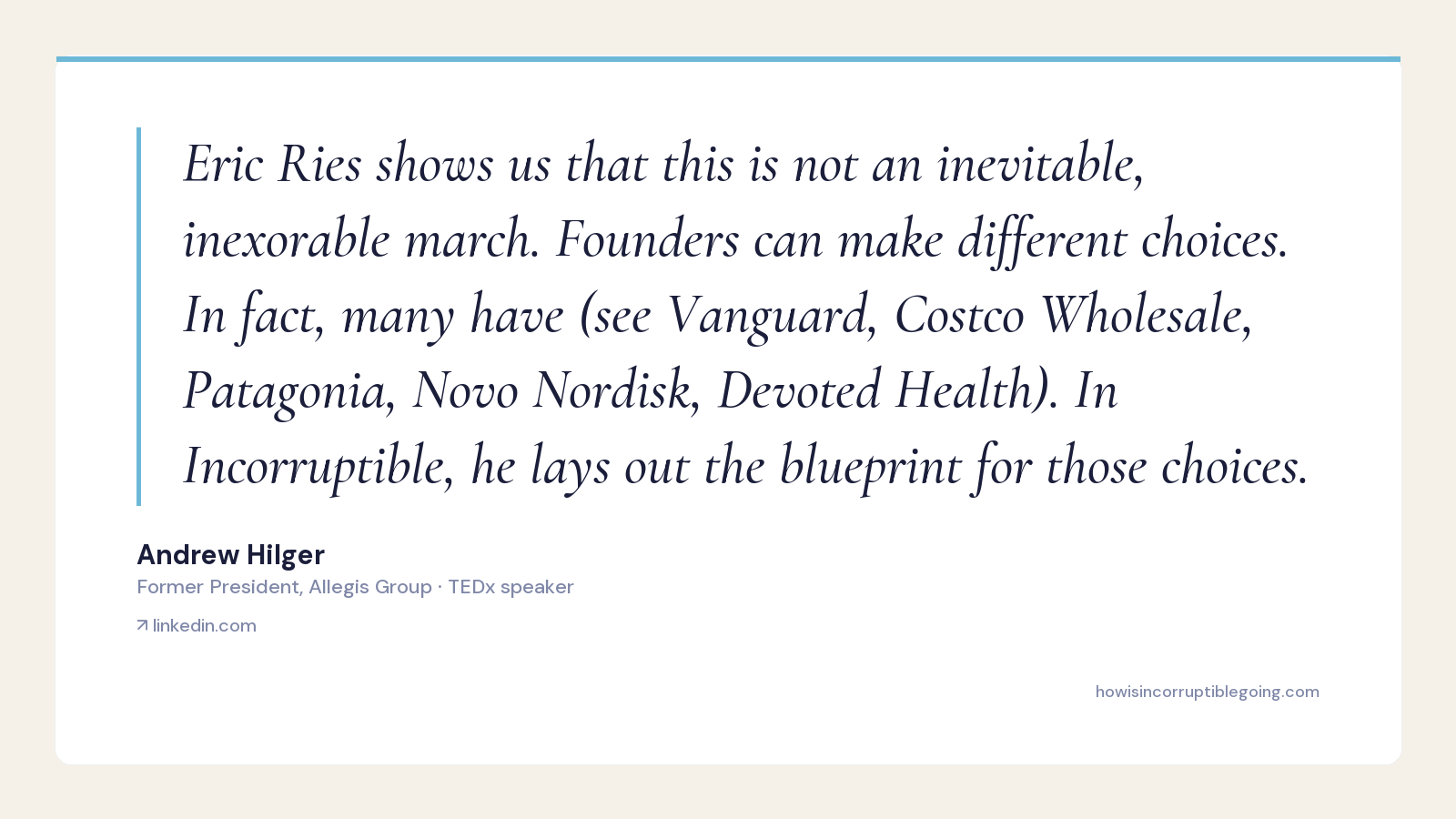
“Eric Ries shows us that this is not an inevitable, inexorable march. Founders can make different choices. In fact, many have (see Vanguard, Costco Wholesale, Patagonia, Novo Nordisk, Devoted Health). In Incorruptible, he lays out the blueprint for those choices.” Andrew Hilger on LinkedIn
NOV 10 2026

A marketing professor puts the book in front of his students — 'a MUST READ for all business students'

Elmer teaches marketing and spent his earlier career as an automotive parts sales and marketing executive. He posted chart photos from the book, set shareholder primacy alongside Cory Doctorow's enshittification, and argued that a mission statement written on top of such a charter tells customers and employees something untrue.

“If a company’s legal purpose is to maximize shareholder value, every tool it uses, including strategy, its business model and experiments, has already been corrupted.” Tom Elmer on LinkedIn
NOV 10 2026

Tony Fish reads Revolut's board purge against financial gravity — 'We keep moving the furniture around inside the same building and calling it reform'

Revolut's co-founder told Sifted he had removed every VC from the board and advised founders to take the money but give investors no seat. Fish, who teaches at Henley and the LSE, credits Eric with the term financial gravity and argues that removing the investors does not remove the pull, only the source of it.

“We keep moving the furniture around inside the same building and calling it reform. Taking VCs off the board doesn’t remove "financial gravity" it just changes whose orbit you’re in.” Tony Fish on LinkedIn
NOV 9 2026

A CEO reads the book against the coming wave of ownership transitions — 'good intentions can only take us so far'

More than half of US businesses with employees are owned by someone over 55, so a great many will change hands this decade. Parsons runs Knowledge Architecture and wants employee ownership trusts and perpetual purpose trusts better known than a sale to private equity.

“What I appreciate about Incorruptible is the way Ries connects a company’s purpose to the structures that govern its future. Good intentions can only take us so far. If we want a company to stay true to its mission over decades and through leadership transitions, we need ownership structures, governance, and incentives that support that commitment.” Christopher Parsons on LinkedIn
NOV 9 2026

KPMG UK's group CTO on what the two books each gave him — 'Incorruptible is giving language to practices of sustaining and protecting what you build'

Gupta read it in two weeks and calls it one of the best books on governance at executive and board level. He singles out the opening move — create something worth protecting, then build with structural integrity — and notes the book carries almost no cases from Asia.

“The Lean Startup gave language to practices of building, Incorruptible is giving language to practices of sustaining and protecting what you build.” Dinkar Gupta on LinkedIn
NOV 9 2026

The Drucker Forum's 'India Way' workshop builds on the book — 50 family business owners asked what a company is for

Guptara chaired the workshop, the third edition of The India Way at the Global Peter Drucker Forum, held in the Hofburg in Vienna and facilitated by the LivingMachine Institute. Mark Goyder, who founded Tomorrow's Company in 1996, opened with Japanese firms that have lasted three centuries and more, then turned to Incorruptible for how governance holds a mission in place.

“Mark then drew on Eric Ries' new book "Incorruptible", which explores why even companies founded with the best intentions can drift away from their purpose, and how governance can protect their mission over time.” Jyoti Guptara on LinkedIn
NOV 9 2026

Nine in ten voters named corruption a major factor — 'corruption need not be illegal or even malicious to be extractive'

Rubenstein sets two polling findings beside the book's definition of the word. Gallup finds more than 70% of Americans think corruption is widespread in business rather than only in government, and her argument to companies is not to wait for regulation before acting on it.

“Nine in ten voters called “corruption” a major factor in their vote (about the same as “cost of living”). Gallup recently found more than 70% of Americans believe corruption is widespread in business, not just in government. As the entrepreneur Eric Ries discusses in his (prescient!) book Incorruptible, "corruption" need not be illegal or even malicious to be extractive and obviously unfair.” Liba Wenig Rubenstein on LinkedIn
NOV 9 2026

An executive chairman adds a job to his own role — 'ser el que recuerda para qué empezamos'

Suite SIDOM is almost twenty years old. La Rosa Pedernera reads financial gravity as a design problem rather than a failure of people, and now asks two questions before any large decision: whether they would take it if no one measured the quarter, and what they will not trade away.

“Cuando pasé a Executive Chairman pensé que mi trabajo iba a ser, sobre todo, mirar la estrategia. Leyendo a Ries sumé otra tarea: ser el que recuerda para qué empezamos.” Santiago La Rosa Pedernera on LinkedIn
NOV 9 2026

'It doesn’t have to be so that boards of directors must sell the company to a bidder paying 10 cents more per share'

Tiago has written 279 Goodreads reviews. He reads the book as a case that a company can seek money without deciding everything on the short term, and closes on Ries's own warning that it is too early to change a structure until it is too late.

“For example, it doesn’t have to be so that boards of directors must sell the company to a bidder paying 10 cents more per share if that buyer goes against the company’s reason of being.” Tiago on Goodreads
NOV 9 2026
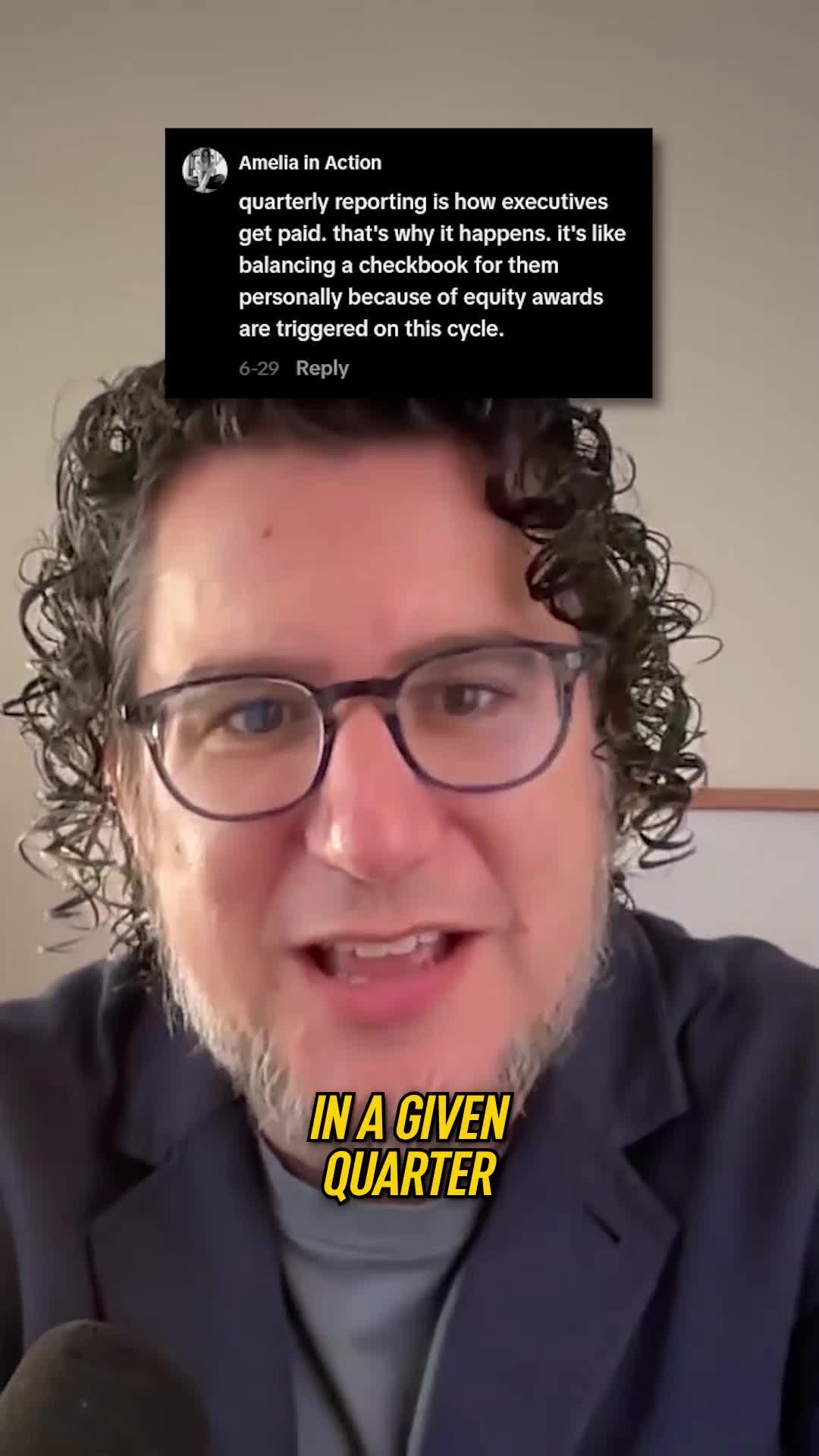
Eric Ries on TikTok: 'if either the CEO or the CFO have stock options vesting in that quarter, then on average R&D spending will be lower'

Eric Ries on TikTok: 'if either the CEO or the CFO have stock options vesting in that quarter, then on average R&D spending will be lower'

Eric answers a viewer who argued that quarterly reporting is how executives get paid, with the finding on options vesting and research spending. The clip has 4,268 plays, the most of any he has posted since June.

“In a given quarter, if either the CEO or the CFO have stock options vesting in that quarter, then on average R&D spending will be lower by that company. Think about what that means. The incentives we give executives can influence whether a company invests in its future or prioritizes short-term financial rewards.” Eric Ries on TikTok
NOV 8 2026

'For the first time in decades, I have profound HOPE that everything I've sacrificed might not have been for nothing'

Springer founded SHiFT and has spent decades funding it out of her own savings. She reads the book as evidence that the sacrifice need not end with a company losing the mission it was built for.

“Then along comes Eric Ries with Incorruptible, offering something I never imagined possible: a roadmap for building enormously successful companies without selling their souls. For the first time in decades, I have profound HOPE that everything I've sacrificed might not have been for nothing.” Isabell Springer on LinkedIn
NOV 7 2026

A B Corp operator reads the SEC's move on shareholder proposals through the book — 'who gets a say in how a company is run'

The SEC has proposed rescinding Rule 14a-8, which since 1942 has let any shareholder put a proposal to a vote at a company's annual meeting. Hirons runs HigherRing, a certified B Corp and public benefit corporation, and is filing a comment against it before the 20 November deadline.

“I’ve been thinking about this alongside Eric Ries’s book Incorruptible, which looks at why good companies go bad and how the great ones stay great. A big part of that is who gets a say in how a company is run. Shareholder proposals give long-term owners a way to ask a board to look hard at a risk before it turns into a problem.” Michelle Hirons on LinkedIn
NOV 6 2026

A bank's internal audit head pushes back — 'a strong organizational ethos should not be confused with a strong control environment'

Mallari runs internal audit at Bank of Commerce. He accepts financial gravity and the mission-guardian idea, then asks who holds the guardians accountable when a regulated bank's duties to its depositors cannot be subordinated to a mission, however well meant.

“However, a strong organizational ethos should not be confused with a strong control environment. When people become too convinced of their mission, questioning decisions or unintended consequences can be mistaken for a lack of commitment. There must still be room for disagreement.” Michael Mallari on LinkedIn
NOV 5 2026

An insurance receiver reads page 218 against troubled insurers — 'too much focus on protecting the entity'

Hartz is a certified insurance resolver, appointed to run troubled insurance companies. He takes the book's line on governance protecting the mission rather than the entity and applies it to the firms he is called into, where he says the emphasis has been the wrong way round.

“So many of the insurance companies we work on are troubled because there has been too much focus on protecting the entity. The focus of management and regulator needs to be on the mission.” Douglas Hartz on LinkedIn
NOV 5 2026
NOV 5 2026

'Whoever pays has a pull' — a founder picks her funding model around financial gravity

Kruit is building Stowe and writes the Nevertheless, She Builds newsletter. Asked whether the product would be free, she used the book's term to explain why she decided the people who use it should be the ones paying for it, rather than partners.

“Whoever pays has a pull. In his book Incorruptible, Eric Ries terms it financial gravity. Every business ends up orbiting whoever keeps the lights on, and over time, that’s who it orients to serve.” Lindsay Kruit on LinkedIn
NOV 5 2026

A fractional CMO on why brand purpose keeps failing — 'they need the governance spine to survive and thrive'

Prasad works as a fractional CMO. He walks the book's cases, from Anthropic's trust to Costco's governance fortress, and argues that one-off purposeful gestures read as stray actions because the organisation is not built to choose the mission when it costs money.

“Because, mostly, the organisation itself isn’t built to make mission-aligned choices when they hurt the numbers in the short-term. So if brands are serious about their purpose and ethos, they need the governance spine to survive and thrive.” Manu Prasad on LinkedIn
NOV 5 2026
World's Greatest Business Thinkers — Eric on AI and judgement: 'Outsource the work, not the thinking'

World's Greatest Business Thinkers — Eric on AI and judgement: 'Outsource the work, not the thinking'

World's Greatest Business Thinkers is Nick Hague's interview podcast, 62 episodes in. Eric argues that entrepreneurs have always been tempted to hand off the hard part of thinking, and that AI makes the temptation cheaper to give in to.

“As AI makes it easier to generate ideas, analyse problems, and make decisions, there's a risk that entrepreneurs will stop exercising the very judgment they need to build successful businesses.” World's Greatest Business Thinkers, episode announcement
NOV 4 2026

Dodie Jacobi: 'The world did need this book'

Jacobi, who produces a TV series for the equine, equestrian and pet markets, commented on Daniel Burka's post about Incorruptible, contrasting it with governance books written for maximizing shareholder returns.

“The world did need this book. The one about how to build a thriving venture that profits more when it stays on mission and declines when it deviates.” Dodie Jacobi on LinkedIn
NOV 4 2026
NOV 4 2026

A founder builds the no-commission rule into his platform — 'the structure has to resist that drift'

Stewart founded Achene, an online course platform. He set a pricing rule that charges for resources that cost the company something rather than for access to features, and built the engineering — zero-egress storage, free transcription — that lets him hold it.

“It's also the practical side of an idea from Eric Ries's Incorruptible: businesses drift from their customers under growth pressure, so the structure has to resist that drift. Efficient architecture gives us room to keep prices fair.” Pete Stewart on LinkedIn
NOV 4 2026
SOSV Deep Tech Summit — Eric Ries interviews Steve Blank on how AI forced him to rebuild the Lean LaunchPad

SOSV Deep Tech Summit — Eric Ries interviews Steve Blank on how AI forced him to rebuild the Lean LaunchPad

SOSV's Deep Tech Summit ran free and virtual from 4 to 6 November, with 100 speakers across climate tech, human health and AI for the physical world. Eric interviewed Steve Blank about rebuilding the Lean LaunchPad course he launched at Stanford 15 years ago, after AI made a polished prototype the easy part.

“Steve will be joining our 𝐒𝐎𝐒𝐕 𝐃𝐞𝐞𝐩 𝐓𝐞𝐜𝐡 𝐒𝐮𝐦𝐦𝐢𝐭 (Nov. 4-6) to discuss startups in the new AI era, alongside Eric Ries, author of The Lean Startup and Incorruptible.” SOSV on LinkedIn
NOV 3 2026

Daniel Burka, who co-founded the agency behind the Firefox identity — 'It’s rare for me to recommend a business book, but this is a strong exception'

Burka co-founded the design agency silverorange in 1999, which made the Firefox brand identity, and was director of design at Digg. He read the book against his own agency's 26 years and the governance decisions he credits for them.

“It’s rare for me to recommend a business book, but this is a strong exception. Incorruptible is a thoughtful book that should inspire founders to want more from their companies than making millions.” Daniel Burka, Hard Problems
NOV 3 2026
Eric Sillies
“He easily could have written "Lean Startup 2.0: How AI is Turning Everyone into the Next Silicon Valley Tech Bro" Instead, he wrote "Incorruptible: Why Good Companies Go Bad and How Great Companies Stay Great" I respect it.”
Eric Sillies Innovation coach and product strategist
NOV 3 2026

Infrakit's COO calls it 'the best business book I've read in the last few years' — then applies 'it's always too early until it's too late' to construction

Frost is COO at Infrakit, which sells software to infrastructure contractors. He took the principle Eric applies to locking in a company's mission before money pressure wins, and used it on the decision contractors defer every time: whether to put new software on a job already running.

“Incorruptible by Eric Ries is the best business book I've read in the last few years. One of his principles has always stuck with me: "it's always too early until it's too late."” John Frost on LinkedIn
NOV 3 2026
McKinsey's Inside the Strategy Room takes up financial gravity — 'Why do so many beloved companies lose their way after taking on outside capital or going public?'

McKinsey's Inside the Strategy Room takes up financial gravity — 'Why do so many beloved companies lose their way after taking on outside capital or going public?'

Inside the Strategy Room is McKinsey's strategy podcast, hosted by Sean Brown. Eric and McKinsey senior partner Ryan Davies worked through financial gravity and the governance that resists it, using Costco's origins as the case.

“Why do so many beloved companies lose their way after taking on outside capital or going public?” Inside the Strategy Room, episode 329, McKinsey & Company
Reactions · 1
  • Thank you Eric for the terrific conversation, and for being a bold thinker always pushing on frontier topics!

    source ↗
NOV 2 2026

An Extern top performer audits Ben & Jerry's with the four lenses — 'I initially rated its governance too generously'

Wiky placed in the top 10% of the Corporate Strategy Externship that Eric mentors, where participants score real companies against Mission Drive, Financial Gravity, Governance and Mission Transmission. The dispute over Ben & Jerry's independent board made him revise his own scoring.

“My focus was Ben & Jerry’s, where I initially rated its governance too generously. The ongoing dispute surrounding its independent board highlighted an important lesson: safeguards only work when backed by genuine authority and independence.” Dinojan Wiky on LinkedIn
NOV 2 2026
Kathleen Egan
“ecomedes is exploring "mission lock" as recommended by Eric. Do investors like this? Well, one of our largest investors, Jack McMackin from Mission Innovation Network is the one helping us work on it, so yes that seems to be the case.”
Kathleen Egan CEO and co-founder, ecomedes
NOV 2 2026
Robert Pasin
“My grandpa founded Radio Flyer in 1917, and we’re now 109 years into this experiment. Almost everything about Radio Flyer and our world has changed during that time: our products, consumer preferences, the retail landscape, technology…the list goes on!”
Robert Pasin Chief Wagon Officer (CEO), Radio Flyer
NOV 2 2026
NOV 2 2026
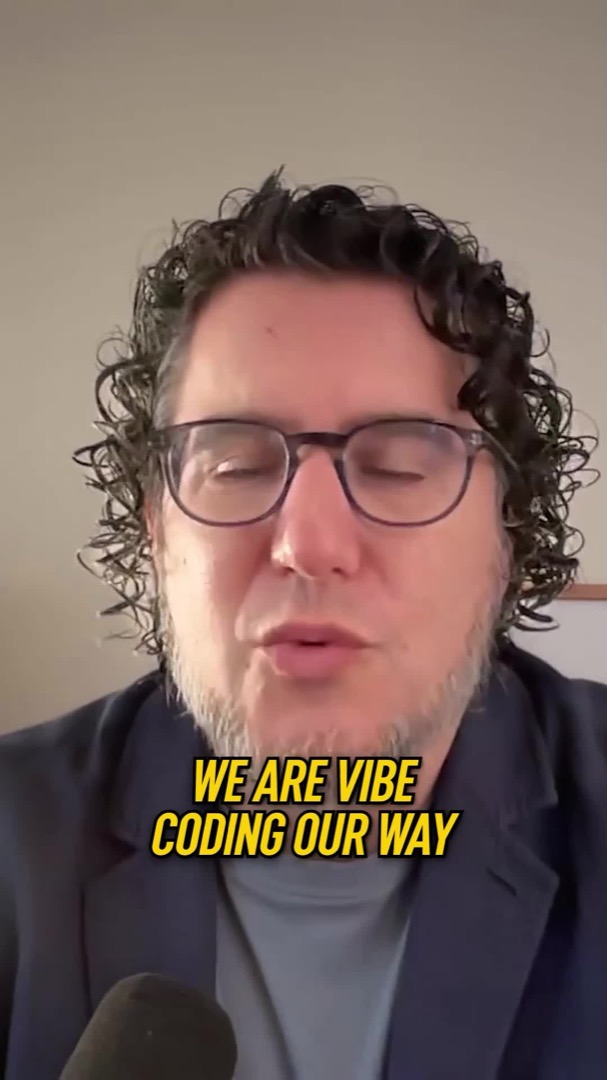
Eric Ries on TikTok: 'We are vibe coding our way towards a Chernobyl level disaster'

Eric Ries on TikTok: 'We are vibe coding our way towards a Chernobyl level disaster'

A direct-to-camera piece arguing that AI is not the problem and that the danger starts when people ship software they have not reviewed and could not fix. Five people took it up on X, several disputing the premise — one that the blame belongs with the managers setting the deadlines, another that the fix will be vibe coded too.

“We are vibe coding our way towards a Chernobyl level disaster.” Eric Ries on TikTok
NOV 1 2026
Reactions · 1
  • Laura Zizzo

    It clarified a lot for me and we are implementing the thinking in how we are building Estian too. I also highly recommend.

    source ↗
NOV 1 2026
OCT 31 2026

Eric O. Keosky-Smith: 'I've been evangelizing this amazing book'

Keosky-Smith is a business development and growth strategist in Arizona. He replied to Eric's post quoting Steve Blank, reporting what he had run into at an event there.

“I've been evangelizing this amazing book. At an event in Arizona yesterday, I found out one of those I was talking to about it also said they received an investment and followed some of your structure for their company.” Eric O. Keosky-Smith on LinkedIn
OCT 31 2026

'The bot created the savings. The people created the new revenue' — James Brake reads IKEA's refusal to cut 8,500 jobs through Incorruptible

Ingka Group, which runs most IKEA stores, retrained the 8,500 call-centre workers its Billie chatbot displaced rather than cutting them, moving some into remote interior-design consulting, now its fastest-growing channel. Brake credits the lens to Incorruptible, and IKEA is one of the companies Eric names from the stage.

“In an era where “AI replaced X employees” is treated as a victory metric, IKEA's decision looks less like sentiment and more like long-term strategy. Retraining loyal, hard-working people who already understood the customer turned out to be one of the bigger wins of the whole effort.” James Brake on LinkedIn
OCT 31 2026

A Buenos Aires books contributor takes it to air on Neura — 'la confianza es el activo más subestimado de los negocios'

Balayan runs Maure Inmobiliaria in Buenos Aires and has a standing books slot on Neura, where she recommended Incorruptible on air. Her written summary tracks the book closely: financial gravity growing with investors and short-term return pressure, governance and legal structure as what fixes it, Costco and Patagonia as the examples.

“La idea más potente del libro es que la confianza es el activo más subestimado de los negocios.” Sole Balayan on LinkedIn
OCT 29 2026

AdventHealth's CEO is working through the book with his leadership team — 'mission isn’t lived out through words on a wall'

Banks runs one of the largest non-profit health systems in the United States. He reports discussing the book with AdventHealth leaders and turning it into three standing questions for the organisation: whether it keeps the promises that make the mission real, whether the mission shapes how work is actually done, and whether it gets daily attention rather than periodic attention. The framing is the book's own — mission as structure rather than statement — applied by someone with the authority to change how a hospital system operates.

“But mission isn’t lived out through words on a wall. As Ries explains, it has to be embedded within the fabric of an organization’s DNA and practices.” David Banks on LinkedIn
OCT 29 2026
OCT 29 2026

Kasia Triantafelo (Buffer): 'Buffer is on the path to become one of the incorruptible ones'

Triantafelo works in operations and automations at Buffer. She listed Incorruptible among the books she read through Buffer's book benefit, which pays for staff reading.

“Every word kept showing me how Buffer is on the path to become one of the incorruptible ones.” Kasia Triantafelo on LinkedIn
OCT 29 2026
Raj Sisodia
“Eric is one of the most important thinkers, writers, advisors, and influencers active in the world of business and leadership today, and it was a pleasure to exchange ideas with him. His new book “Incorruptible” belongs on the bookshelf of every leader in the world.”
Raj Sisodia Co-founder, Conscious Capitalism · FEMSA Distinguished University Professor of Conscious Enterprise, Tecnológico de Monterrey
OCT 29 2026

'Stop treating purpose as a slogan. Start treating it as organisational architecture'

Immink advises CEOs on organisational design and writes on business books. His recommendation is short but shows the reading: he lists mission locks, spiritual holding companies and governance fortresses — all terms of Eric's own — as what the book is actually about, and puts the architecture framing ahead of the language of purpose. The post names the book only in its hashtag, which is why the two-word production query cannot match it and the bare query exists.

“Stop treating purpose as a slogan. Start treating it as organisational architecture. A must-read for CEOs, founders, and boards.” Ron Immink on LinkedIn
OCT 29 2026
OCT 29 2026
OCT 28 2026
'It's not just you' — Bryan Cantrill picks Incorruptible for Oxide and Friends' annual Books in the Box

'It's not just you' — Bryan Cantrill picks Incorruptible for Oxide and Friends' annual Books in the Box

Oxide and Friends runs an annual books episode, and Cantrill — Oxide's co-founder and CTO — spent six minutes on Incorruptible, working through the foundation-controlled drugmaker behind Ozempic and the Twilio super-voting sunset. Co-host Adam Leventhal bought a copy on the strength of it; they plan a full episode and hope to have Eric on.

“Every company that does some of these things like setting yourself up as a public benefit corporation and so on, feels like they're doing something completely bonkers that no one has ever conceived of before. And this book helps to stitch some of this together … people are doing things like this. It's not just you” Bryan Cantrill on Oxide and Friends, 'Books in the Box VI'
OCT 28 2026

A decade in social impact, reading Anthropic's S-1 through the book — 'for the first time I actually see a world where this could become the norm, not just the aspiration'

Sugarman-Lash opens with the plainest reaction the timeline has recorded — he cried reading it — and then does something more unusual with it. He reads Anthropic's S-1, filed the day before, as evidence that the book's argument is becoming practice: companies using real legal structures to lock themselves into their missions for the long term. Ten years studying social impact is the standard he measures it against, and his claim is that the aspiration has become achievable rather than that the book is persuasive.

“I found myself crying while reading Eric’s new book, Incorruptible. I've been studying social impact for ten years, and for the first time I actually see a world where this could become the norm, not just the aspiration.” Faolan Sugarman-Lash on LinkedIn
OCT 28 2026

A publishing CEO names it one of two books she hand-sold this year — 'I must have recommended to 3 dozen people'

Pierucci is the CEO of a publishing company. Her post argues that publishing follows a Pareto distribution steep enough that YA Fiction lost 25% of its sales in the first half of 2026 for want of a Suzanne Collins release, and that the only dependable route to sales is a book readers hand on to each other. She names two titles she pushed personally, Theo of Golden and Incorruptible, and puts her own count for the latter at three dozen people.

“This year I recommended the bejeezus out of "Theo of Golden," but another book I honestly assisted greatly with sales was Eric Ries's "Incorruptible," which I must have recommended to 3 dozen people.” Stephanie Pierucci on LinkedIn
OCT 27 2026

A. Richard Newton Lecture Series (UC Berkeley SCET Changemaker Course) — Eric joined the Fall 2026 lineup with Scott Galloway, Vivienne Ming, Kapor & Kapor

UC Berkeley's Sutardja Center for Entrepreneurship & Technology runs the Newton lecture series inside its Berkeley Changemaker course, ENGIN 183A/283A, led by Victoria Howell. Eric spoke online on 27 October, under the Fall 2026 theme Making an Impact for Greater Good.

“The A. Richard Newton Distinguished Innovator Lecture Series honors the entrepreneurial vision of A. Richard Newton, the Dean of UC Berkeley's College of Engineering 2000–2007. Inspired by his legacy, we host distinguished innovators sharing valuable lessons from their personal and professional journeys. Keynote speakers include highly accomplished leaders and notable Cal alumni. Their engaging stories reveal insights for innovation, leadership, industry trends and life lessons.” UC Berkeley Sutardja Center for Entrepreneurship & Technology (SCET)
OCT 27 2026

A founder reads Anthropic's S-1 through the book — 'The shareholders don't control Anthropic. A mission-aligned trust does. Even the trustees don't own it'

Nelson runs FoundersForge and has started six companies. On the day Anthropic filed, he uses the book to explain why its structure interests him: ownership held by a mission-aligned trust whose trustees do not own it either, which he reads as a public benefit corporation design capable of resisting the short-term pressure that reshapes public companies. He cites a concrete test — Anthropic holding its position when the government pushed against its values — and is candid that the experiment is unproven and that data centres and job displacement remain unanswered. He opens by telling founders to read the book.

“The shareholders don’t control Anthropic. A mission-aligned trust does. Even the trustees don’t own it.” David Nelson on LinkedIn
OCT 27 2026

Itamar Gilad interviews Eric on AI and founder mode — 'the total cost of taking a wrong turn in terms of product, strategy, design or value proposition goes way up'

Gilad coaches product strategy, created the GIST framework and was a product manager at Google. His Q&A, 'Interview with Eric Ries: AI, Founder Mode, and Why Good Companies Go Bad', takes the Lean Startup fifteen years on and turns it toward AI: cheaper iteration does not make direction cheaper, it makes being wrong more expensive. Eric also grants the diagnosis that professional managers are captured by a gravitational field of best practices, and observes that executives are fired for it far less often than they should be. Gilad's own verdict is that the book challenges yet more corporate best practices.

“As the cost of building individual iterations or features goes down, the total cost of taking a wrong turn in terms of product, strategy, design or value proposition goes way up.” Eric Ries, interviewed by Itamar Gilad
Reactions · 1
  • Guy Kedar

    Asking an AI to play the customer is just the newest way to avoid meeting one.

    source ↗
OCT 27 2026

IESE's School of Founders puts the book against the 88% figure — 'Governance rules and term sheets are the point of attack'

Ross co-founded and directs the School of Founders at IESE Business School. He posted a study of almost 250,000 founders from 1987 to 2025 that puts 88% of them at zero exit value, with a 39% chance a founder had already left even when the company exits well, and traced it to liquidation preferences paying investors back first. His school's manifesto commits to fair rewards for creators; he points founders to the book for how to avoid those outcomes, and to bootstrapping as the alternative to the VC route.

“Governance rules and term sheets are the point of attack.” Sebastian Ross on LinkedIn
OCT 26 2026
OCT 26 2026
Carol Van Den Hende
“This book is for any leader who’s felt that purpose-driven businesses create more societal value and would like the data to back that. The thesis is clear, compelling, and actionable.”
Carol Van Den Hende Global AI Responsibility Chair, Mars Inc · board trustee · author
OCT 26 2026
OCT 26 2026

Council Fire's CEO places Eric among four converging diagnoses — 'the fourth independent voice in the last six months to arrive at the same structural diagnosis from a different vantage point'

Chmael runs Council Fire, a sustainability and management consultancy, and reads Eric's piece on the end of shareholder primacy as confirmation rather than novelty. He sets it alongside his own firm's End of Extraction white paper, Paul Polman naming the move from extraction to stewardship as the century's defining challenge, and the World Inequality Lab quantifying the link between inequality and ecological breakdown — four vantage points, he argues, reaching one conclusion within a year. What Eric adds, in his reading, is the organizational mechanics: companies without mission protection get stripped. His firm is building on it, through a place-based strategy called Redefining Profit whose first demonstration is in the Mid-Atlantic.

“For my count, he is now the fourth independent voice in the last six months to arrive at the same structural diagnosis from a different vantage point.” George Chmael II on LinkedIn
OCT 26 2026

Two founders incorporating as public benefit companies name the book as the reason — 'inspired by Eric Ries's vision of the "incorruptible company"'

Springer founded SHiFT and is writing about Peter Ward, who stepped down as COO of Oura and is building a venture around what he calls Aliveness. The adoption sits in one line of an otherwise unrelated post: both of them are incorporating as public benefit companies, and both name the book's argument as the reason. Ward is the same practitioner who reported in October that more builders were choosing public benefit missions — this is him acting on it, and a second founder alongside him.

“we're both building Public Benefit Companies inspired by Eric Ries's vision of the “incorruptible company” - businesses designed to stay true to their purpose as they grow.” Isabell Springer on LinkedIn
OCT 26 2026

Nick Hague recognises financial gravity from the inside — 'When I sold my agency, the culture began to shift'

Hague co-founded and exited B2B International and now hosts the World's Greatest Business Thinkers podcast. He summarises the book's argument accurately — that what turns a company into something its founders no longer recognise is not bad leadership or bad luck but financial gravity — and then supplies his own case for it: after the sale of his agency, budgets were cut, five-minute decisions became five-month ones, and the direction drifted from what had been built. His conclusion is that every founder believes it will not happen to them.

“When I sold my agency, the culture began to shift. Marketing budgets got cut. Decisions that would have taken five minutes now took five months. The company was moving in a direction that felt increasingly disconnected from everything we had built.” Nick Hague on LinkedIn
OCT 26 2026

Sarah Mosseri, author of Trust Fall, reads the FedMart board against her own research — 'trust is not a thing a company has'

Mosseri studies workplace equity and wrote Trust Fall, a book about how organisations hollow out the trust they advertise. Reading Incorruptible, she stops on a line about FedMart's board and recognises her own subject in it: a board treating the trust Sol Price had built with customers as latitude to spend rather than a relationship to maintain. She uses the case to sharpen her own argument — that trust is not an asset a company holds but a reflection of relationships requiring continued investment — and reads its fetishization as hollowing out how people connect at work.

“Organizations celebrate trust, measure it, put it in rankings, because trust buys latitude. What gets lost is that trust is not a thing a company has. Trust reflects relationships that must be maintained and invested in.” Sarah Mosseri on LinkedIn
OCT 26 2026
Eric Ries on TikTok: 'We've accidentally designed companies to behave like sociopaths'

Eric Ries on TikTok: 'We've accidentally designed companies to behave like sociopaths'

A direct-to-camera piece on the gap between making money and creating value: a business can look profitable on paper while pushing its real costs onto customers, employees and communities, succeeding financially in the short term while destroying value in the long run. The clip pulled nine replies on X within a day, several of them arguing with the premise rather than agreeing — Hason Greene's 'Not sure it accidental' among them — which is the signal worth watching on these rather than the play count.

“We've accidentally designed companies to behave like sociopaths.” Eric Ries on TikTok
OCT 24 2026
The Fourth Effect builds its 2026 summit on the book — 'not because people fail, but because structures do'

The Fourth Effect builds its 2026 summit on the book — 'not because people fail, but because structures do'

The Fourth Effect's annual summit, an invitation-only convening of 200-plus founders, investors and cross-sector leaders in New York on Tuesday 27 October, takes 'Governance, Ownership, and the Future of Value Creation' as its theme and names Incorruptible on its own programme page as the framing. The organisers single out financial gravity — Eric's term for the structural pull toward extraction — as mirroring the question they set for the year. The programme runs to Justin Rockefeller of The ImPact, former Revlon general counsel Cari Robinson, and four Kirkland & Ellis partners. Eric is not a speaker; the book is being used as the intellectual frame for someone else's room.

“Incorruptible by Eric Ries asks why good companies go bad, and lands on an answer we recognize: not because people fail, but because structures do.” The Fourth Effect, Summit 2026 programme
OCT 24 2026
OCT 23 2026

B Academics Teaching Roundtable 2026 — Eric's keynote brought the network one of its biggest audiences ever

B Academics, the global network of educators and researchers studying B Lab, B Corp certification and benefit corporations, held its fifth annual Teaching Roundtable online on Friday 23 October, and says it was its highest attended to date. Eric gave the featured keynote, alongside mini keynotes from LIFT Economy's Ryan Honeyman and B Lab's Erik Kivimaki.

“Our featured keynote speaker, Eric Ries, blew our audience away with a candid discussion on what it takes for an organization #ForGood to become truly #Incorruptible, bringing together one of B Academics’ biggest audiences ever.” B Academics on LinkedIn
OCT 23 2026
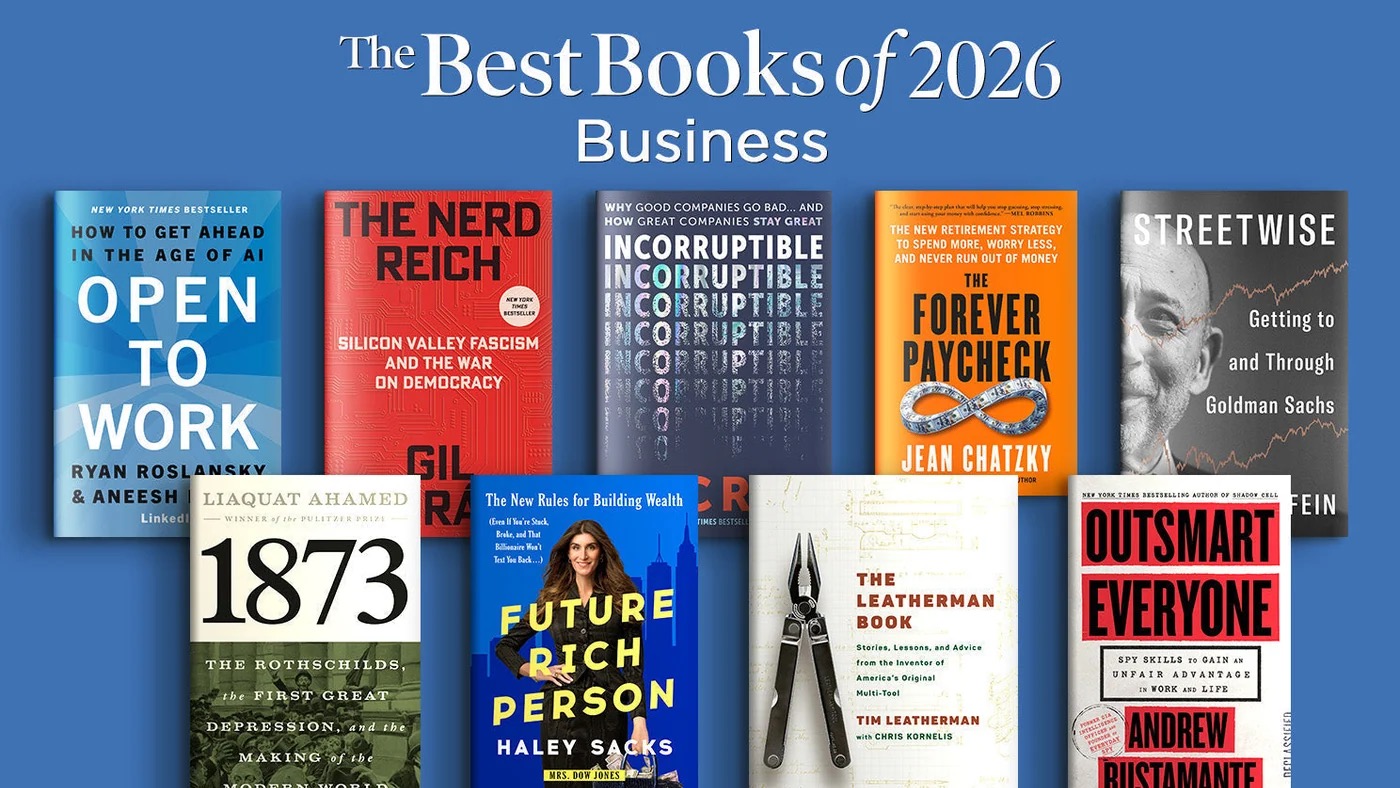
Barnes & Noble names Incorruptible to The Best Books of 2026 — Business

Barnes & Noble names Incorruptible to The Best Books of 2026 — Business

Barnes & Noble's year-end Best Books of 2026 — the chain's flagship annual selection, the same programme whose overall Book of the Year is decided by a nationwide staff vote — names Incorruptible in its Business category. The book is one of nine titles B&N put on the category's cover artwork, alongside Ryan Roslansky and Aneesh Raman's Open to Work, Gil Duran's The Nerd Reich, Jean Chatzky's The Forever Paycheck and Liaquat Ahamed's 1873. B&N's own booksellers describe it by its argument rather than its author's reputation. This is the largest bookstore chain in the United States putting the book on the table at the front of the store, which is a different kind of reach from a review.

“Author of The Lean Startup Eric Ries identifies the structural failures that cause corporate corruption and how to avoid these predictable pitfalls.” Barnes & Noble, The Best Business Books of 2026
OCT 23 2026

Daria Gonzalez, whose agency built the book's brand, takes 'harder is easier' to marketing — 'companies discover their values in moments when two things they care about conflict'

Gonzalez co-founded Wunderdogs, the agency that worked with Eric Ries and his team on the Incorruptible release; she first read The Lean Startup in business school. She interviewed him about what it takes to be a marketing leader the C-suite gets behind, and published the conversation on the Wunderdogs site. Her three takeaways cover bringing finance into the brand conversation, standing for something specific, and the 'harder is easier' principle applied to the points where a company's own commitments collide.

“Long term, harder is easier. Companies don't start out knowing their values; they discover them in moments when two things they care about conflict. The best results come when you push your team to find a way to deliver both.” Daria Gonzalez on LinkedIn
OCT 23 2026

Erik Visser turns the argument on his own fund — 'how we prevent mission drift during or after our exits'

An impact investor in agri-food SMEs at Truvalu reads the book as a question about his own practice rather than about portfolio companies: how a fund balances impact against financial return, and what happens to a mission once the investor leaves. He summarises financial gravity as the constant pull toward short-term results and picks out Novo Nordisk's foundation as the ownership structure that answers it. The exit is the part the book's structures have to survive, and it is the part an investor controls.

“it made me think about our own role as investors, how we balance and align impact and financial returns, and how we prevent mission drift during or after our exits.” Erik Visser on LinkedIn
OCT 22 2026

Dan Barker finishes the book and lands on AI — 'If founders and early stage company leaders don't design the governance to match the technology, financial gravity will win'

Barker has been reading in public since September, first applying the book to his own development team and then finding the Leeroy Jenkins joke in chapter nine. This is the finished verdict, and it goes somewhere new: he reads the structural argument — values written into legal and operational governance rather than left to moral intention — against the economics of AI, where he expects the payoff from abandoning a mission to grow large enough that intentions will not hold. His conclusion is that governance has to be designed to match the technology.

“If founders and early stage company leaders don't design the governance to match the technology, financial gravity will win.” Dan Barker on LinkedIn
OCT 22 2026
Giant Robots #628 (thoughtbot) — Chad Pytel and Eric on why best practices can harm a company's longevity, and what employee ownership is worth

Giant Robots #628 (thoughtbot) — Chad Pytel and Eric on why best practices can harm a company's longevity, and what employee ownership is worth

thoughtbot's long-running developer and founder podcast gives Eric a full hour, and the host turns the subject on his own company: Chad Pytel talks through thoughtbot's ownership structure alongside the book's case for employee ownership. The episode also covers why conventional best practices can work against a business's longevity and how corporate motivations shifted over the last century. thoughtbot's YouTube channel carries 34,200 subscribers.

“Eric flips business on it’s head as he examines why best practices could actually be harmful to your business’ longevity, how the motivations of corporations have changed over the last century, why employee ownership is often more beneficial than you might think, and Chad talks about his own experience with thoughtbot’s ownership.” thoughtbot, Giant Robots episode 628 (show notes)
Reactions · 1
  • Natalie Reitman-White

    Kudos to Chad Pytel for being a part of the growing group of entrepreneurs boldly leading the change in their own businesses, and to Eric Ries for his clarity in making the case for this becoming the new norm.

    source ↗
OCT 22 2026

Masters of Scale Summit (Presidio Theatre, SF) — Eric on 'a place for bold vision and the conviction to do what's right'

Masters of Scale — Reid Hoffman's flagship 800-attendee, invite-only summit — closed its October 20–22 run at the Presidio Theatre with Eric in conversation with Krista Tippett of On Being. He shared the programme with Reid Hoffman, Eric Schmidt, Kara Swisher, Reed Hastings, Van Jones, Maria Ressa (Nobel Peace Laureate), Meredith Whittaker (Signal), Matthew Prince (Cloudflare), Dr. Toyin Ajayi (Cityblock), Amjad Masad (Replit), Anjali Sud (Tubi), Baratunde Thurston, and Ariel Ekblaw (Aurelia Institute). Madeline McIntosh — co-founder of Authors Equity and former chief executive of Penguin Random House US — called the Ries–Tippett conversation her personal highlight of the conference.

“The Masters of Scale Summit stage is a place for bold vision and the conviction to do what's right. This October, these leaders will show us what it means to build and fight for the future we all want to see. ❇️ Eric Schmidt, Former Google ❇️ Maria Ressa, Nobel Prize Laureate ❇️ Baratunde Thurston, Life With Machines ❇️ Eric Ries, Author, Incorruptible ❇️ Ariel Ekblaw, Aurelia Institute Alongside a lineup of the most iconic names in business.” Masters of Scale on LinkedIn
Reactions · 4
  • Madeline McIntosh

    Personal highlight for me was listening to these two in excellent conversation. Thank you Eric Ries and Krista Tippett!

    source ↗
  • Caroline Dell

    Eric Ries: An organization that can’t be trusted can’t endure. Trustworthiness is an asset, and it powers everything else.

    source ↗
  • I found his new work utterly amazing, bringing just beautiful, thoughtful language to reframing how we think about purpose, mission, values, and growth.

    source ↗
  • Baratunde Thurston

    Eric Ries was my favorite speaker. The Lean Startup shaped how a generation of founders build and helped get us into this mess we're in. His new book, Incorruptible, is about the "financial gravity" that drags good companies away from their purpose. He reminded us that companies once lost their charters for behavior we now treat as normal. And he asked the question "Who aligns the aligners?" Watching someone that influential tell a more interdependent story was a gift. Seeing someone own their role in the current collapse and try to make it right was shocking tbh, and hella inspiring.

    source ↗
OCT 22 2026

The Toronto book group met, and left with a plan — 'rallying around founders building incorruptible, purpose-locked businesses, and pioneering new structures in Canada'

Five weeks after Natasha Freidus posted 'Who else is reading this?' halfway through the book, the group she was asking for met in person at Aldo de Jong's apartment — founders, employees, investors, board members, policy and non-profit people from Waterloo to the Beaches. Kris Braun writes that his fear was a polite arm's-length discussion; what happened instead was creative disagreement with the book and with each other, and a decision to organise. They have started a WhatsApp group and are trying to gauge how many people in Canada want to build or convert businesses to steward ownership and mission locks.

“The biggest surprise was where we ended up. Not just interest in further discussion, but concrete action: rallying around founders building incorruptible, purpose-locked businesses, and pioneering new structures in Canada rather than defaulting to the way it’s always been done.” Kris Braun on LinkedIn
OCT 21 2026

Cranlana Centre for Ethical Leadership builds its Global Ethics Day essay on financial gravity — CEO Matt Finnis extends it to 'political gravity' and 'competitive gravity'

Australia's Cranlana Centre for Ethical Leadership — which runs the Vincent Fairfax Fellowship — makes Incorruptible the spine of 'Defying Gravity', an essay by chief executive Matt Finnis published in the Cranlana Quarterly and promoted as the Centre's contribution to Carnegie Council's Global Ethics Day. Finnis takes Eric's metaphor past the balance sheet, naming the political gravity acting on public institutions and the competitive gravity in sport, alongside the pull of loyalty, reputation and self-preservation on individual leaders. His argument is that treating organisational failure as a gravitational problem rather than a question of malicious intent explains why individual leaders so often take the fall when the forces are systemic.

“I'm drawn to the metaphor of gravity because it doesn't centre malicious intent as the basis for organisational failure. No single individual needs to direct it. Gravity operates continuously and often unnoticed. And in my experience, organisational success intensifies the pull.” Matt Finnis, 'Defying Gravity', Cranlana Centre for Ethical Leadership
OCT 21 2026

Kaley Cross Warner puts a price on financial gravity in business school — 'they need to justify the thousands of hours and dollars spent'

A corporate sustainability practitioner answers Christopher Marquis's 'I Teach at a Business School. It's Time to Shut Them Down' with the mechanism she thinks it misses: cost. Marquis watched students abandon altruistic intentions for consulting and finance; Warner argues the debt is what does it, and names that pressure as the financial gravity the book describes. She chose a $3,600 nine-month programme over a two-year MBA for the same skills. The third person in two days to answer the Marquis op-ed by reaching for Incorruptible.

“Of course students are abandoning their creative business idea, leadership role in a nonprofit, or desire to align their values with their work. They need to justify the thousands of hours and dollars spent, and find the quickest way to pay off their debt.” Kaley Cross Warner on LinkedIn
OCT 21 2026

Liz Loving takes 'harder is easier' from the company to the individual leader — 'set your principles early, and it will pay off'

Loving is a senior people and performance partner, and posted on leaving Halter for fractional HR work. She built the post around the book's case for fixing your principles before pressure arrives, then carried that down to her own practice: the guardrails she holds herself to are direct, timely, actionable feedback and comfort with vulnerability, and the question she puts to the leaders she coaches is what it costs to leave the hard thing unsaid.

“Eric Ries’ most recent book INCORRUPTIBLE (remember his earlier hit, THE LEAN STARTUP?) argues that success pulls companies off course, and that the fix is setting your principles early to guide daily decision-making. His book highlights examples where “harder is easier” leads to long-term success.” Liz Loving on LinkedIn
OCT 21 2026

Logan Yonavjak's 'yes AND' — 'structure constrains bad leaders without necessarily producing good ones'

Two decades of translating ESG into risk-and-return language, turned on the book's central claim. Yonavjak calls the case for designing companies to resist extraction the one she has spent her career circling, then argues design is necessary but not sufficient: the governance can be right and the leader still wrong. Her closing point is the sharper one — mission lock was built for quarterly-earnings pressure, not for a world where one leader's judgment is amplified across millions of automated decisions.

“structure constrains bad leaders without necessarily producing good ones. You can have the right governance structure, legal mechanisms, and mission, but we also need to pay attention to the mindset, business philosophy, and decision making approaches of the leaders themselves.” Logan Yonavjak on LinkedIn
OCT 21 2026

Mo Salah reads Red Bull's engine programme through the book — 'Eric moves beyond the comfortable advice to “think long term”'

A Startup Grind director and host of the Founders Paddock applies the framework to Formula 1: Red Bull built a championship engine from no factory and almost no internal expertise, and Christian Horner walked away from advanced Porsche negotiations because shared control risked the independence that made the project possible. Salah reads that decision as the book's argument in practice — a cost paid immediately against a competitive test years away — and the Ford partnership as the version that bought resources without buying control.

“What I appreciate most about Incorruptible is that Eric moves beyond the comfortable advice to “think long term.” He examines why companies sacrifice research, talent, trust, and experimentation to satisfy immediate financial expectations, even when those sacrifices undermine their future. He then asks how ownership, governance, and incentives can give an organization the strength to resist that pressure. Eric deserves enormous recognition for making this conversation so concrete and consequential for builders.” Mo Salah on LinkedIn
OCT 21 2026

Rita McGrath draws on the NACD keynote for Fast Company — 'Eric Ries gave a thought provoking keynote on financial gravity'

McGrath — Columbia Business School, Thinkers50 Top 10 — publishes 'Shareholder capitalism is anything but good for shareholders' in Fast Company, tracing Friedman's 1970 doctrine through buybacks, executive pay and shortening planning horizons, and setting against it firms proceeding differently: Patagonia, Costco, Wegmans, Progressive and NVIDIA. She names Eric's financial-gravity keynote at the NACD Directors Summit as one of the two sources she draws on, alongside her own work on strategic centering.

“I draw on insights from last week’s NACD (National Association of Corporate Directors) Directors Summit, where Eric Ries gave a thought provoking keynote on financial gravity, as well as my new work on how strategic centering changes incentives.” Rita McGrath on LinkedIn
OCT 21 2026
Eric Ries on TikTok: 'Ask whether the company is mission-driven. Then ask how they know'

Eric Ries on TikTok: 'Ask whether the company is mission-driven. Then ask how they know'

Eric addressed job candidates in a direct-to-camera TikTok, handing them two questions to put to an employer. He argued that the follow-up forces a company to point at something written down, such as a charter commitment, and that it gets harder to deflect the more candidates ask it.

“Ask whether the company is mission-driven. Then ask how they know.” Eric Ries on TikTok
OCT 20 2026

Mohammadmahdi Fesharaki applies the book to Iranian founder-dependent firms — 'باید برای محافظت از آن سازوکار داشته باشیم'

A Persian-language essay working through the book's central move: when a founder leaves and a new chief executive changes the metrics, nothing in culture or shareholder goodwill reliably protects what the company was built for. Fesharaki, a PhD student in strategic management, traces the argument into ownership structure, governance design and the rules successors inherit — including models that separate control rights from economic rights — and argues the problem is acute for Iranian companies whose identity and customer relationships are tied to a founder.

“اریک ریس در کتاب Incorruptible یک مسئله مهم را پیش می‌کشد: اگر می‌خواهیم مأموریت یک شرکت با تغییر مدیران، فشارهای مالی و گذشت زمان از بین نرود، باید برای محافظت از آن سازوکار داشته باشیم.” Mohammadmahdi Fesharaki on LinkedIn (Persian)
OCT 20 2026

Michael Kobori (former Chief Sustainability Officer, Starbucks) — 'the relentless gravity of our financial architecture has inverted this model'

Closing a LinkedIn series on how boards hold strategic focus under short-term financial pressure, Kobori argues governance has to move from risk-managing crises to actively restoring purpose — and names Incorruptible as the influence on that turn. He sets out three commitments for boards: return to purpose, structural alignment of board and management, and redefining markets. He was Starbucks's first Chief Sustainability Officer and spent thirteen years leading sustainability at Levi Strauss & Co.

“Over the last several decades, the relentless gravity of our financial architecture has inverted this model. It has elevated short-term shareholder maximization above the purpose of the enterprise.” Michael Kobori on LinkedIn
OCT 20 2026

Ollie Forsyth on the book's structural case — 'values in your head die with your role. Values in your structure outlive you'

Writing to 37,000 followers on X, Forsyth retells the Sol Price story from the book — the FedMart founder who capped his markup at 14%, told customers to shop elsewhere if they could do better, and was pushed out of the company he built. He uses it to state the distinction the book turns on, in his own words: personal conviction is tied to whoever holds the job, and only structure survives the person who holds it.

“Twenty years of trust, liquidated in 7. @ericries’s point: values in your head die with your role. Values in your structure outlive you.” Ollie Forsyth on X
OCT 19 2026

Dave Reilly, arguing against abolishing business schools — 'good intentions need structural support: ownership, governance and incentives'

An advisor to startups, SMBs and family-owned businesses pushes back on Christopher Marquis's New York Times call to shut down business schools, then concedes the deeper point: the owners he works with take a long view and still get pulled off it. He puts the book forward as the practical answer and would rather business schools taught its principles than closed.

“He makes the case that good intentions need structural support: ownership, governance and incentives designed to protect a company’s mission through growth and change. It’s a worthwhile read for anyone interested in practical solutions.” Dave Reilly on LinkedIn
OCT 19 2026

Melissa Meredith (CEO of a public benefit corporation) sets the book against the NYT business-school argument — 'value creation vs. value captured'

Meredith co-founded and runs Collective Kairos, a public benefit corporation. She posted Christopher Marquis's New York Times finding that firms appointing business-educated CEOs saw wages and labor's share fall while shareholder value rose about 5%, with output, investment and employment flat, and lined his case up beside Eric's. Her own framing is extraction against regeneration, with the public benefit corporation as a structure already available and the book as where to start.

“Eric Ries called for the end of the shareholder primacy era for nearly the same reason that Christopher called for the end of business schools - value creation vs. value captured.” Melissa Meredith on LinkedIn
OCT 19 2026

The Secret CFO — 'finance, in its current form, isn't really set up to make capital allocation decisions on things that are hard to quantify'

The anonymous finance account, run by the former CFO of a multi-billion dollar company and followed by 87,000 people on LinkedIn, returns to the book nine days after first recommending it — this time taking it as a prompt about his own discipline. Capital flows to what shows a tangible financial return, he writes, and in doing so finance steers the business that way too. He says he has a better framework in mind and that if he writes a book, it will be on this.

“And how finance, in its current form, isn't really set up to make capital allocation decisions on things that are hard to quantify.” The Secret CFO on LinkedIn
OCT 18 2026

Kevin Sam (digital health pharmacist & product manager) weeks after the audiobook — 'this question keeps popping into my head on the drive to and from work'

Sam is a product manager working in digital health as a pharmacist and health informatician. He listened to the audiobook and posted the question it left him with about his own workplace, along with four ideas he is carrying into practice: governance that holds when short-term urgency hits, incentives that reward real-world impact over short-term output, standards shared openly, and what he calls mission gravity, where defaults make the right thing the easiest path. He adds that his own work sits outside private-market pressure, and the long game is hard to hold regardless.

“"What more can I try to nurture a work environment truly anchored in data-driven healthcare and human flourishing?" Weeks after finishing the audiobook for Eric Ries's Incorruptible, this question keeps popping into my head on the drive to and from work.” Kevin Sam on LinkedIn
OCT 18 2026
OCT 17 2026

Peter Ward (former Head of Commercial Operations, Oura) reports from the builder community — 'a real and reassuring momentum as I see more and more builders choosing public benefit missions'

Writing up LA Tech Week's Health and Wellness Innovators Summit, a founder and former Oura commercial operations lead records what he is seeing across the room: founders picking public benefit structures at the outset rather than retrofitting them. He places it alongside a wider appetite among builders to move past the extractive side of consumer tech.

“The work of Eric Ries’ Incorruptible is displaying a real and reassuring momentum as I see more and more builders choosing public benefit missions to guide their products from the beginning.” Peter Ward on LinkedIn
OCT 17 2026
The Startup Leap — Eric on the 'graveyard of good intentions': 'I could bake the world's most bizarre cake out of the ingredients of products that have been destroyed by this phenomenon'

The Startup Leap — Eric on the 'graveyard of good intentions': 'I could bake the world's most bizarre cake out of the ingredients of products that have been destroyed by this phenomenon'

A 106-minute conversation built on the book's argument that intent is not protection. Eric describes the extended chart readers can download — two centuries of companies destroyed by their own investors, which he calls the graveyard of good intentions — and the consequence of publishing a book with corruption in the title: strangers now send him fresh cases unprompted, lately a run of British food companies.

“There's a whole chart you can download, the extended version of the chart with the QR code, called the graveyard of good intentions — 200 years of this happening to companies where they are ultimately destroyed by their own investors. But people are sending me new fresh stories... a tortilla company, an eggs company, a milk company, a flour company, a chocolate company. I could bake the world's most bizarre cake out of the ingredients of products that have been destroyed by this phenomenon.” Eric Ries on The Startup Leap, 'Your Good Intentions Are Not Enough'
OCT 16 2026

Hanna Eastvold-Edwins (Climate & Impact Ventures, NZ) hits a jurisdictional wall — 'New Zealand does not have a #PublicBenefitCorporation structure, which is the first of Eric's recommendations'

A climate-venture builder in New Zealand downloads the transcript of Eric's NEW ECONOMIES interview, works through the three steps he gives founders — become a public benefit corporation, have directors swear an oath to the mission, appoint a mission guardian — and finds step one unavailable in her jurisdiction. She has booked time with Parry Field Lawyers to work out what to do instead for a new seaweed venture.

“It is unfortunate, however, that #NewZealand does not have a #PublicBenefitCorporation structure, which is the first of Eric’s recommendations.” Hanna Eastvold-Edwins on LinkedIn
OCT 15 2026

Inc. 5000 Conference & Gala (Omni Dallas) — Eric Ries speaks to America's fastest-growing private companies

Eric speaks on Thursday October 15 at the 2026 Inc. 5000 Conference & Gala, Omni Dallas Hotel (the conference runs Oct 14–16). His session, 'The Uncertainty Advantage: How Leaders Navigate Risk and Seize Opportunity', is at 11:15am CT in Dallas Ballroom E alongside Janet Napolitano, moderated by Inc.'s Melissa Angell. Inc.'s speaker page lists him as 'Bestselling author and founder, Long-Term Stock Exchange.' The conference culminates in the black-tie gala with the Inc. 5000 roll call.

“The most prestigious event in entrepreneurship is back live – join us for the largest celebration of Inc. 5000 honorees ever.” Inc. 5000 Conference & Gala
Reactions · 2
  • Elena Armijo, MCC, ACTC

    1. Name the one principle you’d protect over money. Eric Ries’s message was that growth is not the risk. Drift is. Build the structure now that protects what matters most, before the pressure arrives.

    source ↗
  • Scott Anderson

    I’ve been reading the book Incorruptible, by Eric Ries, who I’ve had the pleasure of meeting at the Inc 5000 Conference last week. (Excellent book, by the way!). And these are the thoughts that I’ve been swimming with over the past week.

    source ↗
OCT 15 2026

Logan Lenz (5x exits) finishes the book — 'Anyone can vociferate their values. The incorruptible keep them'

A founder with five exits reads the book as a sequel that takes on the harder question than the one Lean Startup answered: once you have built something good, how do you keep it good. His answer, and the line he closes on, is that shouting values costs nothing — companies go bad one small, easily justified exception at a time.

“Most companies don’t go bad all at once. They go bad one small exception at a time, each one easy to justify. Anyone can vociferate their values. The incorruptible keep them.” Logan Lenz on LinkedIn
OCT 15 2026

Maureen Conway (VP, The Aspen Institute) — 'a must read for anyone trying to understand why our economy is so unsatisfying to so many people'

The Aspen Institute vice president, whose own essay ran alongside Eric's in the Business & Society Program's weekly Navigator, calls the book amazing and frames it as the explanation for a broadly felt dissatisfaction with the economy.

“And an honor to be included alongside an essay from Eric Ries whose amazing book "Incorruptible: Why Good Companies Go Bad ... And How Great Companies Stay Great" is a must read for anyone trying to understand why our economy is so unsatisfying to so many people.” Maureen Conway on LinkedIn
OCT 15 2026
NEW ECONOMIES (38K subscribers) — Eric on the advice founders are handed: 'They are designed to make you lose control of your company by force or by corruption'

NEW ECONOMIES (38K subscribers) — Eric on the advice founders are handed: 'They are designed to make you lose control of your company by force or by corruption'

NEW ECONOMIES is a YouTube interview channel with 38,400 subscribers, whose host opens by telling Eric that The Lean Startup was the first business book his parents bought him. The hour covers financial gravity, the 'any lawful act or activity' clause that standard incorporation documents in America default to and that courts read as a duty to maximize shareholder value, and the mission protective provisions a young company can adopt.

“They are designed to make you lose control of your company by force or by corruption. Either way, it's the same to you. This company will betray you eventually. We spend so much energy as leaders focused on the surface characteristics of organizations, but also worthy of our attention are the underlying forces that shape organizations.” Eric Ries on NEW ECONOMIES, 'The Simple Blueprint to Never Lose Control of Your Company'
OCT 14 2026

Nils Stotz (Bocconi lecturer) takes the book's emergent-intelligence idea to AI — 'We are adding intelligence to organizations faster than we are redesigning how that intelligence coordinates'

A product lead and Bocconi lecturer picks up the book's framing of organizations as emergent intelligence — the ant-and-maze experiment where the colony develops a short-term memory no individual ant has — and turns it on enterprise AI. His argument: companies are adding capability at the individual level, in private chats and fragmented workflows, which produces more local intelligence without a more intelligent organization.

“I recently read Eric Ries's new book, Incorruptible. One idea I found particularly interesting was his description of organizations as a form of “emergent intelligence”: the whole can develop capabilities that do not exist in any individual member.” Nils Stotz on LinkedIn
OCT 14 2026
Stanford eCorner publishes the full ETL talk, 'Be the Human Spark' — Eric on the AI gold rush: 'The people that win the lottery are not happy. I know many of them personally'

Stanford eCorner publishes the full ETL talk, 'Be the Human Spark' — Eric on the AI gold rush: 'The people that win the lottery are not happy. I know many of them personally'

Stanford's eCorner, which publishes the Entrepreneurial Thought Leaders archive to 108,000 subscribers, released the complete 46-minute fireside with STVP faculty director Saikat Chaudhuri. Asked how he talks students out of chasing the gold rush with VCs waiting outside the door, Eric declines to try — then makes the case that the winners he knows personally are not the advertisement they appear to be, and lands on the word his great-grandparents would have used for making money without creating value.

“I've lived through multiple of these cycles, so I've watched it go up, I've watched it go down, and I've watched what happens to the people that chase the trend. Some of them do get lucky. Some people do win the lottery. But does that mean that playing the lottery is good for you? No, it is not. Now, here's the truth, okay? I know this is not what you want to hear. The people that win the lottery are not happy. I know many of them personally.” Eric Ries on Stanford eCorner, 'Be the Human Spark' (Entrepreneurial Thought Leaders)
Reactions · 1
  • Nicolas Landrin

    Lean Startup is more relevant than ever. AI accelerates the Build part of the Build–Measure–Learn loop, but learning remains the true measure of entrepreneurial progress.

    source ↗
OCT 13 2026
NACD Directors Summit 2026: Eric Ries on the mainstage

NACD Directors Summit 2026: Eric Ries on the mainstage

Eric gave the mainstage keynote on Incorruptible at the National Association of Corporate Directors' annual Directors Summit (October 11 to 14, Gaylord National Harbor, outside Washington, DC; 1,700+ board directors), opening Tuesday morning ahead of a fireside with Mark Weinberger. NACD's own account afterwards published the line he left the room with, putting the board's responsibility for the mission in the directors' own language.

““Boards, you have the ultimate responsibility. You are the mission guardians. Do better.”” NACD (National Association of Corporate Directors) on LinkedIn, quoting the Summit keynote
Reactions · 17
  • Kathleen Camilli

    Best practices are the bane of an independent directors existence when they don’t represent all the stakeholders, and conflict with the founders mission, but there are solutions!

    source ↗
  • Rita Gunther McGrath

    Loved your talk at the #nacdsummit and yes you can taste it!

    source ↗
  • Tatyana Mamut

    The first wake up call by Eric Ries came early, and the NACD northern CA group chat group lit up. Corporate directors are buzzing, asking “what are alternative corporate structures? and “how can we actually govern companies differently?”

    source ↗
  • Alessandra Ginante, Ph.D.

    No palco principal, Eric Ries foi bastante provocador: os conselheiros realmente agregam valor? Que perfil de conselheiro os presidentes e suas equipes de liderança mais apreciam? Perguntas que merecem reflexão.

    source ↗
  • Julie Gilbert

    Eric Ries so eloquently and powerfully elevated the leadership of Sol Price, the 'father of warehouse retailing' and his unrelenting leadership in morals and values to the customer even when slight moves could have dramatically increased short-term profitability.

    source ↗
  • Lemar Marie Brown

    Eric Ries spoke about his new book, Incorruptible: Why Good Companies Go Bad and How Great Companies Stay Great. It was a full-circle moment for me. When I was a professor at Texas A&M, we taught his Lean Startup method to our Executive MBA students. Hearing him now turn to how “good” corporate governance can have unintended “bad” consequences.

    source ↗
  • Melissa Fors Shackelford

    He had fascinating stories that he covers in his new book (can't wait to read!) about companies that are considered exceptions to the rule but continuously outperform. Novo Nordisk, IKEA, Rolex, Costco and Patagonia. His message was that when the exceptions keep outperforming, maybe the rule is broken.

    source ↗
  • Carolyn Groobey

    This year, mine came from Eric Ries, who opened with a question you don’t often hear at a governance conference: “Why are boards terrible?” His argument, from his new book Incorruptible: boards that break from “best practices” often outperform, because they stay anchored to mission and values and think in decades, not quarters.

    source ↗
  • Heather Wishart-Smith, P.E., PMP

    - The question every board should ask: “Who would we rather die than betray?”

    source ↗
  • Suzanna de Baca

    Bought a new book called "Incorruptable," by keynoter Eric Ries, who (interestingly) touched on many of the stories and concepts I taught in my recent Iowa State University - Ivy College of Business MBA Ethics Class. A must-read!

    source ↗
  • Daniel Dobrygowski

    Eric’s keynote made a compelling case that corporate governance has to change so companies can serve the public good again. Later that same day, I spoke about how we decide on new technologies, and why those choices will shape governance for decades.

    source ↗
  • Khwaja Shaik

    We usually treat integrity as an ethics question. Eric reframes it as an architecture question. If your governance is designed only to maximize short-term value, financial gravity will eventually pull your mission down, whatever your values statement says.

    source ↗
  • Stephen Straus

    I loved it so much that as soon as I finished it I reached out to a contact at NACD to urge them to consider inviting Eric to speak from the main stage, and apparently others did, as well!

    source ↗
  • Christopher O.H. Williams

    My favorite mainstage talk was by Eric Ries on his new book, "Incorruptible: Why Good Companies Go Bad... and How Great Companies Stay Great", and how foundation-owned and mission-locked companies stay true to their purpose over the long term. It was a powerful case for governance built to last.

    source ↗
  • Gregory Hedges

    Could conventional governance practices actually undermine the great companies directors are supposed to protect?

    source ↗
  • Andy Gilicinski

    The next day, David and I sat together listening to Eric Ries share his thesis around purpose-driven companies outperforming "shareholder-first" public firms.  We kept looking at each other, nodding and whispering, “He’s talking about us!”

    source ↗
  • Kathryn Henry

    The book gives the reader a lot to contemplate and is well worth the read. It makes the case that mission-driven companies can create lasting value, and that governance can either protect that mission or erode it, depending on how thoughtfully it's designed.

    source ↗
OCT 12 2026

'There lies a governance fortress which is the unyielding, incorruptible code that sets the boundary conditions for emergence'

A Goodreads reviewer takes the constellation chapter and works it against a real problem: a mission-driven startup attacking something systemic — exploitation in cocoa, fragmentation in healthcare — cannot afford to build a proprietary end-to-end supply chain, so shared infrastructure becomes the gravitational centre instead. She traces how autonomous units aligning on simple local rules produce intelligence without a micromanager, then why that same mechanism turns extractive if the local rules reward short-term metrics, and lands on governance as the boundary condition that keeps emergence bound to human flourishing.

“Since each unit operates autonomously within its local context, Emergent Intelligence becomes the mechanism of scale. Just like ants in a colony following simple chemical signals rather than waiting for a command, independent nodes in a constellation interact, trade, and align organically. The system therefore as a whole exhibits high adaptability and intelligence without needing a central micromanager.” Mabel's Goodreads review
OCT 12 2026

Oscar Harada Aguilar at Stanford GSB — 'AI can help us build faster, but it can't replace the human ability to learn what truly matters'

A Stanford Graduate School of Business student lists Eric alongside Dragoneer's Marc Stad and Rubrik's Bipul Sinha as the three minds he learned from in one week, describes getting his decade-old copy of The Lean Startup signed, and records the line he took from the conversation.

“I bought and loved The Lean Startup about 10 years ago. Never imagined I'd get to meet the author, have a conversation, and get my book signed while promoting his new book! And a fun fact he shared: he was once at Stanford GSB himself, not as a student, but as an SO (Significant Other)! His message was especially relevant today: AI can help us build faster, but it can't replace the human ability to learn what truly matters.” Oscar Harada Aguilar on LinkedIn
OCT 11 2026

'Working at Google from 2007-09 to 2026-10 gave me a first-row seat to see it gradually become corrupted'

A Goodreads reviewer who spent nineteen years at Google says the span let him watch the place take more and more short-term decisions. His review sets out four contributions chapter by chapter: organizations as systems stronger than any individual, financial gravity made explicit, profit redefined as the maximization of human flourishing, and steward ownership widened into what the book calls Spiritual Holding Companies. He also notes the spread of examples, from Patagonia and Novo Nordisk to Mondragon and Costco.

“I had been thinking about this topic for a long time. Working at Google from 2007-09 to 2026-10 gave me a first-row seat to see it gradually become corrupted —for example, start taking more and more questionable decisions based on short-term gains. The ideas in this book resonated strongly with me.” Alejandro's Goodreads review
OCT 10 2026

Karl Holzer (Director of People & Operations, Sclable) reads financial gravity through Luhmann — 'Eine Mission, die nur in der Kultur lebt, bleibt aber im Reden'

A German-language essay answering the line every founder hears: we trust our culture, extra structure only slows us down. Holzer uses Luhmann's distinction between decidable and non-decidable decision premises to argue culture is the part an organisation can least control, then takes up the book's financial gravity: it wins conflicts because it is written down — budgets, targets, the shareholder agreement. He reads Patagonia not as a counter-example but as proof, since Chouinard moved the mission into a trust rather than trusting culture to outlive him.

“Eine Mission, die nur in der Kultur lebt, bleibt aber im Reden. Satzung, Stimmrechte, etc. holen sie ins Entscheiden. Dort kann sie dann auch gegen ein Budget antreten.” Karl Holzer on LinkedIn (German)
OCT 10 2026

Ramy Saboungui — 'The one book I've been recommending day after day is Incorruptible'

A creative strategist frames the two books as a sequence: the first taught him how to get an idea to walk and run, and left out how to keep it safe once it was operational. He credits the trinity of entities as the shield, and notes the book hands readers a community and artifacts on the way out.

“The one book I've been recommending day after day is Incorruptible by Eric Ries Eric once outlined a lean canvas to take your newborn idea, test and validate, get it to walk, and maybe even run. That book helped me quite a bit. What that book did not outline was how to keep your now operational ideas safe.” Ramy Saboungui on LinkedIn
OCT 10 2026
The Secret CFO — 'Great exercise in thinking about good governance from first principles. Best business book I've read in quite some time'

The Secret CFO — 'Great exercise in thinking about good governance from first principles. Best business book I've read in quite some time'

The anonymous finance account read by 139,000 people — run by the former CFO of a multi-billion dollar company — posted a photo of the book and called it the best business book he has read in quite some time. Two replies in the thread said they were buying it on the strength of the recommendation.

“This is very good. Great exercise in thinking about good governance from first principles. Best business book I’ve read in quite some time.” The Secret CFO on X
OCT 9 2026

Pierre McCann (Scrum Master, PMP) on finishing the audiobook — 'I feel like your book reveals a pathway for me to take that north star and scale it up'

An agile practitioner writes directly to Eric after listening to the book. He says it takes what he learned from agility — the respect for people that makes teams work — and applies it to a broader domain, and that it shows him how to scale a career goal he arrived at years ago through a lot of soul-searching.

“I've got a career north star that I have had for years, and it was the product of a lot of soul-searching: I want to work with technology teams made of smart, kind people who tackle wicked problems and, in solving them, create significant novel value in the world. I feel like your book reveals a pathway for me to take that north star and scale it up.” Pierre McCann on LinkedIn
OCT 9 2026

Everlaw's office book club read the book, then heard Eric at The AI Conference — 'I went in expecting to think more about models. I came out thinking much more about systems'

A senior engineer at the legal-tech company Everlaw describes reading Incorruptible with colleagues at their office book club, then hearing Eric speak weeks later at The AI Conference. He calls the sequence surreal, and names the shift it produced: he arrived thinking about models and left thinking about systems.

“A little surreal to read Eric Ries’ Incorruptible at our office book club, then hear him talk about those ideas in the context of a rapidly evolving AI world weeks later.” Sivaraman Lakshmipathy on LinkedIn
OCT 8 2026

Francisco Pérez Latre (Professor, Universidad de Navarra) cites the book on incoherence at work — 'As that belief erodes, cynicism takes root'

A communications chair at the Universidad de Navarra, who writes on trust and work, puts ethics at the centre of the workplace and quotes the book on what incoherence costs a company — citing the page. He calls it a book that makes you think.

“at an incoherent company, employees stop believing that what they joined to do is possible. As that belief erodes, cynicism takes root” Incorruptible, p. 153, quoted by Francisco Pérez Latre on X
OCT 8 2026

Tessa Wernink (co-founder, Fairphone) opens the Steward Ownership Festival Amsterdam on the book's argument — 'We need to build structural integrity into our businesses'

Fairphone's co-founder frames a 450-person day on steward ownership in Amsterdam around the book's central claim, in her own words: building something worth protecting is not enough on its own, and the protection has to run through investment, ownership and governance. Her sessions put the argument to practitioners — steward-aligned finance, a live case, and the emerging investor funds.

“In the words of Eric Ries the author of Incorruptible, if we want profit to serve the purpose of our businesses, it does not suffice to just build businesses that create something worth protecting. We need to build structural integrity into our businesses. From investment, to ownership and governance.” Tessa Wernink on LinkedIn
OCT 8 2026

Zach Resnick (CEO, Ascend) publishes his company's mission and four ten-year commitments — 'the catalyst for working on this for me was reading Eric Ries's Incorruptible'

Zach Resnick and his co-founder spent the summer drafting Ascend's mission, values and ten-year goals, sent it to shareholders to tear apart, took an investor's note that rewrote a whole section, and opened it to the team before publishing. The page commits in public to four numbers: $100 million saved for members, 100 million hours of booking returned, 10 million hours of travel stress removed, 100 million unwanted decisions eliminated. He names the book as the reason he started.

“And for founders who want to get reinvigorated about why they started their company and ensure that what it makes special stays or grows over time, the catalyst for working on this for me was reading Eric Ries's Incorruptible. Can't recommend the book more highly!” Zach Resnick on LinkedIn
OCT 7 2026

Stanford ETL (Entrepreneurial Thought Leaders) — Eric Ries at STVP's flagship speaker series

Eric returns to the Stanford Technology Ventures Program's Entrepreneurial Thought Leaders series — the weekly Wednesday lecture at Huang Engineering Center that has featured the founder generation from Reid Hoffman to Marissa Mayer to Guy Kawasaki. Talk covers Incorruptible's argument about why great companies drift from their mission and what founders can architect at the earliest stage to keep the drift from happening.

“A candid exploration of the entrepreneurial journey where informed leaders share personal stories of the secrets and setbacks behind real success.” Stanford Technology Ventures Program — Entrepreneurial Thought Leaders
Reactions · 3
  • Saikat Chaudhuri

    Thanks for an insightful and inspiring fireside conversation Eric Ries! #STVP #ETL #Stanford

    source ↗
  • Felipe Contreras

    Incredible talk by Eric Ries at Stanford University. Eric, author of The Lean Startup (2011), is one of the people who changed how business schools teach entrepreneurship and startups.

    source ↗
  • Ash Wallington

    Eric’s earlier book, The Lean Startup, helped define a generation’s approach to entrepreneurship and innovation. Incorruptible asks what comes next: once you discover genuine value, how do you build a company capable of protecting it?

    source ↗
OCT 7 2026
Worthy for Thirty — Eric Tash and guest co-host Kass Lazerow (Buddy Media): 'what it refuses to negotiate when those values become expensive'

Worthy for Thirty — Eric Tash and guest co-host Kass Lazerow (Buddy Media): 'what it refuses to negotiate when those values become expensive'

Host Eric Tash brings back Kass Lazerow to co-host, chosen deliberately: she and Michael Lazerow built Buddy Media to an extraordinary exit without treating culture, people or purpose as expendable. The hour covers why good intentions don't protect a mission, Costco's $1.50 hot dog as a promise kept, and what OpenAI and Anthropic reveal about governance in the age of AI.

“The real test of a company's core values isn't what it stands for when times are good. It's what it refuses to negotiate when those values become expensive.” Eric Tash, Worthy for Thirty
OCT 6 2026
Design Observer publishes the Aspen conversation as 'Eric Ries Would Like to Apologize' — 'He forgot to say for the better'

Design Observer publishes the Aspen conversation as 'Eric Ries Would Like to Apologize' — 'He forgot to say for the better'

Design Observer releases Ellen McGirt's 37-minute Aspen fireside on its DB|BD podcast, and frames it as a reckoning: The Lean Startup taught a generation to build fast, and left out the direction. The publication calls Incorruptible 'a sequel, an apology and a correction.' The conversation itself was recorded at the Aspen Business & Society Summit in July.

“The Lean Startup gave a generation of founders a methodology to build quickly, scale quickly, and build value quickly. Eric encouraged his readers to build businesses to change the world. He forgot to say for the better. And many readers took his omission seriously. The companies The Lean Startup birthed kept going bad.” Design Observer, DB|BD episode description
OCT 6 2026

Fora Fereydouni (Founder & CEO, Cognitai) on the principle her company can't let growth erode — 'Growth is never a good enough reason to become careless with that trust'

Fereydouni founded Cognitai, a Montreal company building clinical decision support for psychologists. Her post opens on pitches that fell flat because she had left her own reasons out of them, then turns to Incorruptible and the drift it describes away from a company's founding principles. For Cognitai the principle at stake is safety, given what patients disclose in mental health care; she ends on a founder's job as guarding the reason and values underneath, while the rest is free to change.

“That’s one reason Eric Ries’s Incorruptible stayed with me. It made me think about how easily a company can move away from the principles it began with. For me, and Cognitai, one of those principles is safety. In mental health, people bring some of the most vulnerable parts of their lives into care. Growth is never a good enough reason to become careless with that trust.” Fora Fereydouni on LinkedIn
OCT 6 2026

Lindsey Grossman (ex-Stripe, Netflix, Intuit, Block, Wise) — 'a wakeup call for any founder who takes the advice of lawyers when setting up incorporation docs'

Lindsey Grossman first met Eric at an Intuit innovation workshop he ran with Scott Cook, in the years when The Lean Startup was everywhere. She reads the new book as the correction to the thing that workshop left out: the incorporation paperwork founders sign without reading. She singles out the IKEA and Costco case studies and Anthropic's governance design.

“I’ve now just finished reading Eric Ries’s new book “Incorruptible”. I highly recommend it for founders and execs building a business and innovating in industries that need truly durable advantages. It is a wakeup call for any founder who takes the advice of lawyers when setting up incorporation docs and corporate structures without digging in to less common alternatives.” Lindsey Grossman on LinkedIn
OCT 5 2026
Alistair Croll
“3 more copies of Eric Ries amazing book going out to friends. I’ve given at least a dozen of these to people since it came out. It isn’t just an incredibly important reset for startups and capitalism itself—it’s a really fun read.”
Alistair Croll Co-author, Lean Analytics · Founder, FWD50
OCT 5 2026
OCT 5 2026

Thomas Inskip (Founder, Alfred) prices every service at cost so the company can't profit from inattention — 'Eric Ries is a genius. i simply could not put his latest book, Incorruptible, down'

Thomas Inskip is building Alfred, a members-only household-services company. He reads financial gravity as the explanation for the UK's loyalty penalty — Citizens Advice put the average homeowner's overpayment at £877 a year in 2018 — and describes the structural answer his own company adopted: every service priced at cost, no retail markup, so Alfred cannot earn more from customers who don't check.

“Eric Ries is a genius. i simply could not put his latest book, *Incorruptible*, down. Here's the crux of it... Most businesses don't set out to overcharge the people they serve. So why do so many end up doing it? Ries brilliantly calls it "financial gravity". It's the steady pull on every company to take a little more from its customers. It rarely looks like greed. It looks like a quarterly target, a new investor, or one small price rise that seems harmless at the time. Each decision makes sense on its own. Add them up over 10 years, and a company built to serve its customers ends up profiting most from the ones who don't check.” Thomas Inskip on LinkedIn
OCT 4 2026
Raj Sisodia
“Eric Ries's exceptional and essential book "Incorruptible" is currently available for $1.99 on Kindle. Every practicing and aspiring Conscious Capitalist should read this book and apply its lessons.”
Raj Sisodia Author, Conscious Capitalism · FEMSA Distinguished University Professor of Conscious Enterprise, Tecnológico de Monterrey
OCT 4 2026

'Now we all appreciate Costco and Patagonia more. And I notice the mission of companies now and think about supporting and buying from those that care about human flourishing'

A reader who opens by saying she is neither an executive nor a company owner — just a consumer and an employee — describes reading the case studies aloud to her husband and teenage son, and the book changing where the household chooses to spend. One of the few reviews on the site written from outside the boardroom.

“Now we all appreciate Costco and Patagonia more. And I notice the mission of companies now and think about supporting and buying from those that care about human flourishing.” Esther on Goodreads
OCT 3 2026
Extraordinary Life Stories (Bloomberg TV) — Eric on delegating thought to AI: 'What a scandal — an industrial-scale scandal'

Extraordinary Life Stories (Bloomberg TV) — Eric on delegating thought to AI: 'What a scandal — an industrial-scale scandal'

John Reynolds is an entrepreneur and investor whose show Extraordinary Life Stories airs on Bloomberg TV and draws on what guests got wrong before it worked. Eric talked about his own failures, named trust as the asset a leader most needs, and turned to what AI is doing to the way people learn.

“I know a lot of college professors who say that AI is robbing their students of the ability to learn because they don't read. They just ask for the summary. They delegate their thinking to the AI. Everyone's so excited about the possibility of replacing human creativity with AI. What a scandal — an industrial-scale scandal. Instead, we should use AI to augment creativity. So next time you're tempted to ask AI to make an artifact for you — write me a novel, write me a poem, write me a piece of software — just one subtle change: ask the AI to teach you how to do the task instead.” Eric Ries on Extraordinary Life Stories with John Reynolds
Reactions · 1
  • John Reynolds

    Eric Ries describes the rush to replace human creativity with AI as an “industrial-scale scandal.” His argument is that we should be using AI to augment human creativity, not replace it. Don’t just ask AI to do the task. Ask it to teach you how to do the task. That distinction feels increasingly important.

    source ↗
OCT 2 2026
Faculty at more than a dozen universities — Harvard, Stanford, Oxford, Cambridge among them — have taken Incorruptible up

Faculty at more than a dozen universities — Harvard, Stanford, Oxford, Cambridge among them — have taken Incorruptible up

Eric marks the book's uptake in the academy, naming Harvard, Stanford, Oxford and Cambridge among more than a dozen universities where faculty have adopted it, and citing two of the academic endorsements the timeline already carries: Tara Ceranic Salinas at the University of San Diego and Rebecca Henderson at Harvard Business School.

“One of the most meaningful developments to me this fall has been the embrace of Incorruptible in the academy. Faculty at more than a dozen universities, from Harvard and Stanford to Oxford and Cambridge, and so many more, have taken it up.” Eric Ries on TikTok
OCT 2 2026

Change.org announces a $100M investment — Charlotte Levitt (ex-B Lab, NYU Stern): 'without the structure to resist financial gravity, many well-meaning founders end up succumbing'

Levitt works on brand at Change.org and teaches responsible business at NYU Stern School of Business, after a stint at B Lab. Change.org announced a $100 million investment in more informed citizens and more accountable elected leaders, and her post credits the company's ownership form for making a commitment that long possible, citing Incorruptible on why leadership alone does not hold.

“As a nonprofit-owned public benefit corporation, Change.org has a structure that supports its intention to invest in products that support democracy for the long term. Of course leadership matters. But as Eric Ries so vividly illustrates in his new book Incorruptible, without the structure to resist ‘financial gravity,’ many well-meaning founders end up succumbing to the whims of shareholders.” Charlotte Levitt on LinkedIn
OCT 2 2026

Gabriela Lendo (creative director, brand & culture) rethinks her own discipline — 'if you want a brand to succeed, you need to learn about law and governance'

Gabriela Lendo has spent her career helping companies turn purpose into everyday decisions through brand and culture work. Halfway through the book she concludes that work isn't enough on its own: brand should come from operations, and the people in her field need to learn governance. She says the premise is slow going because she has watched it happen first-hand.

“I’ve been slowly chipping away at Eric Ries’ 'Incorruptible'. It's taking me time because the book's premise is something I have seen happen with my own eyes. And it’s painful. It doesn’t matter how great your company is or how smart you think you are. If you have a company with a mission, but you don’t have the right legal guardrails to protect it, success will crush you.” Gabriela Lendo on LinkedIn
OCT 2 2026

Grace M. Heiderscheidt (product leader) after a decade in Bay Area startups — 'This book has made me want to build again'

Heiderscheidt is a product leader with more than a decade of Bay Area startups behind her, and had settled into low expectations of the work. She picked the book up from one of the little libraries at Lenny Rachitsky's gathering and posted that it restored her appetite for building. She hopes it proves half as influential on tech as Lean.

“Can we talk about this book? After over a decade in Bay Area startups, I accepted that a good company and a good product were fleeting moments of joy in a long career drudge. This book has made me want to build again. If you want to do work that STAYS mission and valued aligned. Go read this.” Grace M. Heiderscheidt on LinkedIn
OCT 2 2026

Tim Fulton (Small Business Matters · Vistage Chair Emeritus) — 'Don't wait until your business is successful to figure out how you want it to behave'

Tim Fulton, president of the Atlanta-based advisory Small Business Matters and a Vistage Chair Emeritus, recommends the book to every small business owner. His firm also published a full review (bylined Kelly White), which works through financial gravity and the Costco, Patagonia and FedMart cases, and lands on the same point: good intentions aren't enough, the organisation itself has to be designed to resist the pull.

“Don’t wait until your business is successful to figure out how you want it to behave. That’s one of the key messages from "Incorruptible" by Eric Ries. This thought-provoking book examines the relationship between purpose, profitability, culture, and long-term business success. It’s particularly useful for business owners who aren’t simply trying to build a more profitable company, but are trying to build a company that will still be worth being proud of 10 or 20 years from now. I highly recommend this book for every small business owner.” Tim Fulton on LinkedIn
OCT 1 2026

Incorruptible passes 250 reviews on Amazon and reaches #1 Best Seller in Business Management

Incorruptible crossed 250 customer reviews on Amazon at a 4.8-star average and took the #1 Best Seller slot in Business Management, a category ranking separate from the New Release list.

“250 reviews · 4.8★ · #1 Best Seller in Business Management” Amazon
OCT 1 2026

Brian Behm (Founder, Wild Construct; Rooster Teeth emeritus) built the governance in from day one — 'Definite inspiration from Eric Ries Incorruptible'

Behm is a creative director, a Rooster Teeth alum, and the founder of Wild Construct. He posted that the company was organised from the start so its board has to judge success on more than revenue, and named Incorruptible as the inspiration — a point he introduced as the dry corporate-governance part of what he is building.

“You know, and this is very dry because it gets into corporate governance, but we organized Wild Construct from the beginning to force the board to base their success metrics on more than just revenue. Definite inspiration from Eric Ries Incorruptible.” Brian Behm on X
OCT 1 2026

Dan Barker (Founder, Klasma) finds the Leeroy Jenkins joke in chapter 9 — 'The +2 Pauldrons of Invincibility'

Dan Barker, who wrote about the book shaping two live decisions at Klasma a few days earlier, reports a different kind of find: a World of Warcraft gag buried in chapter 9, where a section titled 'The +2 Pauldrons of Invincibility' warns about over-relying on indestructible pauldrons.

“I laughed out loud when Eric Ries referenced Leeroy Jenkins in his new book, Incorruptible. There's a section in chapter 9 titled "The +2 Pauldrons of Invincibility" warning about the risks of over-relying on indestructible pauldrons. Hilarious and well played! Stick to the plan!” Dan Barker on LinkedIn
OCT 1 2026

Jonathan Pearce (CEO, Unbounded Insights) thought the corporate-constellations chapter was 'a little woo-woo' — then used it to describe the AI capex bloc: 'I was wrong'

Jonathan Pearce is candid that the book lost him near the end, at the chapter on corporate constellations. He then changes his mind in public and applies the idea to the AI capex cluster: companies not bound by any single governance framework but linked by embedded economics, critical contracts, investments, supplier dependencies and aligned policy interests — on his count roughly 35% of the S&P 500's market value.

“One of my most recent reads was Eric Ries Incorruptible. I loved it overall. But near the end, when he started discussing “corporate constellations,” I checked out a bit. It felt a little woo-woo. I was wrong. The AI COST companies have effectively formed an “emergent corporate constellation” with a shared mission: widespread AI adoption. They aren’t bound by a single governance framework. They’re linked by something arguably more powerful: embedded economics, critical contracts, investments, customer-supplier dependencies, and increasingly aligned policy interests.” Jonathan Pearce on LinkedIn
SEP 30 2026
The AI Conference (SF) — Tim O'Reilly and Eric Ries fireside on building AI companies that matter

The AI Conference (SF) — Tim O'Reilly and Eric Ries fireside on building AI companies that matter

The AI Conference 2026 — the 5,500-person San Francisco gathering of AI builders, researchers, and leaders (Sept 29–Oct 1) — announces a fireside chat between Tim O'Reilly (O'Reilly Media founder & CEO) and Eric on founder responsibility and the future of the AI-powered economy.

“Join Tim O'Reilly, Founder & CEO of O'Reilly Media, and Eric Ries, Founder and Author of The Lean Startup and The Startup Incorruptible, for a fireside chat on what it takes to build AI companies that matter.” The AI Conference on X
Reactions · 7
  • David Cushman

    Ries describes too many companies as “mission hopeful”. They start with strong intent, but hope that founders, leaders and employees will somehow keep doing the right thing as investors, incentives, quarterly targets and leadership teams change. Sound familiar AI labs? (and Eric has advised Anthropic). His challenge is to become “mission controlled”. Build the purpose into governance, ownership, decision making, incentives and everyday operating practice so the organisation can resist the forces that gradually pull it away from what it was created to do.

    source ↗
  • Jason Yang

    Ries talked about advising Anthropic's founders back when they left OpenAI. His argument in Incorruptible is that good companies go bad not because the founders are sleazy, but because incentives quietly eat the mission over time. Anthropic is his example of a company that designed its structure to defend against that from day one. As a data guy I loved that he treats governance as an engineering problem, not a values statement.

    source ↗
  • Pranav Lakshminarayan

    Incredible day 1 at The AI Conference in San Francisco! The throughline of the day was governance, not models. My favorite part of the keynote was the discussion between Eric Ries and Tim O'Reilly ("Building AI Companies That Matter") which made the case that endurance is a systems problem. Tim O'Reilly’s key point was that the teams doing well with AI aren't the ones with the fanciest stack but the ones who redesigned how work flows around it. Ries added that missions don't die from bad intent; they erode when incentives quietly pull the other way, so governance has to be engineered, not just stated.

    source ↗
  • Luciana Nogales Montalvo

    And then came my favorite conversation of the conference: “Building AI Companies That Matter,” with Eric Ries and Tim O'Reilly . It shifted the conversation from what can we build with AI? to something much bigger: What kind of companies do we want to build?

    source ↗
  • Susanne Hannestad

    Building AI Companies That Matter with Eric Ries and his key action points. 1. Define Your Fiduciary Duty: Go beyond a vague mission statement. 2. Audit Your Corporate Structure: X-ray your corporate documents. 3. Shift from “Mission Hopeful” to “Mission Controlled”: Stop hoping your mission will survive success.

    source ↗
  • Gaurang (Gary) Patel

    The session that tied it together for me: Eric Ries and Tim O'Reilly on Building AI Companies That Matter. The question isnt just what AI can build — its what kind of companies and institutions we build with it.

    source ↗
  • Camilo Barros

    No palco do mesmo evento, Eric Ries perguntou: quem a empresa prefere morrer a trair? No varejo agêntico, essa resposta vai ficar escrita nas regras do agente.

    source ↗
SEP 30 2026

Anne-Marie Maman is building a GCEC workshop around the book — 'How Founding Documents Can Ground Your Ethics', stemming from 'my love of the fantastic new book Incorruptible'

Anne-Marie Maman — entrepreneurship leader and startup/venture strategist — is running a workshop at the Global Consortium of Entrepreneurship Centers conference in Florida in October, built on the book. GCEC is the association of university entrepreneurship centers, which puts the book's governance material in front of the people who design how entrepreneurship gets taught.

“I'll be running a workshop on Saturday, "How Founding Documents Can Ground Your Ethics", stemming from my love of the fantastic new book #Incorruptible, by Eric Ries. Would love to have you join me in a discussion about how to make sure your mission stays central as you grow your company.” Anne-Marie Maman on LinkedIn
SEP 30 2026
FounderCoHo (167K subscribers) — Eric on the one word he got wrong in The Lean Startup: 'We bragged about our ability to change the world, but we didn't specify for the better'

FounderCoHo (167K subscribers) — Eric on the one word he got wrong in The Lean Startup: 'We bragged about our ability to change the world, but we didn't specify for the better'

A 68-minute interview on FounderCoHo, built around the line Eric says he regrets. He traces it to the Anakin-and-Padme meme — 'I'm gonna change the world' / 'for the better, right?' — then goes and checks his own book, and finds the phrase sitting in the last sentence of the introduction without the qualifier. The conversation runs from there through Vectura's sale to Philip Morris, foundation-controlled companies, and advising Anthropic on governance.

“I kind of feel like the whole technology industry failed this very simple test. We bragged about our ability to change the world, but we didn't specify for the better. And so many technology companies have changed the world for the worse. So what happened? Anyway, I didn't think I was responsible for this. I told people very clearly to change the world for the better, or did I?” Eric Ries on FounderCoHo
SEP 30 2026
Grant Canary (CEO & Founder, Mast Reforestation) spots a line from the book on a stranger's email signature — 'highly recommend if you're looking for an antidote to enshittification'

Grant Canary (CEO & Founder, Mast Reforestation) spots a line from the book on a stranger's email signature — 'highly recommend if you're looking for an antidote to enshittification'

Grant Canary, founder and CEO of Mast Reforestation, photographs an email signature carrying a line from Incorruptible — 'Anything worth protecting eventually will need to be' — and posts it as a sighting in the wild. He recommends the book as an antidote to enshittification and notes the line travels well beyond business.

“The quote is from Eric Ries in his new book Incorruptible (highly recommend if you're looking for an antidote to enshittification). He also happens to be Anthropic's governance advisor. Quote also applies to the United States' democracy and many other things.” Grant Canary on LinkedIn
SEP 30 2026

Paige Kaye (Founder & CEO, PaigeKares) enters a $100K founder competition as a solopreneur — 'I can eat glass a little longer until I identify the right investors/partners'

Paige Kaye is going to Stan Launchpad to build her childcare company in public and compete for $100,000 against thirty founder teams. She announces it by naming the terms she won't trade, and credits the book for the patience: she'd rather stay bootstrapped than take money from the wrong people. She called every client personally before saying yes.

“All of my PK fam knows that I will NEVER compromise our mission, trust, safety, or #kare for anything💚 (Eric Ries’s book “Incorruptible” is a big inspiration of mine and reminds me that I can eat glass a little longer until I identify the right investors/partners for PaigeKares)” Paige Kaye on LinkedIn
SEP 30 2026

Samuel Wines (Director, CoLabs Australia) is designing a steward-owned venture studio around the book — 'a mission guardian trust with real veto power'

Wines co-founded CoLabs Australia and directs it. He read Incorruptible with Samin H. of Melbourne Bionics and turned the shared reading into a podcast episode, where the two sketch a four-entity steward-ownership design for the venture studio CoLabs is building toward — one that separates ownership, operations, mission oversight and open research, and gives the mission a body that can say no. The conversation also covers medtech commercialisation in Australia and Mondragon-style cooperatives.

“In this conversation, we dig into how you design a company that can't be pushed off course. The centrepiece: a four-entity structure built on steward ownership principles – holding company, operating company with employee profit share, a mission guardian trust with real veto power, and an open research entity.” Samuel Wines on LinkedIn
SEP 29 2026
AI CXO (Product Faculty) — Moe Ali asks whether automating 95% of operations should be the goal: 'His answer was immediate: he would never set a goal like that'

AI CXO (Product Faculty) — Moe Ali asks whether automating 95% of operations should be the goal: 'His answer was immediate: he would never set a goal like that'

Moe Ali, CEO of Product Faculty, publishes his AI CXO conversation with Eric. It runs the Sol Price and Fedmart story into financial gravity, then turns the frame on AI: how Eric advised Anthropic's founders on protecting their mission, whether a student has learned anything if AI built their capstone, and why AI may improve your output while weakening your ability to judge it.

“Eric uses it to explain something he calls financial gravity: the pressure that slowly pulls a company toward decisions nobody seems to want, but everyone feels compelled to make. And that made our conversation about AI much more interesting. Because every founder is now being asked some version of: “How much can you automate?” I asked Eric if automating 95% of operations should be the goal. His answer was immediate: he would never set a goal like that.” Moe Ali on LinkedIn
SEP 29 2026

Art Moore (President, Clear Systems) — 'he has taken on the mantle of Deming and Drucker to expose the flawed logic of shareholder primacy'

Art Moore, President of Clear Systems LLC, places Incorruptible in the lineage of Deming and Drucker and calls it one of the defining business books of the century. The review is short but specific about the structure of the argument: the evidence on what shareholder primacy costs in productivity and human creativity first, then the proven structures for protecting purpose.

“Eric Ries’ INCORRUPTIBLE is without a doubt one of the top books of this century, and that may be understating it. At a time when our world desperately needs it, he has taken on the mantle of Deming and Drucker to expose the flawed logic of shareholder primacy and the loss of productivity and human creativity that it engenders. He eloquently shares the evidence and then lays out the practical, proven structures for protecting genuine purpose and value creation—offering a real opportunity for us to escape "financial gravity" and truly flourish together if we choose to do so.” Art Moore on LinkedIn
SEP 29 2026

Kris Braun (startup CTO, ex-Google PM) — 'Incorruptible, paradoxically, gave me hope' — and is now gathering a mission-locked founder community in Toronto–Waterloo

Kris Braun — a 0→1 product creator, startup CTO and former Google PM — writes that he had written off whole categories of business and investment as inherently corrupting until this book convinced him mission-locked companies are achievable. He says he wants to spend the rest of his career building one, and he and Natasha Freidus (already on the timeline for her Toronto book group) are organizing a Canadian community around it.

“As a founder, I came to similar conclusions and had written off many forms of business and investment simply because I thought they were inherently corrupting. Incorruptible, paradoxically, gave me hope. Through stories of mission-locked ventures that have successfully maintained their purpose through generations of leadership, I've begun to believe building such companies is possible. I want to devote the remainder of my career to building a mission-locked company, one that chooses public benefit as its primary purpose and profit as the fuel to sustainably achieve it.” Kris Braun on LinkedIn
SEP 29 2026

Sami Mäkeläinen (Children of the Magenta) rates it 5 out of 5 — 'the most practical book about the structural rot in modern capitalism I've read – and more importantly, how it can be fought'

Sami Mäkeläinen reviews the book for his Substack, Children of the Magenta, and is explicit that he came in hostile: his first reading note, a few pages into the introduction, was 'this story seems bullshit.' He says the case studies — Costco, Novo Nordisk, Bosch, Patagonia, Mondragon, credit unions, Johnson & Johnson — are what started chipping away at his fatalism about capitalism. The review also works through what does and doesn't translate to Australian super funds and listing rules. Rated 5 out of 5, with a 'dog-ear index' of 14.3, one of the highest he has recorded.

“However, what followed was the most practical book about the structural rot in modern capitalism I’ve read – and more importantly, how it can be fought. To my surprise, it turns out it can be fought.” Sami Mäkeläinen in Children of the Magenta
SEP 29 2026
Storizen Magazine review — 'a clear and necessary read for founders, executives, board members, and investors who want to build resilient organisations'

Storizen Magazine review — 'a clear and necessary read for founders, executives, board members, and investors who want to build resilient organisations'

Swapna Peri reviews Incorruptible for Storizen, the Indian literary and lifestyle magazine. The review walks through the incorruptible blueprint — compliance, a purpose that supports human flourishing, metrics kept coherent with that mission, and integrity — and lands on the balance between systems thinking and practical strategy as what sets the book apart.

“What makes “Incorruptible” stand out is its insightful balance between big-picture systems thinking and practical strategy. While some readers might find ideas like the Spiritual Holding Company challenging to implement in traditional corporate environments, the book forces leaders to confront urgent questions about ethical culture and moral principles. Ultimately, it is a clear and necessary read for founders, executives, board members, and investors who want to build resilient organisations that achieve lasting success without losing their heart.” Swapna Peri in Storizen Magazine
SEP 28 2026

Dan Barker (Founder, Klasma) — 'The books you read and the mentors you learn from help you build the muscles you’ll need to do the right thing before doing the right thing gets hard'

Dan Barker — founder of Klasma, a vacation-home co-ownership startup — describes an inner critic telling him a small startup doesn't warrant this material, then names two decisions from the past week where the book shaped what he did: holding customer outcomes first while balancing early investors with his real estate development team, and pressing his legal counsel on compliance as customer protection.

“Then last week, I found myself thinking about the book as I guided our real estate development team on the importance of keeping customer outcomes #1, even when balancing the interests of early investors. This morning, I thought about it again during a meeting with legal counsel as I shared my view on how important compliance is to protecting customers in the work we do. For anyone starting to build something new, your inner critic will often tell you things that aren’t true. The books you read and the mentors you learn from help you build the muscles you’ll need to do the right thing before doing the right thing gets hard.” Dan Barker on LinkedIn
SEP 28 2026
Marty Cagan
“I do read a lot of books, maybe the last person, but Incorruptible — it's called Incorruptible, it's by Eric Ries, the guy that wrote Lean Startup, and it is a total surprise, that book. And I think it's better than Lean Startup.”
Marty Cagan Founder & Partner — Product, Silicon Valley Product Group; author of INSPIRED, EMPOWERED, TRANSFORMED
SEP 28 2026

Zachary Perkins (Senior Platform Engineer) — 'I just finished Incorruptible by Eric Ries, and I'm walking away with something I didn't expect: hope'

Perkins is a senior platform engineer, reading the book from inside the industry it describes. He finished it with hope: the market incentives that produced enshittification and the commodification of attention are, on Ries's account, the same ones that can take those things apart, and the people who build and buy these systems have more sway than they assume. He also took from it the claim that the companies lasting longest treat users as stakeholders.

“Ries doesn't shy away from the grim reality—greed, enshittification, and the commodification of human attention dominate our digital landscape. But here's the thesis that stuck with me: the same market forces that created these problems can dismantle them. And we're not powerless. As consumers and builders, we hold more leverage than we think.” Zachary Perkins on LinkedIn
SEP 26 2026

Kudzanayi Mhlanga (Senior Vehicle Engineer · CAE AMIMI) completes Extern Externship — scores Nokia 9/20 against Incorruptible framework; proposes Quarterly Competitive Reality Review

Mhlanga is a senior vehicle engineer who maintains zero-emission buses. He finished the Corporate Strategy Externship that Extern runs with Eric Ries as mentor, and applied the book's four lenses to Nokia, scoring it 9/20 and marking mission transmission the weakest lens at 2/5. He cited Vuori and Huy's 2016 work on fear among senior and middle managers, argued bad news had stopped reaching the board, and proposed a Quarterly Competitive Reality Review feeding unfiltered competitive data straight to the board's technology committee.

“I've completed the Corporate Strategy Externship mentored by Eric Ries, run by Extern. The work: evaluate a real company using Ries's Incorruptible framework across four lenses. Mission Drive. Financial Gravity. Governance. Mission Transmission. My company: Nokia. Overall score: 9/20. Weakest lens: Mission Transmission, 2/5. The evidence (Vuori & Huy, 2016) points to fear at the top and in middle management. Bad news stopped moving upward. The board made decisions on a filtered picture. My recommendation: a Quarterly Competitive Reality Review reporting directly to the Board's Technology Committee. Unfiltered competitive data, on a fixed cadence, to the people who decide. What I'm taking forward: strong results can hide structural risk. Read the governance, not just the numbers. Day job: I maintain zero-emission buses. Same rule applies. The fault nobody reports is the one that strands the vehicle.” Kudzanayi Mhlanga on LinkedIn
SEP 26 2026
Lenny Rachitsky
“Each month in the "Friends of Lenny’s Newsletter" Slack community members vote to read a great book about building and talk about it in our book club. This month’s pick is "Incorruptible: Why Good Companies Go Bad and How Great Companies Stay Great," and the incredible Eric Ries is joining us this week for a Q&A.”
Lenny Rachitsky Lenny's Newsletter (top Substack, ~1M subscribers) · Host, Lenny's Podcast · Ex-Airbnb product lead
Reactions · 1
  • Steve Jones, CFA

    It's an excellent book that forces companies to question a lot of things that are taken for granted about how companies. It also sheds light on the long term cost and consequences (financial and otherwise,) of going with "the way things have always been done." In addition to being a great book for companies, I think many of the lessons also apply to governments and non-profits.

    source ↗
SEP 26 2026

Mohammed A. AlGhamdi (Board Director · CEO · FCIArb · Institution Builder) launches 'Institutions & Individuals' newsletter with a 4-part essay series prompted by Incorruptible

Mohammed A. AlGhamdi is a board director and chief executive who works in corporate governance, and a Fellow of the Chartered Institute of Arbitrators. He announced the newsletter on LinkedIn.

“I’m launching Institutions & Individuals, a new newsletter exploring how institutions shape, and are shaped by, human judgment.    The first essay begins a four-part series prompted by Eric Ries’s Incorruptible and asks a question of institutional continuity: If corporate purpose is meant to endure, what should protect it?” Mohammed A. AlGhamdi on LinkedIn
SEP 26 2026

Rahlyn Gossen (Founder, Revise · 15+ years in clinical trials) — Veeva's PBC conversion via Peter Gassner × Eric Ries: 'success is likely because of, not in spite of, adherence to values'

Gossen founded Revise and has worked in clinical trials for more than 15 years. She wrote up Eric Ries's interview with Veeva founder Peter Gassner about the company's conversion to a public benefit corporation, the first such conversion by a public company, which Gassner treats as codifying how Veeva already operated. From inside the industry, she has watched firms treat clinical trials as a profit-extraction playground and then disappear, while Veeva, which she calls perhaps the most profitable vertical SaaS ever, keeps growing.

“Veeva's success is likely because of, not in spite of, adherence to values that are about more than money. And that lesson is what makes Gassner an ideal interview for Ries, who is promoting his new book Incorruptible” Rahlyn Gossen on LinkedIn
SEP 25 2026
Fabien Pinckaers, founder & CEO of Odoo, recommended Incorruptible to a visitor at Odoo Experience 2026 in Brussels

Fabien Pinckaers, founder & CEO of Odoo, recommended Incorruptible to a visitor at Odoo Experience 2026 in Brussels

Mikail Yilmaz — founder of Repair IT Now, a Dutch circular IT-lifecycle company — met Odoo founder and CEO Fabien Pinckaers at Odoo Experience 2026 in Brussels, told him about his business, and was recommended two books: Never Split the Difference and Incorruptible. The photo is taken at the conference's 'Fabien's book selection' wall. Yilmaz then applies the book to his own scaling problem: making the mission as true for customer one hundred as it was for customer one.

“Op Odoo Experience 2026 in Brussel ontmoette ik Fabien Pinckaers, oprichter en CEO van Odoo. Ik vertelde hem over Repair IT Now. Hij raadde me twee boeken aan: → Never Split the Difference – Chris Voss → Incorruptible – Eric Ries” Mikail Yilmaz on LinkedIn
SEP 25 2026

Ivan de Souza (CEO, Novara Advisory · Board Member) — Brazilian NeoFeed coverage of Incorruptible: 'quanto mais valiosa é a galinha dos ovos de ouro, maior pode ser a tentação de sacrificá-la'

Ivan de Souza — CEO of Novara Advisory, board member and value-creation leader — publishes a Portuguese-language reflection triggered by NeoFeed's (Brazilian business publication) coverage of Incorruptible. Frames the book's argument around 'the golden-goose dilemma' and connects it to governance: the more valuable the goose, the greater the temptation to sacrifice it for short-term results. First Brazilian-media-anchored ship on the timeline.

“Ao ler uma matéria recente do NeoFeed, me chamou atenção uma reflexão sobre um tema que considero cada vez mais relevante para quem lidera empresas: por que organizações que construíram grandes histórias acabam, em algum momento, se afastando dos princípios que as fizeram crescer? A reflexão parte do novo livro de Eric Ries, criador do movimento Lean Startup Co., e traz uma provocação importante: quanto mais valiosa é a "galinha dos ovos de ouro", maior pode ser a tentação de sacrificá-la em nome de resultados imediatos.” Ivan de Souza on LinkedIn (in Portuguese)
SEP 25 2026

Robert Slifka (Founding Engineer, Escape Velocity) — 'enshittification and extraction feel inevitable — but the best practices that make this decline inevitable are recent human inventions'

Robert Slifka — Founding Engineer at Escape Velocity — publishes an insider framing of Incorruptible's argument (27 likes). Grounds the case in the historical framing that shareholder primacy is recent, and announces he has joined Eric Ries and Janice Fraser at Escape Velocity to put the research to work.

“We're living in a moment where enshittification and extraction feel like the inevitable destination of any for-profit venture. For founders, 'raising money' is seen as the end of a long-term mission focus and the beginning of short-term shareholder primacy. We've come to accept this gradual "corruption" of successful companies as though it were as natural and inevitable as gravity. It's not! The research in Eric Ries' book Incorruptible (May 2026) reminds us that the "best practices" that make this decline inevitable, from governance to organizational modeling and management, are recent human inventions. Companies once needed a public purpose to exist, with "shareholder primacy" only recently emerging out of boardrooms and courtrooms in the late 1970s.” Robert Slifka on LinkedIn
SEP 24 2026

Andrew Davies (Ex-CEO, B Lab AU/NZ) — 'Read Incorruptible. It's part history, part toolkit, and Part III on how a business can change the systems around it is where I'd start'

Andrew Davies — Ex-CEO of B Lab AU/NZ, SILA & Vincent Fairfax Fellow — publishes a post-CEO Climate Week reflection. Frames Incorruptible as the antidote to Climate-Week pessimism, gives a specific starting-chapter recommendation (Part III), and connects it to his post-B-Lab view that certification is 'often necessary, but rarely sufficient on its own.' 54 likes.

“Some of that is from Eric Ries new book, Incorruptible. It's full of stories of businesses built around a clear purpose, that went on to create value over decades. Cadbury. John Lewis. Vanguard. Costco. What stayed with me is how old most of this wisdom is. We didn't discover it. We lost it somewhere in the last 50 years of management theory.” Andrew Davies on LinkedIn
SEP 24 2026

Anuradha Chugh (Ex-Ben & Jerry's · Ex-Pukka Herbs · Bio-Leadership Fellow) — applies Incorruptible's 'Virtuous Performance Cycle' concept to permaculture

Anuradha Chugh — Non-Executive Director, Board Advisor, Bio-Leadership Fellow, and former senior operator at Ben & Jerry's and Pukka Herbs — pulls the 'Virtuous Performance Cycle' concept from Incorruptible and applies it to her Permaculture in Practice series. Uses fun at Ben & Jerry's and plant potency at Pukka Herbs as living examples of the frame.

“What creates a virtuous performance cycle? At Ben & Jerry's, I saw this in action with fun. At Pukka Herbs, it was plant potency. Neither was an add-on. Both shaped the product, culture, choices and economics of the business. I’ve been thinking about this through this month’s design principle: Use biological and renewable resources.” Anuradha Chugh on LinkedIn
SEP 24 2026
Greg Harmeyer
“The third is "PBC" - We are a Public Benefit Corporation and we want people to know it. For those not familiar with this, it is a legal structure. Our purpose, as stated in our articles of incorporation, is to create healthy high performing organizations where people can realize their potential and do their best work. Our governance requires us to pursue this purpose. In his most recent book Incorruptible, Eric Ries (famous for The Lean Startup) discusses how the PBC structure can help organizations from succumbing to the "financial gravity" that inevitably pulls organizations away from a broader purpose.”
Greg Harmeyer CEO, Impact* PBC · Co-Founder, TiER1 Performance · Author, 'Impact with Love'
SEP 24 2026
Peter Gassner
“I often get questions about why Veeva became a Public Benefit Corporation (PBC) and our experience as the first public company to convert. I recently joined Eric Ries, author of The Lean Startup and the new book Incorruptible, to share about our early days and what we have learned operating as a PBC. We covered our transition and how balancing the interests of multiple stakeholders including customers, employees, and shareholders is a key part of how we build a durable business. Thanks Eric Ries for the thoughtful conversation!”
Peter Gassner CEO, Veeva Systems
SEP 24 2026
Real Ventures 2026 Annual Meeting (Montreal) — Eric Ries keynote on Incorruptible; 'every attendee went home with their own copy of this #mustreadbook'

Real Ventures 2026 Annual Meeting (Montreal) — Eric Ries keynote on Incorruptible; 'every attendee went home with their own copy of this #mustreadbook'

Real Ventures — Montreal-based VC firm (21K followers) — hosts its 2026 Annual Meeting around the theme #DefyingGravity, with Eric as the keynote walking attendees through the novel ideas behind Incorruptible. Every LP, founder, investor, and community member in the room went home with a copy of the book. Host: Aithan Shapira. Corporate account post: 25 likes.

“To Eric Ries, thank you for joining us as our keynote and walking us through the novel ideas behind your new book, #Incorruptible. Eric made visible the forces that quietly pull mission-driven companies away from their purpose as they scale, and provides concrete ways for founders to safeguard their mission as they grow. The room was captivated, and every attendee went home with their own copy of this #mustreadbook. We can't wait to see what his ideas spark in our community.” Real Ventures on LinkedIn
Reactions · 1
  • Guillaume Parent

    What stuck with me was the idea that scaling a company should not mean drifting away from the reason you started it in the first place. At Gallea we think about this a lot. Our mission is simple: make art accessible everywhere. But as we grow, the challenge is not only to bring more artworks into more spaces. It is to build a network that continues to serve artists, companies, real estate owners and communities while staying true to why we started.

    source ↗
SEP 24 2026
Rebecca Henderson
“I could go on forever on this, but I would be quoting almost entirely from my favorite business book of the last five years, which I happen to have right here because it's so good. It's just coincidence. Eric Ries's Incorruptible. It is fabulous. It will be on my reading list and I will put it in the show notes.”
Rebecca Henderson John and Natty McArthur University Professor, Harvard University · Author, Reimagining Capitalism in a World on Fire
SEP 24 2026

Willem Nolens (Founder, in24 · ex-CEO SolarNow) — Incorruptible's independent mission council idea shaping in24's governance: foundation board with a golden share

Nolens has spent 25 years as an impact entrepreneur: he founded in24, and was CEO of SolarNow from 2011 to 2019, where headcount went from 3 to 1,200. In the final part of his Pulse series, Staying True to the Mission, he set out the structure in24 uses: a foundation board that holds a golden share in the for-profit entity and can step in when the business pulls away from what it exists to do. He credited the book with giving him that shape, and wrote it against two episodes from his own career — an embezzlement case in Accra, and customer satisfaction sliding at SolarNow as short-term sales targets displaced the health of the long-term credit portfolio.

“Eric Ries's brilliant book 'Incorruptible' gave me a concrete way to organise that counterweight: an independent mission council, with the mandate and authority to intervene when a company drifts from its mission and values.” Willem Nolens on LinkedIn Pulse
SEP 23 2026

Anubhav Srivastava (Founder, Uptales · Expert Economy OS) — 'The best companies, and the best people, are built on structure AND ethics'

Srivastava founded Uptales, which he describes as the OS of the expert economy. He wrote an essay prompted by Richard Branson's autobiography about his own no-asshole policy, and credited Incorruptible and the cohort he took with Eric Ries for making that policy non-negotiable.

“This is exactly why Eric Ries's work hit me so hard. I read Incorruptible. I sat through an excellent cohort ran by him. And the core lesson stayed with me: The best companies, and the best people, are built on structure AND ethics. Not one or the other.” Anubhav Srivastava on LinkedIn
SEP 23 2026

Big Think+ launches a new Eric Ries class on AI: 'Don't ask AI to make the artifact for you. Ask it to teach you how to make it.'

Big Think+, a learning platform, launched a new class with Eric on using AI in creative work. It announced the class on LinkedIn.

“AI should be used to augment human creativity, never to replace it. Early research shows people often overestimate the quality of what they create with vibe coding and chatbot tools, while their own skills get degraded. That's according to Eric Ries, who says the fix is simple: don't ask AI to make the artifact for you. Ask it to teach you how to make it.” Big Think+ launch post on LinkedIn, quoting Eric Ries
SEP 23 2026

Frida Halltorp (Founder, Onuai) — 'It's always too early until it's too late.' Second Incorruptible Early Stage Founders Cohort recap

Halltorp founded Onuai. She completed the first Early Stage Founders Cohort — six weeks on Eric Ries's book that moved from mission and vision into fiduciary responsibility, governance and legal structure — led by Marny Sumrall and Janice Fraser with the Escape Velocity team. In Sweden she had repeatedly been told a company like hers should be a foundation or a nonprofit; her recap argues that building for purpose does not require giving up profit, and names Warner Bros as a case where structure and marketing copy said different things.

“It’s always too early until it’s too late. I just finished the first Incorruptible Early Stage Founders Cohort, built around Eric Ries’ new book, Incorruptible. Six pretty intense weeks with a diverse group of early-stage founders trying to answer a question I’ve been wrestling with for a long time: how do you build a company that does good AND makes good business?” Frida Halltorp on LinkedIn
SEP 23 2026
Jamey Delaplane, NACD.DC
“I’m thrilled to now be joining the board of another important company, the Long-Term Stock Exchange, working to encourage companies and #capitalmarkets toward the long view. LTSE is the business ecosystem helping visionary private and public companies drive long-term profit with purpose and impact. Founded by tech entrepreneur, management innovator, and best-selling author (The Lean Startup, Incorruptible), Eric Ries, LTSE is the only #stockexchange redefining the role of capital markets by structurally changing the rules to better support long-term #valuecreation.”
Jamey Delaplane, NACD.DC Board Member · Ex-Vanguard · Financial Services & Policy Expert
SEP 23 2026
Responsive Conference (Oakland Museum) — Eric joins the September 23–24 leadership convening

Responsive Conference (Oakland Museum) — Eric joins the September 23–24 leadership convening

Responsive Conference — the 275-person CHRO/CPO/founder convening established in 2016 from the Responsive.org manifesto — returns to the Oakland Museum of California with Eric on the speaker roster alongside Rebecca Hinds (Your Best Meeting Ever), Adam Rosendahl (Late Nite Art), Tony Levitan (Leaders in Tech), and A.C.T.@work.

“Established in 2016, Responsive Conference brings together 275 CHROs, CPOs, founders, and executives for an immersive two-day experience about work — built for leaders who want new ideas, tools, and a community that understands what it's actually like to lead amidst uncertainty.” A.C.T.@work on LinkedIn
Reactions · 7
  • Dane Groeneveld

    Dart Lindsley led us through a great exercise at Work in Progress this week in the lead up to Responsive Conference Means ——————————— Ends …this is what he wrote on the board. In the simplest and shortest way of honoring the conversation we explored that language and mindset many use in the workplace treats humans as a means to an end (a means of production, headcount, assets, employees). Then Eric Ries came on stage to talk about incorruptible… and how good companies slide into bad companies.

    source ↗
  • Michelle Riconscente, PhD

    Yesterday at Responsive Conference, Jamie Lynn White hosted a fantastic closing keynote by Eric Ries. My favorite part? His points about the need to rethink performance management, of course! Some key themes: > Trust is an asset. Ries called it the “Culture Bank”: every time a company does the right thing at a real cost to itself, it makes a deposit. Every short-term, spreadsheet-driven compromise makes a withdrawal. > Mission needs infrastructure, not posters. We build serious systems to ensure financial compliance. If mission is truly core, it should have real accountability, rituals, and decision-making weight too.

    source ↗
  • You know an event is truly special when you come home with 30 pages of notes and ideas, along with some amazing new connections. Gianna Driver, Eric Ries, Tim Casasola, and Tony Levitan were just some of the speakers who have me reviewing my notes, inspired to act, and a little bit worried on how I can pick my "1 thing" to focus on Monday!

    source ↗
  • Jamie Lynn White

    Which is how I ended up closing our conversation by asking a room full of people to repeat after me: I have power. I don't want my organization to become corrupt. I will do something about it.

    source ↗
  • Jesse Freese

    One conversation I particularly enjoyed was Jamie Lynn White's discussion with Eric Ries. Thoughtful, practical, and one of those sessions that could have easily gone another hour.

    source ↗
  • Trent Wakenight

    What a treat! Last week, I got to record a presentation by Eric Ries, lean startup expert at the Responsive Conference in Oakland. Check out his new book "Incorruptible"!

    source ↗
  • Elizabeth Solomon

    At the Responsive Conference last week, I heard Eric Reis talk about Incorruptible, his book on why good companies drift from their mission once they succeed. There was a lot happening in that room -- his words were provocative, honest and data driven. His focus is on structure: how governance and ownership that can hold a mission steady when the pressure comes. This nods back to a piece Daniel Goleman and I published earlier in the month on the AI race. Knowing your values and acting on them when money, speed and competition are bearing down are two different capacities. The second one takes emotional work: noticing what's actually driving a decision, staying steady when fear shows up, making it safe for someone to say "stop." Put together, we could say structures protect a mission when people are tired or afraid AND people with inner steadiness are what keep structures from becoming theater.

    source ↗
SEP 23 2026

Sir Richard Harpin (Founder, Homeserve; £4.1bn exit) — pulls six lessons from Incorruptible, including Costco's $1.50 hot dog defense

Sir Richard Harpin — founder of Homeserve (built a £4.1bn business), host of The Business Leader Podcast and How To Make A Billion newsletter — publishes his own six-lesson breakdown from the Ries interview (57 likes). Frames the book around 'the two questions Eric asks every audience' (every hand up for loved brands sold; every hand down for whether they got better) and quotes Jim Sinegal on the hot dog: 'If you raise the effing hot dog, I will kill you. Figure it out.'

“On tour, he asks every audience two questions. First, who has a brand they loved that got bought, floated or backed by private equity? Every hand goes up. Then, who has one that got better afterwards? Every hand goes down. Eric's point is that it doesn't have to happen. Great companies go bad because of how they're built, which means founders can build them differently. I sat down with Eric for the Business Leader podcast and he shared with me six lessons that business leaders can take away: 1. Success makes you a target. Eric calls it "financial gravity": the pull towards cost cutting and extraction that gets stronger as your business becomes more valuable. Gravity doesn't bring down every bridge, he says. You just have to engineer for it.” Sir Richard Harpin on LinkedIn, summarizing Eric Ries on The Business Leader Podcast
SEP 23 2026

Selman Mujovic (CEO, Purafide) — reading Incorruptible on the NYC subway at 1am during Climate Week

Selman Mujovic — CEO of Purafide (Brooklyn-based water and sustainability tech) — posts a moment from Climate Week: late night at the lab, could have called a taxi home, chose the subway with Incorruptible in hand. 36 likes on the vignette that quietly makes the point about walking the walk.

“The Empire State is lit blue for water as NYC starts Climate Week. A late night at the lab, surprisingly common, calls for a taxi home. Always putting my money (time) where my mouth is, I take the subway home with Eric Ries's Incorruptible in hand. As I try to quantify the true value of sustainability, this packed train at 1am reflects it without realizing it. Another lesson learned in the World's Borough.” Selman Mujovic on LinkedIn
SEP 22 2026
The Business Leader Podcast — Sir Richard Harpin hosts Eric Ries: 'Anybody who has found a way to make money without creating value is corrupting the moral logic of our economic system'

The Business Leader Podcast — Sir Richard Harpin hosts Eric Ries: 'Anybody who has found a way to make money without creating value is corrupting the moral logic of our economic system'

The Business Leader Podcast — UK business publication (38K YouTube subs; sponsored by RBC Wealth Management) hosted by Sir Richard Harpin (founder of Homeserve; £4B exit) — releases a 62-minute conversation with Eric on Incorruptible. Frames the book as 'Silicon Valley's innovation bible, Part Two': how successful startups get ground down by corporate governance norms and best practices, why financial gravity affects even visionary founders, and Ries's blueprint for retaining integrity through long-term growth.

“Anybody who has found a way to make money without creating value is corrupting the moral logic of our economic system.” Eric Ries on The Business Leader Podcast with Sir Richard Harpin
Reactions · 1
  • Dougal Shaw

    "Who would you rather die than betray?" Strong words from Eric Ries, author of The Lean Start Up, on our Business Leader podcast. I think this clip really conveys some of the moral urgency behind his new book, Incorruptible. Ries is angry at the way the financial system corrupts companies as they scale. A company's original moral purpose is stripped away in the name of shareholder primacy. And this isn't even in anyone's true long-term interest.

    source ↗
SEP 22 2026

Federica Torgneur (Founder & CEO, Reveevo · ex-McKinsey · INSEAD MBA) — 'Someone had put into writing everything I had been thinking about building mission-driven businesses'

Torgneur founded Reveevo and runs it as CEO; she worked at McKinsey and holds an INSEAD MBA. She found the book through a webinar hosted by PURPOSE® while researching the legal and governance structures open to mission-driven founders, then completed the six-week Early Stage Founders Cohort built around it and led by Marny Sumrall. Her recap lists what the group worked through: each company's mission, its fiduciary ranking, embedding the mission across an organisation, the mission-related failures to expect, and the legal protections available.

“Last week I wrapped up an inspirational six weeks of the Incorruptible Early Stage Founders Cohort.   In the past months, I have been deep into researching legal and governance frameworks for founders building mission-driven businesses. Thanks to a webinar hosted by PURPOSE®, I learned about Eric Ries's new book, Incorruptible, which turned out to be one of the best books I read recently (can't recommend it enough!). Most of all, I finally felt like someone had put into writing everything I had been thinking about building mission-driven businesses that do more than maximizing shareholder value.   For those who haven't read Incorruptible yet, Eric argues that companies drift from their mission because of "financial gravity," the structural pull of investor expectations and short-term incentives that erodes even well intentioned organizations as they succeed, with the results, at times, to damage (if not even kill) the company itself. His answer is to build protection in early through mission-locked governance, before success makes the mission a target worth stripping away.” Federica Torgneur on LinkedIn
SEP 22 2026
Hanno Renner
“Personio is officially a Certified #BCorp 🌱 Over the summer, I read Eric Ries’ 'Incorruptible', a book about what it really takes to build a mission-driven company. It was a timely read, because for the past five years, our teams have been working toward a goal that puts those exact principles into practice. When we set out on this journey half a decade ago, we knew we didn't want a superficial badge. We wanted a framework that would rigorously challenge us across governance, workforce policies, environmental impact, and how we serve our community.”
Hanno Renner Co-Founder & CEO, Personio
SEP 21 2026

Andrew Smith, ICE-AC — 'What if the profit we optimized for was not just money, but human flourishing?'

Smith coaches product and technology leaders through operating-model and transformation work. He finished Incorruptible and named the redefinition of profit as human flourishing the part he valued most, with customers, employees and communities counted in. He read the book as an argument for hope and agency, and for the claim that mission-protecting structures produce outsized value.

“What if the "profit" we optimized for was not just money, but "human flourishing?" For customers, shareholders, employees, communities, and society-at-large? I just finished Eric Ries book, Incorruptible. In it, he describes how common business practices leave companies vulnerable to losing the very thing that made them great — and goes on to show the means by which this can be prevented. But beyond this, Eric paints a picture of hope and agency. There *is* a way to preserve the mission. Companies can create *outsized value* by using structures that protect the mission. There *is* a way to influence what gets amplified. And I love this the most: defining "profit" as "human flourishing."” Andrew Smith on LinkedIn
SEP 21 2026

'Incorruptible institutions can't be built only out of governance design, because law is itself an institution'

Pritikin wrote Religion Unburdened by Belief. His review accepts the diagnosis — financial gravity as shareholder primacy pulling companies toward extraction, answered by Costco's governance, Patagonia's ownership and GitLab's values built into process — then raises it a level: every one of those structures sits inside a legal system, and a legal system holds only while the people running it follow the rules, which he illustrates with the For the People Act of 2019 dying in the Senate. His own question is whether people in power can feel the pull of self-interest without folding, and he finds no reliable way to test for it.

“Incorruptible institutions can’t be built only out of governance design, because law is itself an institution. Someone still has to choose to honor it.” Joshua Pritikin on Goodreads
SEP 21 2026

'Mission drift is not a character problem but a structural one: financial gravity bends every company eventually'

Bassino has written 348 reviews on Goodreads. He ranks Incorruptible at the top of the business books he has read and points to the case studies as its strongest element: Costco, Cadbury, John Lewis and Anthropic's benefit trust, plus a stage-by-stage playbook he found concrete. Not being venture-backed, he notes that much of the governance machinery assumes funding he does not have, while the diagnosis holds at any size.

“Best business book I have read in a while. The argument is that mission drift is not a character problem but a structural one: financial gravity bends every company eventually, so if you care about staying who you are, you design it into ownership and governance instead of trusting yourself to be good. That reframing landed hard. The cases are the strongest part, Costco, Cadbury, John Lewis, Anthropic's benefit trust, and the stage by stage playbook is concrete. Most of the machinery assumes venture backing, which is not my situation, but the diagnosis applies at any size and I have not stopped thinking about it.” Nacho Bassino on Goodreads
SEP 20 2026

Kelly Chewning (ESOP & Employee-Owned Company Executive Coach) — pulls Eric's 'brilliant line' on organizational structures amplifying (or degrading) group intelligence

Kelly Chewning — ESOP and employee-owned company executive coach — reads Incorruptible and builds a full applied-analysis post around one Ries line about how organizational structures either amplify or degrade group intelligence. Layers on NCEO research on ESOP + participatory-management productivity gains and the Taylor Guitars 'Taylor Way' case as the informal-culture side of the same coin.

“Just finished Eric Ries's Incorruptible and he had a brilliant line: "Good organizational structures can amplify a group's intelligence far beyond any one person in it, and bad structures can actually make a smart group of people worse than they'd be on their own."” Kelly Chewning on LinkedIn, quoting Eric Ries
SEP 19 2026

Richard Kilgarriff (Founder, Bookomi · Host, Books for Breakfast at Soho House) — Incorruptible on his three-book ASAP list for the AI moment

Richard Kilgarriff — founder of Bookomi and host of the Books for Breakfast series at Soho House — pairs Incorruptible with Bostrom's Superintelligence and Mallaby's The Infinity Machine as the three books to 'buy and read the shit out of ASAP.' Frames Eric's human-flourishing lens as the antidote to shareholder primacy operating at AI speed.

“AI platform leaders operate at high speed in a business ecosystem designed to reward (and rightly defend) shareholder primacy, even at the expense of what Eric Ries describes as human flourishing. The biggest threat to human prosperity then, is likely to be (as ever) humans acting inhumanely in pursuit of financial growth and political power, not by man-made machines augmenting our brilliant minds. I recommend buying and reading the shit out of these three books ASAP: Bostrum's Superintelligence, Mallaby's The Infinity Machine and Ries's Incorruptible.” Richard Kilgarriff on LinkedIn
SEP 18 2026

Christina Wodtke (Stanford lecturer · author, 'Radical Focus') — 'suddenly I understood the answer to "if it can destroy humanity, why do AI labs keep working toward it?"'

Wodtke lectures at Stanford Continuing Studies and wrote Radical Focus and The Team That Managed Itself; she is one of the earliest OKR practitioners in Silicon Valley. She came out of the financial-gravity chapter with an answer to a question she had never been able to answer: why AI labs keep pushing toward a technology that could destroy humanity. She also said the book is what she can hand students who ask her what to do with that.

“I just finished the chapter on financial gravity in Eric Ries terrific book, and suddenly I understood the answer to "if it can destroy humanity, why do AI labs keep working toward it?" It's been a while since a book helped me understand the world I live in so deeply. It's also is the book I'll be able to hand my students when they ask "but what can I do about it?"” Christina Wodtke on LinkedIn
SEP 18 2026

Daniel Dobrygowski (Author, techgov.info · Adjunct Professor, Columbia) — 'Ries effectively broke down where corporate governance in the US has failed'

Daniel Dobrygowski — technology-governance author (techgov.info), Adjunct Professor at Columbia, attorney at Sophos, and board member — publishes a substantive Incorruptible endorsement singling out the 'New Governance' chapter and connecting the book's framework to Digital Trust: multistakeholder methods for building better guardrails on innovative tech.

“I just finished Eric Ries latest book: Incorruptible: Why Good Companies Go Bad … and How Great Companies Stay Great. If you are interested in good governance and/or what makes an organization with a mission sustainable over the long term, check it out. There's a lot of great ideas and stories in the book, but I was especially excited to see his chapter on "The New Governance". Ries effectively broke down where corporate governance in the US has failed to serve the public or business leaders and what can help us govern better. The ideas in "Incorruptible" fit in incredibly well with #DigitalTrust concepts like responsible decision making for new tech and multistakeholder, interdisciplinary methods to build better guardrails for tech.” Daniel Dobrygowski on LinkedIn
SEP 18 2026

Eric Brafford (Decision Signals Method · Advisor to executive teams) — 'once you see what he sees, you won't be able to unsee it'

Eric Brafford — creator of the Decision Signals Method and advisor to executive teams at multi-unit operators — publishes a long-form review that uses Incorruptible's financial gravity and Spiritual Holding Company frames to unpack why the word 'leadership' has always made him uneasy. Proposes 'people-builders' as a more descriptive replacement, arguing the book's Spiritual Holding Company idea should extend to how we recognize and reward the humans inside those companies.

“I read Eric's new book, and I've been smitten with it since. He outlines the concept of "financial gravity" — the force pulling our capitalist economy toward the short-term, self-centered, profit-only core that ultimately destroys great companies. He argues that even the best people and organizations can't escape its pull unless structural safeguards are hard-coded into the organization to prevent it from consuming them. He also discusses "Spiritual Holding Companies," organizations intentionally structured to keep the real purpose of an organization (promoting human flourishing) from getting extinguished in the capitalistic pursuit. Once you comprehend his perspective, a lot of our social problems become easier to understand. I promise you: once you see what he sees, you won't be able to unsee it.” Eric Brafford on LinkedIn
SEP 18 2026

Preethi Nair (Keynote Speaker · Bestselling Novelist · Storytelling Expert) — 'This event was a masterclass in storytelling'

Preethi Nair — keynote speaker, bestselling novelist, and storytelling coach for leaders and founders — publishes a masterclass-in-storytelling breakdown of an Eric Ries book event. Uses Sol Price → FedMart → Jim Sinegal → Costco (one of Incorruptible's core case chains) to illustrate why Eric's talk worked: one theme, every story bent back to it.

“This event was a masterclass in storytelling because... Eric Ries stuck to one theme, and every story he told brought us back to it. And this is one of the biggest mistakes I see people make when they tell stories in business. They have lots of stories. But no clear theme holding them together. Eric's theme: How good companies go bad because they gradually become corrupted by success, compromising the values that made them good in the first place. And then... how do you build a company that doesn't lose its soul as it grows?” Preethi Nair on LinkedIn
SEP 18 2026

Sourav Kundu (Group PM, BrowserStack) — Incorruptible on why founders lose culture control: 'set it during the time of incorporation itself'

Sourav Kundu — Group Product Manager at BrowserStack, ex-nuclear-systems engineer, IIM Bangalore top-10% — cites Incorruptible on structural governance and works through the Anthropic non-profit trust and Google dual-class share examples as concrete cases of founders keeping control of company culture beyond incorporation.

“Founders want to set the company culture but often they are not able to control it after a point when they lose control to shareholders / board unless they structurally set the company's direction differently. Recently came to know from a podcast by Eric Ries and he also wrote in his book Incorruptible, that for companies to be able to control the value system, they need to set it during the time of incorporation itself such that nothing in future can go sideways from the value system. Anthropic is a good example where key decisions are always overseen by a non-profit trust that structurally cannot hold equity in the company and cannot benefit from the company's gains and its sole job is AI safety.” Sourav Kundu on LinkedIn
SEP 17 2026
Giant Ideas (Giant Ventures) — Tommy Stadlen & Cameron McLain host Eric Ries: 'the best practices of modern corporate governance destroy value'

Giant Ideas (Giant Ventures) — Tommy Stadlen & Cameron McLain host Eric Ries: 'the best practices of modern corporate governance destroy value'

Tommy Stadlen and Cameron McLain run the purpose-driven venture firm Giant Ventures and host its podcast, Giant Ideas. Eric was their guest for a 26-minute episode.

“Eric wrote the book that taught a generation of founders how to build under uncertainty, and he has spent the years since trying to fix what happens to those companies once they grow. His new book, Incorruptible, is about a double mystery: why successful companies so often get ruined, and why a handful avoid that fate. Tommy Stadlen and Cameron McLain talk to Eric about why he thinks the best practices of modern corporate governance destroy value, why he believes a strong founder is not enough to protect a company, and what he'd change about The Lean Startup if he could go back.” Giant Ideas podcast description
SEP 17 2026

Jaap van Ede, PhD (Editor-in-Chief, Procesverbeteren.nl / Business-Improvement.eu) — in-depth Incorruptible review: 'a kind of multi-layered firewall'

Jaap van Ede — PhD Editor-in-Chief of Procesverbeteren.nl and Business-Improvement.eu, Dutch continuous-improvement publications on Lean, Agile and Smart operations — publishes a full-length review of Incorruptible with Ries's central metaphors intact: financial gravity, mission lock, and a multi-layered firewall of three external + three internal protective measures. Concludes the book resonates strongly with Lean-focused companies.

“Eric Ries calls the "shareholders first" phenomenon #FinancialGravity. His new book #Incorruptable about this, is full of business horror. But it doesn't have to be that way, and this makes the book hopeful! Eric Ries is best known for his book The Lean Startup. In Incorruptable, he shows how to safeguard a customer-focused #mission. Ries proposes a kind of multi-layered firewall, that not only protects a company mission like a fortress, but even makes the mission leading. The fortress consists of three building blocks for external protection, and three for internal protection.” Jaap van Ede on LinkedIn (Procesverbeteren.nl)
SEP 17 2026

Jeremy Turner II (Morehouse College · Morgan Stanley HBCU Scholar) — starts 4-week Extern Corporate Strategy Externship on the Incorruptible framework

Turner is a business administration and finance undergraduate at Morehouse College and a Morgan Stanley HBCU Scholar. He started a four-week Corporate Strategy Externship run by Extern and guided by Eric Ries, applying the book's governance lens to real companies: proxy statements and SEC filings, the composition of boards, and a set of strategic recommendations at the end.

“Excited to start my four-week Corporate Strategy Externship with Extern, guided by Eric Ries. Over the next month, I'll be analyzing real companies using the Incorruptible framework, with a focus on financial pressures, corporate governance, and long-term strategy. I'll also be working with SEC filings and proxy statements, evaluating board composition, and developing strategic recommendations based on my analysis.” Jeremy Turner II on LinkedIn
SEP 17 2026

Liz McBeth (CEO, Armour Valve Ltd) — extends Incorruptible's citizens-vs-tourists frame: 'why we've come to assume they should have the loudest voice'

Liz McBeth — CEO & President of Armour Valve Ltd, an Ontario family-owned industrial distributor that achieved Top Tier status in Canada's Net-Zero Challenge — publishes a substantive long-form reflection extending one of Incorruptible's central metaphors: shareholders as tourists, employees and communities as citizens. She questions why transient capital gets the loudest voice in institutions that shape our communities.

“Another idea from Eric Ries' Incorruptible that has really stuck with me is the distinction between citizens and tourists. We would never allow tourists to vote in our elections. That right, and responsibility, belongs to citizens because they have a lasting stake in the outcome. Ries suggests that many public company shareholders are more like tourists than citizens. They may hold shares for days, hours, or even milliseconds. Their incentives can be disconnected from the long-term health of the organization. Employees, on the other hand, are much closer to citizens. They invest their time, talent, relationships, and careers. They live with the consequences of decisions long after the quarterly earnings call is forgotten.” Liz McBeth on LinkedIn
SEP 17 2026

Michael Sliwinski (Founder, Nozbe) — 'This brilliant book by Eric Ries… one of the best books of this year to me personally'

Michael Sliwinski — founder of the productivity app Nozbe (running since 2007) — is halfway through Incorruptible and applying its framework to his own company in real time. His conclusion after listening: 'founder mode' isn't enough to keep a company aligned; you need structural protection against the gravity of aggressive capitalism.

“I’m in the middle of this brilliant book by Eric Ries and I love it. I’ve tried to make Nozbe incorruptible by now I know my “founder mode” approach is not enough. It’s amazing to discover how to align your business, profits and incentives to make sure your company will always choose the correct path and never sway by the “gravity” of “aggressive capitalism” that only “maximizes shareholder value”. It’s a great read - I encourage you to check it out. One of the best books of this year to me personally. And I haven’t finished it yet…” Michael Sliwinski on LinkedIn
SEP 17 2026

Natasha Freidus (Serial Founder, NeedsList; Inc. Top 100 Female Founders) — 'I need a book group to discuss!'

Natasha Freidus — serial social-impact founder (NeedsList, acquired 2023) and Inc. Top 100 Female Founder — is halfway through Incorruptible and posts an open invitation for a Toronto book group. She lists three specific ideas she wants to work through with peers: redefining profit as the surplus of human flourishing, mission-lock governance measures, and building cultures of trust and integrity.

“I'm about halfway through Eric Ries's new book, "Incorruptible" and I need a book group to discuss! Want to join me to talk through ... - Redefining profit to be the surplus of human flourishing that an organization creates. - What governance measures can be put in place to ensure businesses stay true to mission? (i.e. are indeed "incorruptible") - How to build a culture of trust and integrity. So much fantastic stuff in here...happy to do a zoom book discussion or in person in #Toronto.” Natasha Freidus on LinkedIn
SEP 15 2026
Augment fireside — 'How to Build Companies That Last with Eric Ries' — live to their 300+ student community

Augment fireside — 'How to Build Companies That Last with Eric Ries' — live to their 300+ student community

Augment.org is a Paris-based learning platform whose instructors include Morgan Housel and Mark Pincus. It ran a live fireside with Eric for its student community on 15 September, taking questions from the audience.

“Why do so many great companies stop being great? It's easy to blame bad leaders but Eric Ries thinks the real problem is something else entirely: success changes companies and many of the best organizations drift from what made them worth building in the first place.” Augment.org on LinkedIn
Reactions · 1
  • Three takeaways that stuck with us: Success can pull a company away from its mission. The mission is easy to protect when everyone is aligned, but the real test comes as you add investors, executives, board members, and competing incentives. It's always too early until it's too late. The governance decisions that protect what makes your company special are easiest to postpone when things are going well, and hardest to make once you've accumulated investors, boards, and bankers. Don't rely on trust where you could build a system. If you care about mission alignment, treat it like financial performance: hire for it, train for it, build controls around it, audit it, and make sure it factors into decision making.

    source ↗
SEP 15 2026
Create or Destroy (Seth Matlins · Vox Media Podcast Network) — 'Making Money But Creating No Value' with Eric Ries

Create or Destroy (Seth Matlins · Vox Media Podcast Network) — 'Making Money But Creating No Value' with Eric Ries

Matlins hosts Create or Destroy: Reimagining Marketing on the Vox Media Podcast Network. His 55-minute conversation with Eric starts from Sol Price's founding of Costco and is pitched at marketing chiefs, chief executives and boards.

“In a study of 401 CFOs, 78% admitted they'd cancel profitable projects to hit quarterly targets, which means they're knowingly destroying the value they were hired to create. And yet the companies that resist this — Costco, Patagonia, Vanguard, Novo Nordisk — don't share culture or brand or geography or personality. What they share is governance architecture, structural protections that keep the short-term from cannibalizing the long-term, because as Eric puts it, culture can walk out the door when people leave, but architecture endures.” Seth Matlins on Create or Destroy (Vox Media)
SEP 15 2026
SEP 15 2026

Tara Ceranic Salinas, PhD (Professor of Business Ethics · Lead Editor, Journal of Business Ethics Education) — 'Hands down the best business book I've ever read'

Tara Ceranic Salinas, PhD — Professor of Business Ethics at University of San Diego Knauss School of Business; Lead Editor of the Journal of Business Ethics Education — endorses Incorruptible in the strongest possible terms and adds it to her required reading for the MBA Ethics, Values, and Corporate Culture course. Already using material from the book in Business & Society and her new Wellbeing, Work and You class.

“Hands down the best business book I’ve ever read: #Incorruptible by Eric Ries. I finished listening to the audiobook and immediately bought the hardcover just so I could re-read, mark it up, and make sure I didn't miss anything. I can't recommend it enough! It moves ethics from vague #values to concrete, operational #strategy and addresses how to protect your organization's #culture and #mission when real stakes and trade-offs are on the line. Essential for anyone trying to navigate business (or life) with long-term #integrity.” Tara Ceranic Salinas, PhD on LinkedIn
SEP 14 2026

Marcel van den Bosch (CFO & CEO · Steward Ownership) puts Incorruptible on his summer list next to Toekomstbedrijven

Van den Bosch is a CFO and CEO working on strategic finance transformation, co-founder of HYMNN, and is exploring steward ownership. He put Incorruptible on his summer reading list next to Toekomstbedrijven by Gijsbert Koren and Nina de Korte, the Dutch text on steward ownership. He frames the book's question as a generational one: whether a company stays true to its purpose as decades pass.

“After The Lean Startup, Eric Ries turns his attention to mission-led companies — and the forces that can gradually pull them away from their purpose. The big question: how do we build companies that can remain true to their purpose over generations?” Marcel van den Bosch on LinkedIn
SEP 13 2026

Christian Soschner (24K+ audience of investors & execs) pulls Eric's Sears line: 'It was taken over by a parasite'

Christian Soschner — C-Level Executive, Advisory Board Member, Board Director; deep-tech and biopharma operator with 24K+ followers of investors and executives — uses Incorruptible to reframe the Sears collapse. Not disruption. Extraction: 'It has a name attached, a board that approved it, and a legal theory that called it a duty to shareholders.' Ends by inviting his audience to apply the same test to their own industry.

“Ask why Sears died and almost everyone answers Amazon. Eric Ries, who wrote The Lean Startup, tells it differently. Disruption was the final illness, and the disease had arrived years earlier. "It was taken over by a parasite. Somebody took over Sears and managed to extract for himself $1.5 billion at a time when the company lost $11 billion." More than a century of American retail, and the last chapter went to a man who did better out of it than the company did.” Christian Soschner on LinkedIn, quoting Eric Ries
SEP 13 2026
Thinking With Mitch Joel #1053 — 'Great Companies With Eric Ries': the Vonnegut/Heller 'enough' moment applied to AI

Thinking With Mitch Joel #1053 — 'Great Companies With Eric Ries': the Vonnegut/Heller 'enough' moment applied to AI

Mitch Joel — author of Six Pixels of Separation and CTRL ALT Delete, founder of the Next Era Institute, one of Fast Company's Most Original Minds in Marketing — hosts Eric on episode #1053 for a wide-ranging conversation on Incorruptible's core themes: financial gravity, why 'more' becomes the direction instead of the outcome, and the Kurt Vonnegut / Joseph Heller 'enough' anecdote applied to the current AI moment. Mitch's own accompanying LinkedIn essay (150+ engagements) elevates one Eric line above the rest: 'speed requires a long-term container.'

“Eric has spent years thinking about how great companies get built… and increasingly, what happens to them after they succeed. And too often, what happens next isn't great. We don't know what "enough" means. It reminded me of that famous story… at a party hosted by a billionaire, Kurt Vonnegut pointed out to his friend Joseph Heller that their host made more money in a single day than Catch-22 had earned in its entire history. Heller responded that he had something their host would never have… enough. For a company that's a very strange idea… enough? We don't build companies around enough… we build them around more. AI may be our Vonnegut moment… this relentless pressure for more without any understanding of when it will be enough.” Mitch Joel, host of Thinking With Mitch Joel #1053
SEP 12 2026
Chris Coleridge
“Those who are especially interested in the latter subject may want to read Incorruptible, by Eric Ries.) I have had the misfortune to fall in with some low-integrity folks on my journey… and it’s caused me to focus hard on how to empower my students not to overlook the fundamental significance of proper, high-integrity governance as they build.”
Chris Coleridge Associate Professor, Strategy & Entrepreneurship Management Practice, University of Cambridge · Founding Partner, Technology Innovation Associates · Fellow, Wolfson College
SEP 12 2026
“As they grow, businesses risk losing their actual mission. The causes are structural rather than incidental. And that means they are fixable. In his recent book #Incorruptible, Eric Ries presents real solutions with business governance and ownership structures that can serve human flourishing rather than just profit maximization. An important book.”
Jasper van Brakel CEO, RSF (Regenerative Social Finance) · Board Member · Aspen Fellow · Economist
SEP 12 2026
Think School × The Indian Business Podcast — Eric Ries with 213K+ views: the Lean Startup / Incorruptible trilogy for first-time founders

Think School × The Indian Business Podcast — Eric Ries with 213K+ views: the Lean Startup / Incorruptible trilogy for first-time founders

Think School's Indian Business Podcast releases a 66-minute conversation with Eric that reaches 213,276 views + 2,400 likes within days — the largest single-video audience the Incorruptible tour has landed on so far. Framed as a masterclass for first-time founders on Product-Market Fit, vanity metrics, and the three engines of growth. Description positions Eric's full trilogy — The Lean Startup, The Startup Way, Incorruptible — with a direct link to incorruptible.co.

“Your startup can have 10,000 customers and STILL have zero Product-Market Fit. In the age of Meta ads, vanity metrics and AI, it has never been easier to convince yourself that your startup is working. But according to Eric Ries, the creator of the Lean Startup, most founders are measuring the wrong things.” The Indian Business Podcast (Think School)
SEP 11 2026
Disruptive Innovators Network — Eric in conversation with Ezechi Britton MBE at Salesforce Tower on Incorruptible

Disruptive Innovators Network — Eric in conversation with Ezechi Britton MBE at Salesforce Tower on Incorruptible

The Disruptive Innovators Network is a UK housing-sector innovation network. It hosted Eric at Salesforce Tower on 11 September for a members-only session, with Fusion21 giving every delegate a copy of Incorruptible.

“So we're delighted that on 11 September at Salesforce, Eric will be joining us for an exclusive event for DIN members, in conversation with Ezechi Britton MBE, where he'll explore what it takes to build a successful business and then keep it there.” Disruptive Innovators Network on LinkedIn
Reactions · 4
  • Henry Majed

    Organisations rarely abandon their purpose in one dramatic moment. They are teased away gradually, by incentives, governance structures and what he calls #FinancialGravity. "Investors won't like this." "The board will expect that." "This is what good governance looks like." And slowly, by stealth, the means become the mission.

    source ↗
  • Jenny Burns

    I've been thinking about a deceptively simple question since Friday. Who is a company actually for? … We've built so much of corporate life around creating shareholder value that sometimes reporting on value starts consuming the time we could be spending creating it. QBRs. Board packs. Forecasts. Endless PowerPoint. Managing the quarter rather than building for the long term.

    source ↗
  • Avril Chester

    My book The Lean Startup gave a generation of founders the tools to build quickly, to scale, and to create massive value. But I failed to anticipate what came next. I taught people how to build something worth protecting — but not how to protect it.

    source ↗
  • Ayo Dawodu

    So what delight it was, when I heard Eric Ries would be in #London, on tour for his new book #Incorruptible. Last Thursday evening was phenomenal, the retention of the audience was 95%+ the conversation was rich, and the premise was solid. Just like the Lean Startup Book, Incorruptible is a must read for anyone building. In retrospect, I could also identify in my journey how Success can make you a target. Financial gravity is a real phenomenon. How you navigate such moments of pull depends largely on the ideas and practices the book suggests based on historical evidence and stories from mentioned organizations like Cloudflare and Whole Foods.

    source ↗
SEP 10 2026

Dana Mincer, DO (physician-led health plan founder) — Incorruptible 'gave me language for what I've believed for years: the metric is not the thing'

Dana Mincer, DO — physician and founder of WOOP Care (physician-led, self-funded health plan solution) — publishes a patient-care reflection that ends in an Incorruptible frame. A patient told her she'd 'done ten times what her child's pediatrician had'; her only intervention was sitting with the mother for an hour and building the plan with her, not for her. Incorruptible, she writes, gave her language for what she'd believed for years: 15-minute visits measure activity, not whether a mother felt heard.

“I've been reading Incorruptible by Eric Ries, and it gave me language for what I've believed for years: the metric is not the thing. Fifteen-minute visits measure activity. They don't measure whether a mother felt heard.” Dana Mincer, DO on LinkedIn
SEP 10 2026
KPMG Partner Conversation, Canary Wharf — Eric Ries with UK & Swiss partners on Incorruptible

KPMG Partner Conversation, Canary Wharf — Eric Ries with UK & Swiss partners on Incorruptible

Eric joins KPMG for a partner-only conversation at Canary Wharf London on the fourth day of the UK tour, with an internal livestream to UK and Swiss partners.

“KPMG — a global network of professional firms providing audit, tax and advisory services.” KPMG
SEP 10 2026
SEP 10 2026
Prosper breakfast @ The Old Sessions House (London) — Eric Ries in conversation with Nick Perrett on Incorruptible

Prosper breakfast @ The Old Sessions House (London) — Eric Ries in conversation with Nick Perrett on Incorruptible

Prosper co-founder Nick Perrett talked with Eric over breakfast at The Old Sessions House in Clerkenwell, London, on the fourth day of the UK tour. Andrew Olley, one of the attendees, wrote up the morning on LinkedIn.

“A must read for businesses of all shapes and sizes that putting the customer first, ahead of the shareholders isn’t a luxury or a compromise.” Andrew O. on LinkedIn
Reactions · 4
  • Hattie Moll

    "Corruption breaks the logic of capitalism itself" and yet here we are, surrounded by an economy that increasingly rewards value destruction over value creation.

    source ↗
  • Oli Hammond

    Thanks to Eric Ries and Prosper for hosting me today for breakfast. My usual rule is that I don't read industry books, only fiction, but will be making an exception here.

    source ↗
  • 𝐀𝐧 𝐞𝐯𝐞𝐧𝐢𝐧𝐠 𝐰𝐢𝐭𝐡 Eric Ries. 𝐀𝐧𝐝 𝐚 𝐫𝐞𝐦𝐢𝐧𝐝𝐞𝐫 𝐭𝐡𝐚𝐭 𝐬𝐨𝐦𝐞𝐭𝐢𝐦𝐞𝐬, 𝐭𝐡𝐞 𝐛𝐞𝐬𝐭 𝐭𝐡𝐢𝐧𝐠 𝐚 𝐟𝐨𝐮𝐧𝐝𝐞𝐫 𝐜𝐚𝐧 𝐝𝐨 𝐢𝐬… 𝐥𝐢𝐬𝐭𝐞𝐧.

    source ↗
  • Jonathan Bertfield

    One of the big challenges Eric Ries put to the audience — what is your definition of a company? As Eric put it, if you thought it was a vital living thing that is designed to make high quality products that make your customers lives better, you are suckers. In fact when the pressure mounts and push comes to shove, the only thing that counts is maximizing shareholder value. It is the default mission statement written into almost every company charter in the U.S. or articles of incorporation in the UK.

    source ↗
SEP 9 2026
Octopus Energy Oxford Street — Eric Ries fireside for the Octopus team

Octopus Energy Oxford Street — Eric Ries fireside for the Octopus team

Eric joins Octopus Energy at their Oxford Street London office for an employees-only fireside on Incorruptible during the UK tour.

“Octopus Energy — a global energy technology company disrupting a stagnant industry.” Octopus Energy
SEP 9 2026

The Startup Leap @ Huckletree Oxford Circus — Eric Ries with Yvonne Bajela (LocalGlobe) and Maria Rotilu (Openseed.VC)

Yvonne Bajela (LocalGlobe) and Maria Rotilu (Openseed.VC) host Eric for a live episode of The Startup Leap at Huckletree Oxford Circus on the third day of the UK book tour. The Startup Leap airs on Spotify and Apple Podcasts.

“The Startup Leap — a podcast for founders navigating the leap, hosted by Yvonne Bajela and Maria Rotilu.” The Startup Leap
Reactions · 6
  • Ifeoluwa Ogunbufunmi

    Last night, I asked Eric Ries how receptive founders and investors have been to his message of building from Day Zero — staying anchored to your mission and remaining incorruptible. His response got me thinking.

    source ↗
  • Irina Chuchkina

    Incorruptible is a book that gives you hope and encouragement to keep fighting for your principles, for the intention you had when you started a new business or a new project. It reminds you that it is possible to stand by your convictions, even when doing so is difficult, and to build organisations that create lasting value without compromising the things that matter. Because too many customers were let down and too companies were murdered in the name of profit. … Let's defy the financial gravity, together.

    source ↗
  • Maria Rotilu

    Eric wrote #TheLeanStartup, gave us language, tools, and mental models for building lean startups i suspect his new book, #Incorruptible will do the same for founders who want to create ambitious startups that outlive them for good. I was glad to read the book before its release as part of prep for our conversation with Eric on The Startup Leap, and i believe posterity will judge this book kindly. I really enjoyed speaking with Eric Ries, connecting with a wide range of intentional builders on day zero, and chatting through this book. Listening to the questions, hearing Eric's answers. Incorruptible is a must read for every intentional builder of our time.

    source ↗
  • Safak Erkol

    There's a force that pulls organisations toward mediocrity. Eric calls it financial gravity, "the force no one controls but everyone obeys." It doesn't come from greed, or from companies getting old and tired. It comes from governance. Structural pressure, built into how a company is owned and who it answers to. … Nobody sits in a meeting and votes to become extractive. Everyone makes a reasonable call, one quarter at a time. Till a pattern emerges.

    source ↗
  • Laura Csuka

    I've been looking for a book like this for a long time, and I'm so grateful that Eric Ries wrote it just in time for it to arrive at the beginning of the company founding path Thomas Duffield and I are on. When I came to the event, I had already read about 90% of "Incorruptible: Why Good Companies Go Bad and How Great Companies Stay Great", so the version that I was lucky to get signed by Eric was already heavily bent and highlighted. I'm glad though that I was reminded not to stop short of the last part. Most of the time, last chapters in non-fiction books can be safely skipped because they tend to read like an afterthought. The Epilogue in Incorruptible couldn't be more different: it summarised the core message beautifully. Thank you Openseed VC for hosting the evening and thank you Eric Ries for writing the best book on founding that I have ever encountered.

    source ↗
  • Adebayo Rotilu

    Harder is easier. That was the line from Eric Ries that stayed with me after the fireside chat on 9 September about his new book, Incorruptible: Why Good Companies Go Bad and How Great Companies Stay Great. I was Head of Media for the evening, covering both the fireside chat and the podcast recording, so I had a front row seat. His point: we're always looking for the easy way out, but great leaders don't take shortcuts. They lean into the difficult moments, because that's where the real work happens.

    source ↗
SEP 8 2026
Reactions · 2
  • Chanuki Illushka Seresinhe, PhD

    Eric Ries, author of The Lean Startup, asked this at Books for Breakfast this morning, hosted by Richard K. Bookomi series at Soho House & Co. He was there to talk about his new book, Incorruptible. Nobody in the room could think of a company that got better after a significant investment. We all have stories where the company or the product just got worse.

    source ↗
  • Erika Hakala

    The bigger point for me is that you don't and shouldn't need to wait for the world to change. You can make these choices when you build the company. And why wouldn't you? Being ethical and being commercially successful don't have to be opposing goals.

    source ↗
SEP 8 2026

'6 years at Meta has hardened me as a cynic, and this thawed me a few degrees'

Katie has written 152 reviews on Goodreads and spent six years at Meta. She listened to the audiobook and read it as evidence against her own cynicism: people inside corporate America are working on ethics, and there are concrete tactics for holding values in place through governance. She had been looking for a roadmap of that kind, and she restarted the audiobook to go through it again.

“I found this a very hopeful book, and a much-needed balm for the despair I’ve (we’ve all?) been feeling about the corruption of society by way of unrestrained capitalism. There ARE people thinking about ethics in corporate America. There ARE (or so the author confidently describes) concrete tactics for preserving values, principles, and ethics via thoughtful corporate governance. And it DOESN’T have to be a race to the bottom, to sell the worst, cheapest, most base offering that will extract a quick buck, discarding people and communities as collateral in the processes. I have been hungering for this kind of roadmap; just to know it exists and can be / has been done. 6 years at Meta has hardened me as a cynic, and this thawed me a few degrees. I restarted it and am listening a second time, if that says anything about the book!” Katie on Goodreads
SEP 8 2026
Mishcon de Reya Cambridge — Eric Ries client conversation on Incorruptible

Mishcon de Reya Cambridge — Eric Ries client conversation on Incorruptible

Eric visits Mishcon de Reya's Cambridge office for an invited-clients-only conversation on Incorruptible during his UK tour. Recording published after.

“Mishcon de Reya — an independent law firm serving businesses and private clients internationally.” Mishcon de Reya
Reactions · 2
  • One statistic from the book has stuck with me: Harvard Law School research he cites found that only around 20% of venture-backed founders are still #CEO three years after their #IPO. The very success they created pushes them out — and often pushes the mission out with them. He calls the force behind it financial gravity: the quiet, constant pressure on every successful company to prioritise short-term gain over the purpose it was built for. And unless something in the company's design actively resists it, it always wins.

    source ↗
  • M. Kartika Chendorain-Tulusan

    I met Eric Ries. Eric is such a downer. That won't happen to you. You're a visionary! A decade earlier, the CEO of a multibillion-dollar startup sought Ries's advice before an IPO. Ries flagged weak points in the company's governance structure, alarming the CEO but the founder's bankers and lawyers dismissed the warning with "Eric is such a downer…" reassuring him he was the exception to the rule. Can you already guess what happened next?

    source ↗
SEP 7 2026

Author Insights (Quebec House, London) — Eric opens the UK tour with an intimate book conversation

Eric kicks off his UK book tour with an Author Insights event at Quebec House in London on Monday September 7 — the first stop before the Bookomi breakfast (Sep 8), Mishcon de Reya (Sep 8), Startup Leap × Huckletree (Sep 9), Octopus Energy (Sep 9), KPMG (Sep 10), and Disruptive Innovators Network (Sep 11).

“Author Insights at Quebec House, London — Sunday September 7, 2026. Direct confirmation from Eric; formal public listing to follow.” Direct confirmation from Eric Ries
SEP 7 2026
SEP 6 2026
“I have long suspected that our efforts are better put into creating systems that are as close as possible to being incorruptible rather than trying to reform existing systems. “Incorruptible” is literally a blueprint for how to make it happen.”
Michelle L. Christian Governance advisory principal · AI governance & stewardship
SEP 5 2026

Adrián Moreno Peña (VP Technology, Worksome) — Incorruptible as the guide to stop a company you built with Lean Startup from rotting into what you never wanted

Moreno Peña is VP of Technology at Worksome and came to it from SumUp. He read Incorruptible as the companion to The Lean Startup: one book on getting a company started, the other on keeping it from becoming something its founders never wanted. He also picked out the book's redefinition of profit as the maximization of human flourishing.

“I find poetic that the same person that taught so many people how to validate an idea and turn it into a business (with The Lean Startup) brings now the guide on how to not let that company rot and evolve into what you never wanted it to be.” Adrián Moreno Peña on LinkedIn
SEP 5 2026
Exit Paradox — Anastasia Koroleva (4x exited founder) on why building again after a successful exit can be harder than the first time

Exit Paradox — Anastasia Koroleva (4x exited founder) on why building again after a successful exit can be harder than the first time

Anastasia Koroleva (4x exited tech founder, 9-figure first exit) hosts Eric for a 69-minute conversation on what changes when founders build after success — why the motivation that carried you the first time may not carry you again, why experience doesn't automatically become useful learning, and why founders often leave a difficult exit with a personal story that avoids changing the structures that allowed it. Chapters span Sol Price / Costco, Eric's four dimensions of governance, vanity metrics, and contribution vs status.

“Building a second company after a successful exit can look easier. You have experience, a network and financial freedom. But one of the forces that carried you through the first company may no longer be there: financial necessity. Eric Ries, author of The Lean Startup and Incorruptible, joins Anastasia Koroleva to examine what changes when founders build again after success.” Anastasia Koroleva on Exit Paradox
SEP 5 2026

Gabriele Orrico — 'A mission can survive its founder and still fail the people it exists to serve'

Orrico works on operating models and governance and is part of the Incorruptible community. His post takes the book's structural protections as settled and asks what comes after: once a mission is locked, who decides what it means. Founder intent and a successor's reading can diverge from what employees experience, and he treats that gap as a governance problem of its own. The post carries 21 likes and an 8-comment thread.

“A mission can survive its founder and still fail the people it exists to serve. … Who gets to challenge the interpretation without being accused of disloyalty? Because whoever controls what the mission means has considerable power over whom it serves.” Gabriele Orrico on LinkedIn
SEP 4 2026
Dr. Nikolaus S. Lang
“What makes this book particularly compelling is its focus on systems rather than individuals. Rather than asking how leaders can make better decisions, Ries explores how organizations can build the structures and governance needed to stay true to their purpose over time.”
Dr. Nikolaus S. Lang Global Leader, BCG Henderson Institute · Global Vice Chair, BCG Global Advantage Practice · Managing Director & Senior Partner (Munich)
SEP 3 2026
Untrapping Product Teams (David Pereira) — 'Making money by destroying value instead of creating it'

Untrapping Product Teams (David Pereira) — 'Making money by destroying value instead of creating it'

Product-management thought leader David Pereira hosts Eric for a 37-minute Untrapping Product Teams conversation released Sep 3. Chapter markers span Sol Price getting fired from FedMart, Costco's governance fortress, Anthropic's mission protection, the culture bank ('every decision is a deposit or a withdrawal'), and why 'harder is easier'.

“Think about a favorite product after the company went public or got taken over by private equity. Did it get better? Of course not. Eric puts a name on what's happening: corruption. Making money by destroying value instead of creating it.” David Pereira on Untrapping Product Teams
SEP 3 2026

Dennis Yao Yu (ex-Shopify, Art.com/Walmart) interviews Eric on AI governance — 'Either way, the AI creates only the simulacrum of responsibility'

Dennis Yao Yu is a founder and CEO who worked at Shopify and Society6, and at Art.com before Walmart acquired it. He published a Q&A with Eric on LinkedIn about what Incorruptible implies for AI adoption, including Eric's view that companies buying AI instead of building it end up with an 'incoherent Frankenstein mess.'

“We can already see this happening in vibe coding, you have a situation where the person who 'wrote' the software has never actually seen the software and does not know what it does. When they have the impulse to check, they ask the harness, 'Does this reflect the value?' Meaning that no human being has actually independently verified that the AI properly understood and properly implemented the value in question. Quite often, because of the way that LLMs are trained, they will sycophantically tell you, 'Yes. You're correct. Don't worry, it's all taken care of.' Either way, the AI creates only the simulacrum of responsibility.” Dennis Yao Yu interviewing Eric Ries on LinkedIn
SEP 3 2026

Esther Clark (Forbes contributor, Drucker Challenge winner) — 'You're not stuck in traffic. You are traffic'

Author and Forbes contributor Esther Clark — Fellow of the Royal Society of Arts, Fellow of the Chartered Institute of Marketing, Drucker Challenge Entrepreneur/Manager winner — reads Incorruptible on Steve Blank's recommendation and pulls one line that stayed with her: a reminder that we all play a role in shaping the organizations we want to see.

“Just finished reading 'Incorruptible: Why Good Companies Go Bad and How Great Companies Stay Great' by Eric Ries, recommended to me by Steve Blank. … One line that stayed with me: 'You're not stuck in traffic. You are traffic.'” Esther Clark on LinkedIn
SEP 3 2026
SEP 3 2026

Liz Barber FCA GAICD (ASX100 Risk & Transformation Executive) — 'Everything worth protecting will eventually need protection'

Barber is a risk and transformation executive working with ASX100 companies in Australia. She wrote a three-part post on Incorruptible, anchored on two quotes from the book: Corporate Governance as Strategy, Success as Gravity, and Drift Is Never One Decision. Her reading treats governance as creative work a founder does early, and success itself as the force that pulls a company off its purpose.

“Governance is a creative act, not a compliance checkbox; the strategic work of deciding, in advance, what your company will never trade away. Build something worth protecting, then build the structure that protects it, 'everything worth protecting will eventually need protection.'” Liz Barber on LinkedIn, quoting Incorruptible
SEP 2 2026
Divot with Derek Andersen (Startup Grind founder) — 'The Lean Startup's creator on why good companies go bad and how to make yours incorruptible'

Divot with Derek Andersen (Startup Grind founder) — 'The Lean Startup's creator on why good companies go bad and how to make yours incorruptible'

Derek Andersen — Startup Grind co-founder — hosts Eric on his new podcast Divot for a 45-minute conversation covering why Build-Measure-Learn is more relevant than ever in the AI era, why software has gotten more expensive (not cheaper), the sentence hidden in nearly every corporate charter that legally forces mission-betrayal, and Anthropic's Mission Guardian as the model others are copying.

“Eric explains why 'Lean Startup' has held up in the AI era, why AI has made building software nearly free while learning what customers truly need remains the real bottleneck, and why founders chasing AI-generated demos are skipping the customer validation that actually determines survival. 'The learn step,' he says, 'has always been the rate-limiting step.'” Derek Andersen on Divot
SEP 2 2026

'Purpose without power is just poetry' — Sylvie Reinhard on why she stopped handing governance over to the lawyers

Swiss governance advocate Sylvie Reinhard — board member (SUISA, Republik Magazine, HEAD Geneva), formerly CEO of Lift Conference — pulls a line from Incorruptible that reframed her work: 'Purpose without power is just poetry.' She reflects on the shift from finding governance boring to seeing it as protecting what you care for.

“Purpose without power is just poetry” Sylvie Reinhard on LinkedIn, quoting Incorruptible
SEP 2 2026

Vlada Bortnik (Marco Polo CEO) — 'I'm giving up the ability to stab my customers in the back'

Marco Polo CEO and co-founder Vlada Bortnik answers the question she keeps getting asked — 'Why doesn't Marco Polo have ads?' — by lifting an anecdote from Incorruptible: a purpose-driven CEO's answer to what he thinks he's giving up. She frames Marco Polo's no-ads / no-likes / no-algorithm choices as the same instinct.

“When Eric Ries was writing Incorruptible, he asked purpose-driven leaders what they thought they were giving up. One CEO answered: 'I'm giving up the ability to stab my customers in the back.'” Vlada Bortnik on LinkedIn, quoting Incorruptible
SEP 1 2026

Prof. Nils Högsdal (HdM Stuttgart, ex-Vice President for Innovation) — Incorruptible reframed through the German Mittelstand and its Hidden Champions

Prof. Dr. Nils Högsdal — Corporate Finance & Entrepreneurship professor at Stuttgart Media University, one of the early German promoters of Lean Startup — traces the arc across Ries's three books (Lean Startup → Startup Way → Incorruptible) and argues Incorruptible is the most interesting because it opens a conversation the German startup ecosystem doesn't have: how do you build companies that stay committed to founders' vision long-term? His answer points at the Mittelstand and its Hidden Champions.

“Wie baut man Unternehmen, die nicht nur schnell wachsen, sondern langfristig der Vision der Gründenden verpflichtet sind?” Prof. Nils Högsdal on LinkedIn
AUG 31 2026

Dr. Bettina Palazzo (business ethics expert, 2024 ICA Compliance Influencer) — 'Nothing new under the sun': Sol Price's 1975 employee promises rediscovered

Business ethics expert Dr. Bettina Palazzo — Palazzo Ethics Advisory, 2024 ICA Compliance Influencer of the Year — pulls Sol Price's 1975 statement of employee promises from Incorruptible and asks whether it's a recent purpose-driven company or a compliance-culture email. Neither: it's 50 years old. Her takeaway is that the ethical-company playbook has been proven for a century, only to be kidnapped by mainstream capitalism.

“All of those ideas about more ethical companies have been with us for at least 100 years. And most of those companies were highly successful - until they somehow got kidnapped by mainstream capitalism and perished.” Dr. Bettina Palazzo on LinkedIn
AUG 31 2026

'It is a book that fills you with hope and that greed is not good'

Prolific Goodreads reviewer Jamie Bowen (1,209 reviews) gives Incorruptible 5 stars, praising the case studies of mission-durable companies and Eric's playbook for building governance structures that prevent the erosion of purpose.

“It is a fascinating book with some really good examples of organisation that have stayed true to their mission, Eric also provides a playbook of how to do it and establish a new governance structure. It is a book that fills you with hope and that greed is not good.” Jamie Bowen on Goodreads
AUG 31 2026

'For the past nearly 60 years, we have fetishized shareholder returns at the cost of other stakeholders'

Berman has posted 177 reviews on Goodreads at a 4.74 average. He gives Incorruptible five stars in three sentences, reading it as a verdict on 60 years of shareholder primacy: the people a company has been trained to treat as costs are the ones who pay it back over a long enough horizon.

“For the past nearly 60 years, we have fetishized shareholder returns at the cost of other stakeholders. It turns out, elevating the interests of team members, customers, suppliers, and broader society, isn’t just better for the world. In the long run, it’s better for shareholders too. An absolute must read.” Jeff Berman on Goodreads
AUG 31 2026

Jonathan T. Marks (BDO partner, NACD Board Fellow) — 'Companies rarely go bad because someone evil showed up. They go bad because the structure quietly started rewarding the wrong things'

BDO forensic-services partner and NACD Board Fellow Jonathan T. Marks reviews Incorruptible through his fraud-investigation lens — recognizing Eric's 'financial gravity' as the same structural force he sees in DOJ and COSO cases, and adding one field observation: structure determines whether candor can travel; grace and gratitude determine whether it will.

“Companies rarely go bad because someone evil showed up. They go bad because the structure quietly started rewarding the wrong things. Eric Ries calls that force financial gravity in his new book Incorruptible, and he is right about more of it than I expected.” Jonathan T. Marks on LinkedIn
AUG 31 2026

Tony White (Franchise Expansion Specialist, 25 years / 800+ stores) — 'Franchise systems don't usually go bad because something went wrong. They go bad because things went right'

White is a franchise expansion specialist with 25 years across 42 markets and 800+ stores, including the team that scaled Gloria Jean's Coffees to a $180M exit. He applied Incorruptible to his own vertical, listing the decisions that bend a network toward extraction: volume rebates, field teams run via forms, the model tuned for a sale. His conclusion is that intent does not survive scale, and only what was agreed beforehand does.

“Franchise systems don't usually go bad because something went wrong. They go bad because things went right. Success creates a pull toward extraction, and it arrives one reasonable decision at a time.” Tony White on LinkedIn
AUG 30 2026
12 Geniuses E188 — Eric on why Costco endures: 'a prescient founder in Jim Sinegal who protected the company from external financial pressures'

12 Geniuses E188 — Eric on why Costco endures: 'a prescient founder in Jim Sinegal who protected the company from external financial pressures'

MacPherson posted a clip from episode 188 of 12 Geniuses, his interview with Eric, to LinkedIn. The segment takes Costco as its case study.

“Eric Ries, author of 'Incorruptible,' explains why Costco can attribute its success to a prescient founder in Jim Sinegal who protected the company from external financial pressures.” Don MacPherson on LinkedIn
AUG 29 2026

Alberto Onetti (Mind the Bridge) — Polaroid's post-1982 collapse as the textbook 'unusual failure' from Incorruptible

Mind the Bridge chairman Alberto Onetti reads Incorruptible and uses Polaroid's 1982 boardroom coup against founder Edwin Land — and the company's slow-motion collapse into bankruptcy — to illustrate Eric's concept of the 'unusual failure' pulled down by financial gravity rather than competition.

“Unusual failures don't come about as the result of ordinary reasons companies go under, competition, creative destruction, or replacement by a superior form of value creation. They're caused by something altogether different. Just as surely as physical gravity pulls an apple, organizations face their own invisible force that pulls them down.” Alberto Onetti on LinkedIn, quoting Incorruptible
AUG 28 2026
One Knight in Product — 'If you have a mission statement, but this is your corporate purpose, then you are lying'

One Knight in Product — 'If you have a mission statement, but this is your corporate purpose, then you are lying'

Jason Knight hosts Eric on the podcast's 6th anniversary episode for a deep conversation on Incorruptible: why MVP is more important than ever in the age of AI, why founders take marching orders from their own lawyers, and why mission statements that don't match corporate charters are lies to customers and employees alike.

“If you have a mission statement, but this is your corporate purpose, then you are lying. You are lying to your customers, you are lying to your employees, and you are lying to yourself about what this company really is. Fix it.” Eric Ries on One Knight in Product
AUG 27 2026
Zebra Growth Playground — Eric with Rana Dajani (We Love Reading founder) on regenerative growth in the age of AI

Zebra Growth Playground — Eric with Rana Dajani (We Love Reading founder) on regenerative growth in the age of AI

Zebra Growth — the Amsterdam-based regenerative-growth studio — hosts a free online 'Playground' pairing Eric with Rana Dajani, the Jordanian molecular biologist who founded We Love Reading (now in 70+ countries reaching close to half a million children). Moderated by Zebra's Moh Al-Haifi.

“Join Eric Ries, author of The Lean Startup and Incorruptible, and Rana Dajani, scientist, social entrepreneur and founder of We Love Reading, for a timely conversation about the future of growth.” Zebra Growth on LinkedIn
AUG 26 2026

Jason Fagone (author, The Woman Who Smashed Codes) — 'Eric writes with passion and precision about the wrecking ball of big-money investing'

Fagone is the bestselling author of The Woman Who Smashed Codes, about the codebreaker Elizebeth Friedman, with The Husband Simulation to come. His post marking Friedman's birthday ends with a short run of reading recommendations, and Incorruptible is among them. Eric was an early supporter of Fagone's book a decade ago and sent him this one.

“Eric writes with passion and precision about the wrecking ball of big-money investing, how Wall Street and private equity turn companies with integrity into rubble. He tells a number of infuriating stories that resonated with me. I remember my father going through this when I was a kid, at his company, which was bought and drained by a private equity firm. Eric proposes solutions that feel human and also achievable. I didn't expect to be moved by a "business" book but I was.” Jason Fagone on Substack
AUG 25 2026

Dave Kellogg (Kellblog, EIR at Balderton Capital) — 'If the mission matters, protect it through governance, incentives, metrics, and ownership structures. Do it early.'

Dave Kellogg — EIR at Balderton Capital, independent director, and author of the influential Kellblog — publishes a weekend read of Incorruptible framed as a Clayton Christensen comparison. Argues Ries did NOT make the mistake Christensen made in going 'way up' with How Will You Measure Your Life: Incorruptible starts practical and stays practical, then keeps going into governance, capitalism, and civic infrastructure without losing its footing. Closes with a founding-decisions checklist (mission-in-charter, PBC, board control, veto rights, IPO/acquisition survival).

“It's a good book with several important ideas. The strongest is that good intentions and mission statements are insufficient. If the mission matters, protect it through governance, incentives, metrics, and ownership structures. Do it early. By the time you need those protections, it may be too late to install them. "Financial gravity," as Ries calls it, will have taken over.” Dave Kellogg on LinkedIn
AUG 25 2026

FounderX (Founder Institute, Oakland + SF) — Eric on 'AI companies that do not lose themselves on the way up'

The Founder Institute ran its Global FounderX Conference from 25 to 27 August, the first two days at 1900 Broadway Tower and STAK Space in Oakland and the third at Step San Francisco. Eric was one of its speakers.

“At FounderX, Eric joins the conversation on the future of startups and what it takes to build AI companies that do not lose themselves on the way up. August 25-27, STAK Space and Step San Francisco.” Founder Institute on LinkedIn
Reactions · 1
  • @adeoressi, @markpinc and @ericries joined together to have spontaneous group panel on Life At Speed of Play + the Financial Gravity (Incorruptible) of being a founder and how big companies end up drifting away from their mission and customers.

    source ↗
AUG 25 2026
AUG 25 2026

'I'm trying to build a company that's Incorruptible as Eric Ries would say and that means protecting my mission at all costs' — a founder off-boards a client who begged to stay

Founder and CEO Paige Kaye describes off-boarding a childcare-services client who pleaded to remain — framing the decision as protecting her mission against the pull of easy revenue, and citing Incorruptible as the language for the choice.

“I'm trying to build a company that's Incorruptible as Eric Ries would say and that means protecting my mission at all costs.” Paige Kaye on LinkedIn
AUG 24 2026

Incorruptible reaches #1 New Release in Entrepreneurship on Amazon

Incorruptible takes the top New Release slot in Amazon's Entrepreneurship category.

“#1 New Release in Entrepreneurship” Amazon
AUG 23 2026

Serban Dinu (Founder, ROMO, Romania) — 'design ROMO astfel încât succesul să nu ajungă să distrugă fix lucrurile pentru care merită construit'

Serban Dinu — founder of ROMO, a producer-to-consumer food-supply platform in Romania — publishes a substantive Romanian reflection after Eric's Incorruptible interview, applying the framework to his own live company. Argues that ROMO's responsibility is to architect the company now — while it's small — so that if it becomes 100× bigger, success won't destroy the very things that made it worth building.

“Cum construiești o companie care să NU ajungă să-și piardă sau vândă sufletul atunci când începe să aibă succes? Nu e suficient să fi un fondator bine intenționat sau să ai niște valori scrise pe pereții din office. Dacă modelul economic, incentive-urile și governance-ul împing în direcția opusă, la final tot lăcomia riscă să câștige. Cred că una dintre responsabilitățile noastre este să proiectăm ROMO astfel încât, chiar dacă într-o zi devine de 100 de ori mai mare decât e azi, succesul să nu ajungă să distrugă fix lucrurile pentru care merită construit. "Build something worth protecting. Then design the system to protect it."” Serban Dinu on LinkedIn
AUG 22 2026
AUG 22 2026

Sudha Shankar (Troo founder, India) — 'Losses are expensive tuition. Most founders pay the fee and skip the class.'

Sudha Shankar — founder of Troo (India) — returns from a 45-day school-signing trip through India (7 schools signed) and publishes a substantive founder-in-action reflection. Names Eric Ries's Lean Startup among the books that kept her honest during the honest post-mortem she and her team did on every deal (wins and losses).

“Losses are expensive tuition. Most founders pay the fee and skip the class. The audit was us refusing to skip the class. The The Mom Test Book, Eric Ries's The Lean Startup, and Click by Jake Knapp and John Zeratsky kept me honest :)” Sudha Shankar on LinkedIn
AUG 21 2026

Tom Gilb (Planguage inventor) ships an 'Incorruptible AI Agent' that scores plans against Eric's principles

Tom Gilb invented Planguage and is a veteran author of software-methodology textbooks. On the August Datocracy call he demonstrated an agent inside his Planguage SIM platform, built by feeding it the whole of Incorruptible along with Eric's additional chapters.

“Tom demonstrated a new SIM agent that evaluates plans against Eric Ries' Incorruptible principles, generates an incorruptibility score, proposes targeted improvements, and records every accepted or rejected recommendation as part of a permanent decision trail.” Datocracy Monthly meeting notes (Aug 21, 2026)
AUG 20 2026

Jesse Hormachea (Fractional COO, Valdivya) — publishes 'Building an Incorruptible Company' essay

Jesse Hormachea, Fractional COO at Valdivya (a Denver-based fractional-leadership consultancy), publishes a full essay at valdivya.com titled 'Building an Incorruptible Company' — walking readers through Ries's core argument that a mission-driven company can take care of its people, customers, and services while still being sustainably and highly profitable. Cites Costco, Patagonia, Cloudflare, and Devoted Health as proof points.

“Maximizing human flourishing in an organization is a direct path to success I recently finished Eric Ries' latest book Incorruptible. You may know him as the author of The Lean Startup. His latest drives straight at the heart of concepts I've always held close. You can build a mission driven company that takes care of its people, its customers and its services and have a sustainable very profitable company. Maximizing shareholder value does not have to be your core mission to achieve success. Costco, Patagonia, Cloudflare have done it. Devoted Health is doing it. It's possible. It's not just an optimist's take on business.” Jesse Hormachea on LinkedIn
AUG 19 2026
Beth McHugh
“I'm reading Eric Ries' Incorruptible, and it has articulated so much of what I've felt in EdTech through my own experiences over the years. One example of many was when I was brought in as a fractional Product leader to fill a gap until they hired a full time person. At first, I was inspired about how they talked about the opportunities and the inspiring mission. Then I was asked to build financial projections for a solution we hadn't even defined. 🙃 There was no evidence behind the numbers. We were making shit up to give the board a good story.”
Beth McHugh Jobs-to-be-Done Innovation Strategist (EdTech)
AUG 19 2026

'公司越成功,就越容易变成资本提取价值的对象' — Chinese-language founder on Incorruptible

Dott Chen — a product tinkerer with 10K X followers (previously early at MeshyAI) — publishes the first substantive mainland-Chinese analysis of Incorruptible on X: the more successful a company becomes, the more easily it becomes an object of capital's value extraction. Frames Ries's argument as: founders who don't think about mission/culture/values will hit this problem, and even those who do will still hit it if there's no hard governance structure to enforce it.

“这时候应该翻出 Eric Ries 的新书《Incorruptible》来看一看,有多少公司的创始人在公司做大之后失去了控制权,被激励机制、资本市场和糟糕的治理结构给毁掉,不得不做一些违背自己的最初价值观和使命的事情。不思考使命、文化和价值观的创始人几乎必定会遇到这个问题,而即便思考清楚了,实际执行如果没有硬性治理结构约束,也会遇到这个问题。公司越成功,就越容易变成资本提取价值的对象,也越容易屈服于短期利润、季度业绩、管理层激励、投资人压力、上市和并购预期这些力量。” Dott Chen on X
AUG 19 2026
Elizabeth Willmott
“The more Courtney Allen Weinstein and I have dug into the Purpose Trust model, the more complicated and worthwhile we've realized the conversation is! So much more than stewardship, values, and mission lock in corporate America — to me PTs are about how we place trust in our institutions and human relationships overall. (Eric Ries' book Incorruptible is also super interesting along these lines.)”
Elizabeth Willmott Purpose Trust researcher
AUG 19 2026
Fredy Vargas Lama, PhD
“Eric Ries argues the strongest organizations aren't run by a charismatic leader but by what Mary Parker Follett called the Invisible Leader: a shared mission everyone acts on, including in the room no leader ever enters. Constitutional Governance is how that mission survives succession — written into founding documents, not into anyone's will. I recognize this problem from the other side. States lose Anticipatory Capacity the same way companies lose mission: not from bad leadership, but because the capacity to foresee was never architected to outlive whoever built it. Ries's toolkit is corporate — ownership structures, fiduciary clauses, golden shares. A ministry has no shareholder register to rewrite.”
Fredy Vargas Lama, PhD Senior Consultant, UN/ECLAC · WEF Global Foresight Network · OECD Government Foresight
AUG 19 2026

Gloria Adaka (B2B Positioning Consultant) — 'most startups don't die from bad ideas. They die from good ideas that never earned the right to scale'

Adaka is a B2B positioning consultant working with early-stage founders on revenue problems. She finished a corporate externship with Extern built on Eric Ries's thinking about innovation, experimentation and Incorruptible, and names financial gravity as the concept she took away from it, the one she now uses to explain why good ideas fail.

“Three weeks ago, I couldn't have told you what "financial gravity" meant. Today, I can tell you why most startups don't die from bad ideas. They die from good ideas that never earned the right to scale. That's one of the biggest lessons I'm taking away from my corporate externship with Extern, where I got to dive deeper into Eric Ries' thinking around innovation, experimentation and The Incorruptible book.” Gloria Adaka on LinkedIn
AUG 19 2026

Isabell Springer, PhD (Founder/CEO, SHiFT) — 'Are incorruptible leaders born, or can we develop them?'

Isabell Springer, PhD, LMFT — founder and CEO of SHiFT and a two-decade trauma therapist — publishes a long LinkedIn reflection on Incorruptible, arguing that governance and structure aren't enough. Every mission-protecting system is ultimately operated by a human being who has to hold under pressure. She sketches SHiFT's Catch-Call-Choose-Own-Return pathway as the emotional-capacity layer that makes structural incorruptibility actually work.

“I've been reading Eric Ries Incorruptible, and I keep coming back to a question underneath the ideas in the book. Are incorruptible leaders born, or can we develop them? Nature versus nurture. Corruptible versus incorruptible. We can build governance structures that protect a company's mission. We can choose the right investors, define fiduciary responsibilities, and embed purpose into the organization. But eventually, a human being has to make a decision. What happens when protecting the mission costs you something?” Isabell Springer on LinkedIn
AUG 19 2026
AUG 19 2026
AUG 19 2026
“'Brave New Capital'. This new book by Aunnie Patton Power and Erinch Sahan is, shortly after the successful launch of 'Incorruptible' by Eric Ries, another piece of work that is crucial for the worldwide #StewardOwnership movement.”
Steward-owned Belgium European Steward Ownership movement hub (3,127 followers)
AUG 19 2026
The Builder's Room (Technovation × Women Techmakers) — Tara Chklovski hosts Eric on Incorruptible

The Builder's Room (Technovation × Women Techmakers) — Tara Chklovski hosts Eric on Incorruptible

Technovation and Google's Women Techmakers program host Eric on The Builder's Room — a virtual conversation with founder Tara Chklovski, with half the questions coming from the Technovation and Women Techmakers communities and half from attendees. Technovation notes Eric gave the keynote at their World Summit 14 years ago and his work shaped the entrepreneurship modules used by 20 years of Technovation builders (25,000 apps and 6,000 AI prototypes to date).

“Eric coined the term "vanity metrics." He built a career telling founders to stop measuring what looks good and start measuring what's real. Technovation builders have always worked that way. His new book, Incorruptible, distills two decades of research into why organizations drift from their mission and what it takes to build one that doesn't.” Technovation on LinkedIn
Reactions · 4
  • Tara Chklovski

    Now his second book, Incorruptible, is just what the world needs right now. A bright light that says each of our actions makes a difference — yes even on the big, important financial markets. And we can make a lot of money — AND — help humans flourish.

    source ↗
  • Salma Mohammed Sayed

    تخيل إنك رايح شغلك في يوم عادي جدًا… تحط المفتاح في باب مكتبك، وتكتشف إنه مش بيفتح. مش عشان المفتاح بايظ. لكن عشان اللي ماسكين الشركة قرروا بالليل يغيروا الأقفال ويمنعوك تدخل. ده بالظبط اللي حصل مع Sol Price، مؤسس FedMart. صاحب الشركة أصلًا مؤتمن على مين؟ Sol كان شايف إن الإجابة هي: العميل.

    source ↗
  • מה קורה לארגון אחרי שהוא מצליח? אתמול השתתפתי בשיחה עם ‏Eric Ries‏ מחבר The Lean Startup, ועם ‏Tara Chklovski‏ , מייסדת ומנכ״לית Technovation , ארגון שבו אני שגרירה דוברת ומנטורית, במסגרת שיחה שעסקה בשאלה מסקרנת במיוחד: How do you build something incorruptible ? אבל הפעם Ries עסק דווקא בצד השני של הסיפור. אנחנו יודעים לדבר על איך ארגון נולד, איך בונים מוצר, איך עושים ולידציה, איך מגיעים ל Product-Market Fit ואיך עושים Scale. אבל מה קורה אחרי שהארגון גדל ? איך ארגון שהתחיל עם מטרה ברורה, חדשנות ויכולת לנוע מהר, לא הופך עם השנים למערכת כבדה של תהליכים, בירוקרטיה, תמריצים ומדדים - שבסופו של דבר מתחילה לשרת את עצמה במקום את המטרה שלשמה הוקמה ?

    source ↗
  • Olga Menissez

    Bringing an insightful book on vacation is a great opportunity for any product enthusiast to slow down, take a step back, and reflect on a bigger question: How can product organizations, institutions, and systems remain resilient, trustworthy, and true to their mission over time? After The Lean Startup, the worldwide bestseller I recommend to my HEC Paris students in the Product Tech Track, Eric Ries is back with The In­corruptible. This time, Eric Ries goes beyond startup methodology to explore leadership, innovation, and the principles that help organizations resist corruption—not only in the obvious sense, but also the gradual erosion of - values, - purpose, - and accountability.

    source ↗
AUG 18 2026
Corporate Governance Tech Summit (SF) — Eric opens with fireside on Incorruptible, moderated by Evan Epstein

Corporate Governance Tech Summit (SF) — Eric opens with fireside on Incorruptible, moderated by Evan Epstein

Pennant AI and the Northern California, Hawaii and Nevada chapter of the Society for Corporate Governance ran the Corporate Governance Tech Summit at WorkOS HQ in San Francisco. Eric opened it, and the rest of the agenda covered reincorporation out of Delaware, AI in the boardroom and shareholder activism.

“Opening fireside with Eric Ries — NYT best-selling author of "The Lean Startup" and founder of the Long-Term Stock Exchange — on the governance lessons in his new book, "Incorruptible: Why Good Companies Go Bad and How Great Companies Stay Great". Moderated by Evan Epstein, Founder of Boardroom Governance. Every guest will take home a copy of Eric's new book.” Pennant AI on LinkedIn
Reactions · 1
  • Ryan Nowicki Stewart

    Full-circle doesn't begin to describe this one....industry colleagues from my roots in SF to home these days in NYC...old friends from and new faces.....communities like Council of Institutional Investors and Society for Corporate Governance I've followed and been part of for longer and bridging together newer ones in my chapter with Y Combinator...to startup legends and governance voices like Eric Ries and Evan Epstein. We've got it all today! Come join us if you're in San Francisco.

    source ↗
AUG 18 2026

Ifeoma Asiagwu — Extern's 4-week Corporate Strategy Externship with Eric Ries is live and uses the Incorruptible framework

Asiagwu works in operations and enrolled in a four-week corporate strategy externship that Extern runs with Eric Ries. Her post describes the coursework as an applied Incorruptible: reading a company past its reported performance for signs of mission drift, then judging its governance and turning that into strategic recommendations.

“I'm excited to share that I've started a 4-week Corporate Strategy Externship with Eric Ries and Extern. We'll be working through the Incorruptible framework to understand how companies stay healthy over the long term, including how to: Analyse companies beyond their surface-level performance; Identify signs of mission drift and organisational risk; Evaluate governance and decision-making structures; Turn analysis into practical strategic recommendations.” Ifeoma Asiagwu on LinkedIn
AUG 18 2026

Rotman Summer Reads (University of Toronto) — Eric closes the 2026 series with a 45-minute virtual conversation

The Rotman School of Management at the University of Toronto runs Summer Reads, a virtual author series. Eric closed the 2026 run on 18 August with a 45-minute noon conversation; registration was free, with a paid option that included the book.

“More than 1,000 people tuned in virtually for Rotman Summer Reads this summer. On August 18, the series concludes with bestselling author Eric Ries and a timely conversation on how organizations can sustain success without losing sight of their purpose.” Rotman School of Management on LinkedIn
AUG 18 2026

Tyler Carey (Trellis) — pulls Incorruptible's GitLab example into a live compensation-transparency argument

Tyler Carey — Trellis — reads Incorruptible's GitLab case study and applies it directly to a live people/talent decision at his own company: GitLab's entire employee handbook is public, including compensation philosophy. Uses the book's spotlight to argue for radical transparency as a competitive trust asset.

“Eric Ries highlights GitLab in the book Incorruptible, and I immediately thought back to the trifecta of traits, specifically, transparency. They have their entire employee handbook available to the public, even their compensation philosophy.” Tyler Carey on LinkedIn
AUG 17 2026
12 Geniuses (Don MacPherson) — 'The best business book I've read in 20 years'

12 Geniuses (Don MacPherson) — 'The best business book I've read in 20 years'

MacPherson hosts the 12 Geniuses podcast and recorded E188 with Eric. His endorsement of the book came in the LinkedIn post announcing the episode.

“"Incorruptible" is the best business book I've read in 20 years. I found this copy out in the wild at my local bookstore. This book will influence a generation of entrepreneurs. It answers the question: "What if human flourishing was the measure by which we evaluate organizations?" I am so thrilled that I had the chance to interview the author Eric Ries for E188 of 12 Geniuses.” Don MacPherson on LinkedIn
AUG 17 2026

Incorruptible reaches #1 New Release in Business Management on Amazon

Incorruptible takes the top New Release slot in Amazon's Business Management category.

“#1 New Release in Business Management” Amazon
AUG 17 2026

André Caldeira (CEO Grupo PROPOSITO, IBGC board-training instructor, Brazil) — pulls the Sol Price chapter into a governance essay

André Caldeira — CEO & co-founder of Grupo PROPOSITO, instructor for IBGC's board member training courses in Brazil, and host of Conversations with Purpose — publishes a Portuguese-language LinkedIn essay building on Incorruptible's opening Sol Price / FedMart chapter. Uses the 1975 boardroom coup against Price as a case study for the governance failure modes Brazilian family businesses face.

“Estou lendo "Incorruptible – Why Good Companies Go Bad…And How Great Companies Stay Great", um belíssimo livro escrito por Eric Ries, autor do famoso "The Lean Startup". Uma das primeiras histórias contadas no livro me inspirou para o texto de hoje: a trajetória de Sol Price. Em 1975, Sol Price, fundador da FedMart, empresa de varejo inovadora e de muito sucesso no EUA, entra em uma reunião do Conselho de sua empresa, que muda sua vida para sempre.” André Caldeira on LinkedIn
AUG 17 2026
Julie Fleischer
“I am devouring Eric Ries's latest work: #Incorruptible. It's an essential new look at what makes businesses succeed long term. He writes about the critical impact of good governance, what it takes to be truly mission-driven and aligned, and the prioritization of stakeholders before shareholders as a way to drive returns and escape financial gravity. It's a provocative and compelling read.”
Julie Fleischer Forbes 50 Entrepreneurial CMOs; global insights, analytics & CX leader; board member
AUG 17 2026

'Бізнес не програв ринку. Його випатрали зсередини ті, хто був упевнений, що знає краще' — Ukrainian reviewer on the Sol Price / FedMart story

A Ukrainian Goodreads reviewer (71 followers / 287 reviews) opens with a narrative retelling of the 1975 Sol Price / FedMart firing — Price arriving at work to find the locks changed overnight, having built a warehouse-membership format that would later reshape half of American retail. Closes with the punch: 'The business didn't lose to the market. It was gutted from within by those who were convinced they knew better.'

“Влітку 1975 року Сол Прайс прийшов на роботу й не зміг відчинити двері власної компанії. Замки змінили за ніч. За двадцять років до того він винайшов формат, який згодом поховає половину американського ритейлу, – магазин-склад із членством, де ціни тримаються близько до собівартості. FedMart на той момент мав сорок крамниць і понад 350 мільйонів доларів річних продажів. Прайс платив працівникам удвічі більше за ринок, обмежував власну націнку й називав покупця клієнтом, перед яким має фідуціарний обов’язок. Він навіть вивішував у залі рекламу конкурентів зі словами: «Не купуйте це в мене. Через дорогу дешевше».” Захарченко Віктор on Goodreads
AUG 16 2026
The German edition: REDLINE publishes 'Incorruptible – Unternehmen zwischen Wachstum und Verantwortung', translated by Jordan Wegberg

The German edition: REDLINE publishes 'Incorruptible – Unternehmen zwischen Wachstum und Verantwortung', translated by Jordan Wegberg

REDLINE Verlag, the business imprint of Münchner Verlagsgruppe, published the German translation on 16 August 2026: hardcover, 432 pages, €26, translated by Jordan Wegberg. The German title keeps the English word and adds a subtitle of its own, 'Unternehmen zwischen Wachstum und Verantwortung' — companies between growth and responsibility.

“Ein unverzichtbarer Leitfaden für alle, die nicht nur Unternehmen aufbauen möchten, sondern auch eine positive Wirkung auf die Welt anstreben – für eine Wirtschaft, die auf Vertrauen und langfristiger Wertschöpfung basiert.” REDLINE Verlag, publisher's description
AUG 16 2026

James Mason (GTM RevOps leader) — Incorruptible's macro guardrails vs. Greg Head's pragmatic playbook

James Mason — GTM RevOps leader writing about governance and execution tension for PE-backed companies — publishes a synthesis pairing Incorruptible's macro side (mission-driven guardrails, structural governance, protecting integrity against short-term profit pressure) with Greg Head's pragmatic side (tactical execution, eliminating value leaks, repeatable systems).

“Eric Ries (in Incorruptible) focuses on the macro side, emphasizing the necessity of mission driven guardrails, structural governance, and protecting institutional integrity against short term profit pressures. Greg Head focuses on the pragmatic side, detailing the tactical, ground truth execution required to stabilize operations, eliminate value leaks, and build repeatable systems in high pressure environments.” James Mason on LinkedIn
AUG 16 2026
Maciej Szymaszek, Ph.D.
“"Gravity doesn't care about your intentions. It makes its point through the concrete consequences - the falls and bruises." I just finished reading Eric Ries's new book "Incorruptible" on a flight, which gave this line an unexpected dimension. Going beyond the metaphor of gravitational pulls and drawing on his experience building multiple organizations, Ries explores what it takes to create something worth protecting and build with structural integrity, so that purpose can last through internal and external changes. I like how he draws a parallel with a bridge. We would not assess it by its designers' intentions alone; we would examine whether its structure can withstand the forces acting upon it.”
Maciej Szymaszek, Ph.D. Head of Strategy & Innovation, Commercial AI (Enterprise AI), AstraZeneca
AUG 14 2026

Derrick Boddie — 'A verified human generated product is gonna be like a super premium item.'

Boddie is a brand and digital strategist. He builds a post around a line Eric delivered on Greg Nelson's Digital Disruption podcast, and extends it into an argument that human-made is becoming a luxury label now that AI authorship is the default assumption about any piece of work.

“Eric Ries said something on Digital Disruption with Greg Nelson that stuck with me: "A verified human generated product is gonna be like a super premium item." Think about that for a second. We're entering a world where the default assumption is that AI made it. And the brands that can prove a human was behind the work? They'll charge more for it.” Derrick Boddie on LinkedIn
AUG 14 2026

Enrique Burgos — Ries's 'física organizacional' aplicada a la traición corporativa (Spanish)

Enrique Burgos — Spanish-language business writer — weaves the Johnson & Johnson credo story together with Eric's HBR framing of 'organizational physics' to explain why good companies end up betraying their principles: it's rarely bad people, it's incentives and systems that end up rewarding the opposite of what the company claims to defend.

“Me acordé de esa imagen escuchando a Eric Ries, el de The Lean Startup, explicar en el podcast de Harvard Business Review por qué las buenas empresas acaban traicionando sus principios. Casi nunca hay malas personas detrás, dice, sino lo que él llama 'física organizacional': incentivos y sistemas que terminan premiando justo lo contrario de lo que la empresa dice defender.” Enrique Burgos on LinkedIn
AUG 14 2026
EO — 'The anatomy of a startup death' — Eric on the governing documents almost every founder signs without reading

EO — 'The anatomy of a startup death' — Eric on the governing documents almost every founder signs without reading

EO is a global media brand for builders with 700K YouTube subscribers. Its 25-minute interview with Eric works through the firing of Sol Price at FedMart, Philip Morris's acquisition of Vectura, and how Anthropic and Patagonia hold their purpose, closing on The Lean Startup 15 years on.

“Fifteen years after The Lean Startup, he's onto a different problem. Not how to find something worth building, but how to keep it. In this conversation, Eric explains why good companies get destroyed in the name of profit, the governing documents almost every founder signs without reading, and the structures a few companies use to protect their mission.” EO episode description
AUG 14 2026

Y Combinator adds Incorruptible to its S26 batch reading list — surfaced by founder Erin McGurk

Erin Meryl McGurk — founder of Egoist Machines (Y Combinator Summer 2026 batch) — posts that YC gave her cohort a curated reading list, and one of the books is Incorruptible. 52-like signal that the world's most influential accelerator is now recommending the book to its current class of founders.

“Y Combinator gave us a few books to read One of them was Incorruptible by Eric Ries. This is one of my favourite quotes from that book, that I think is very well generalisable beyond simply the startup (Though good lessons for Egoist Machines, Inc. (YC S26) contained in there too!)” Erin Meryl McGurk on LinkedIn
AUG 14 2026

Mohammad Mesgarpour — 'most organisations don't fail because they run out of talent, ideas, or technology. They drift.'

Mesgarpour works in product and innovation. Half way through Incorruptible, he posted on the central claim he calls uncomfortable: companies rarely run short of talent or technology, and what gets them instead is a slow accumulation of bureaucracy and short-term thinking that tilts them toward extracting value.

“I've just finished the first half of Eric Ries' latest book, 'Incorruptible', and it's one of the most thought-provoking business books I've read recently. The central idea is uncomfortable: most organisations don't fail because they run out of talent, ideas, or technology. They drift. A little more bureaucracy. A little more short-term thinking. A little more focus on extracting value than creating it.” Mohammad Mesgarpour on LinkedIn
AUG 13 2026

Mike Walsh (Straight Path IT Solutions) — 'the more people in the payout line, the harder it is to maintain the ideal'

Walsh owns Straight Path IT Solutions, a small privately held firm he says puts values first. He listened to Incorruptible and added a caveat from where he sits: each additional layer of shareholders and investors standing between a company and its payouts makes the standard Ries sets more expensive to hold. He credits the book with laying out a route for large companies anyway.

“Just got done listening to Incorruptible by Eric Ries … at Straight Path IT Solutions - We're a very small privately held business and put values first in all we do. It's a lot harder the bigger you are, though. And from what I observe the more people in the payout line (be it shareholders or investors and investors of investors), the harder it is to maintain the ideal he gets at. He absolutely shares a roadmap to get there for the big companies.” Mike Walsh on LinkedIn
AUG 13 2026
Pedro H. Maul
“Vinte anos depois do seu primeiro livro, e tendo participado de dezenas de start-ups, Eric Ries chegou a uma conclusão: São raras as empresas que se mantém fiés ao seu propósito e missão. Infelizmente, a maioria delas perde o rumo. O CEO vira um fantoche dos investidores, correndo em sua roda de hamster para satisfazer o board e devolver o capital investido. O clientes e os funcionários deixam de ser o fim e viram o meio para chegar até la. Um livro necessário para entender por que existe um descompasso tão grande entre o que se vende como cultura e o que de fato é decidido no board, por duas ou três pessoas.”
Pedro H. Maul Revenue & Growth / Go-to-Market operator, defense aeronautics (Brazil)
AUG 12 2026
Asya Paloni
“But actually, my favorite part of the book is the Eric Ries character arc. Apparently at some point this very earnest man looked at the incentives governing the entire financial system and thought, "Fine, I'll make a stock exchange." And then he did. The Long-Term Stock Exchange is an actual institutional attempt to change what the system rewards in the first place. I find this very endearing. There is something charming about a man who reads anarchist science fiction, becomes upset about incentive design, and builds financial infrastructure about it.”
Asya Paloni Chief Product Officer, Welltory
AUG 12 2026
Jacqueline Keidel Martinez
“"In a world of broken promises and corporate betrayals, trust powers magnetic attraction." Halfway through Eric Ries' Incorruptible, and I already know it's my favorite professional read of 2026. He argues that corporate betrayal usually isn't a character problem. It all starts with the infrastructure. Good leaders with good intentions get bent toward extraction by ownership structures, incentive systems, and governance that treated integrity like an afterthought.”
Jacqueline Keidel Martinez Executive-visibility and branding practitioner
AUG 12 2026

Pjotr Sillekens (biotech founder) — 'They drift because caring was never the mechanism. Intentions decay. Structures persist.'

Sillekens founded a biotech company. Reading Incorruptible, he takes on its argument that a company's promises hold only where they are built into structure, and applies that to his own firm's data-stewardship commitments: the test a customer can fairly apply is which of those commitments would outlast the founders who made them.

“I'm reading Incorruptible by Eric Ries. His argument is uncomfortable in a useful way: companies don't drift because people stop caring. They drift because caring was never the mechanism. Intentions decay. Structures persist. So the fair question a customer can ask us isn't whether we mean it. It's what we've committed to that would survive us even if we don't mean it.” Pjotr Sillekens on LinkedIn
AUG 11 2026

Colleen Hendry (Boailoop founder) — 'easily my favorite book I've read in quite some time'

Colleen Hendry — product leader building Boailoop — endorses Incorruptible as her favorite book she's read in quite some time. Names the questions the book raised about leadership, incentives, and how companies lose their way as directly relevant to her consulting work and to Boailoop.

“Incorruptible by Eric Ries is easily my favorite book I've read in quite some time. The stories alone are incredible, but what really stayed with me were the questions it raised about leadership, incentives, how companies lose their way, and how we make better decisions. It was one of those rare books that had me constantly connecting what I was hearing to my own experience, my consulting work, and what I'm building with Boailoop.” Colleen Hendry on LinkedIn
AUG 11 2026

Forbes (Rodger Dean Duncan) — 'Why Eric Ries Thinks The Biggest Threat To Your Company Is Inside The Building'

Forbes senior contributor Rodger Dean Duncan publishes a feature interview with Eric on Incorruptible, framing the thesis as a structural problem — organizations don't lose to competitors; they hollow themselves out from within when incentives reward extraction over stewardship. Rodger draws out Eric's argument that replacing CEOs or rewriting mission statements is beside the point if the incentive system stays intact.

“His premise is both provocative and unsettling: many organizations don't lose because competitors out-innovate them.” Rodger Dean Duncan in Forbes
AUG 11 2026

Jay Friedman (adtech/martech industry veteran) — applying Incorruptible's trust thesis to martech M&A: 'is there a Costco or USAA of martech/adtech?'

Friedman is a long-time adtech and martech industry veteran. Reading Incorruptible while watching M&A and earnings move through his own market, he lands on how a brand or agency feels about working with a vendor as what decides which vendors keep the business, and asks why the sector has produced no company of the kind Ries holds up.

“Reading Incorruptible by Eric Ries and watching our martech/adtech market recently (M&A, earnings) and there's an overlap. Vendors do so much work to acquire/retain business, but I'm wondering - is how brands/agencies *feel* when working with a vendor - where vendors get it right or strike out? Is there a Costco or USAA of martech/adtech? Why aren't there more?” Jay Friedman on LinkedIn
AUG 10 2026

Amanda Miller (product leader) — Incorruptible calls back to her call-center 'guardian angels' work

Amanda Miller — product leader — publishes a mid-read reflection connecting Incorruptible's spotlight on the power of support teams to an early product effort where she productized a 400-person call-center experience. Customers had literally called those agents 'guardian angels.'

“I'm only half way through and there are so many moments of this book that made me sit up straight and, with my inside voice, scream, "Yesss! Power to the people!!" It reminded me of an early product effort where I productized the experience of a 400-person call center. Ries mentions the power of support teams in relation to an 'incorruptible' business model.” Amanda Miller on LinkedIn
AUG 10 2026
Jeffrey Golby
“I binged Eric Ries new book, Incorruptible: Why Good Companies Go Bad, and How Great Companies Stay Great - and it might be the single most important business book I've read. Most business books hand you tips. Incremental stuff to mull on. This one is a diagnosis, a prescription, and an actual map for reorienting how a company thinks about its own purpose, and why that purpose erodes without you noticing.”
Jeffrey Golby Board member and technology-for-non-profits operator
AUG 10 2026

'Incorruptible is a design book, specifically the institutional design of organizations that have business components but an underlying mission to benefit the public'

John has posted 337 reviews on Goodreads. He gives Incorruptible five stars and maps it as a design book laid out on a biblical structure: case studies of the corruption problem, then forming a company whose processes protect its mission, then the outside institutions that lock that mission in place, then a closing vision of the wasteland left behind. He also points to the QR codes leading to templated legal documents.

“"Incorruptible" is an amazing book. Full of good general advice, compelling case studies, and careful implementation detail, "Incorruptible" is getting the full five stars.” John on Goodreads
AUG 10 2026

'I want to answer the question of how do you start a business that directly funds higher quality education in low income neighborhoods?'

Josh Bell — Goodreads reader — publishes a 5-star review comparing Incorruptible to Muhammad Yunus's Banker to the Poor as sharing an outlook of using the economic system as a platform for change. Zeros in on Zita Cobb's Shorefast as the case study that stuck, and says the book brought him one step closer to answering how to start a business that funds higher-quality education in low-income neighborhoods.

“I’m inspired. After finishing this book I want to actively seek to bring these lessons, not only into my own life, but spread them to others as much as possible.” Josh Bell on Goodreads
AUG 10 2026

Kuba Filipowski (Netguru co-founder) — in the AI era, 'the artifact is not the point' (Eric Ries)

Kuba Filipowski — co-founder of Netguru — publishes a sharp AI-era reframing of Lean Startup + Incorruptible: the unit of progress isn't code Claude Code generates for you; it's validated learning.

“When people say 'I want to build an MVP,' they now think: 'Claude Code will build it for me.' Eric Ries says: the artifact is not the point. The author of The Lean Startup and Incorruptible: Why Good Companies Go Bad... and How Great Companies Stay Great notes that even the Agile manifesto says the unit of progress is working code. Lean Startup goes further – the real unit of progress is validated learning.” Kuba Filipowski on LinkedIn
AUG 10 2026
Shiv Shivakumar
“This is a great book from Eric Ries on why companies go bad. He has many examples of companies doing the right thing and also succumbing to the wrong things. The wrong things invariably are greed, financial gravity, board ineffectiveness etc.”
Shiv Shivakumar Operating Partner, Advent International; former CEO PepsiCo India, Nokia India, Aditya Birla Group
AUG 8 2026

Brian Albert (Google Managing Director) — 'corruption is making money without creating value'

Brian Albert — Google Managing Director and 3x Ironman finisher — listens to the Masters of Scale episode with Eric on corporate corruption and picks up the Ries definition: corruption is *making money without creating value*. Publicly notes he's grateful his own employer's timeless mission still serves as its North Star, even under today's competitive tension.

“He defined corruption as "making money without creating value" which deeply resonated with me. It feels like everywhere you look short-term pressures are forcing good companies to abandon their values.” Brian Albert on LinkedIn
AUG 8 2026
AUG 8 2026

Jordan Stephens (Cohearity co-founder) — Salad and Go's collapse as 'a cautionary tale right out of that book'

Stephens co-founded Cohearity with Jim Driscoll. He finished Incorruptible and read the rise and collapse of Salad and Go through it, then turned the same question on the company he runs: what would keep the reason he started it from slipping out of his hands.

“I can't help but think about why I started my own company Cohearity with Jim Driscoll and what we need to do to not lose sight of or control over that 'why.' I just finished Incorruptible by Eric Ries, and the rise and fall of Salad and Go feels like a cautionary tale right out of that book.” Jordan Stephens on LinkedIn
AUG 8 2026

Miraj Collective recap — Muslim founders retreat cites Incorruptible on 'Fortifying the Founder'

Smith recapped a Miraj Collective weekend, a retreat for Muslim founders built around the idea of fortifying founders by waking them to their own power and to the global change their ambition could carry. He cited Incorruptible in that framing and posted video of Ashequl Hoque breaking down what the term means.

“In his recent book Incorruptible, Eric Ries highlights the importance of being a fortified, principle driven founder.” Mikaeel Ahmed Smith on LinkedIn
AUG 7 2026
High-Impact Growth (Dimagi) — Eric on profit as human flourishing, financial gravity, and 'You're not stuck in traffic — you are traffic'

High-Impact Growth (Dimagi) — Eric on profit as human flourishing, financial gravity, and 'You're not stuck in traffic — you are traffic'

Jonathan Jackson co-founded Dimagi and is its chief executive; Amie Vaccaro leads growth and strategy for CommCare. They hosted Eric on their High-Impact Growth podcast, where the worked examples are Costco and Novo Nordisk and the takeaway is a question any job candidate can put to an employer.

“Eric dismantles the conventional definition of profit and offers a radical replacement — profit as the maximization of human flourishing — then explains "financial gravity," the unconscious pull that bends organizations toward the values of whoever holds the money, whether investors or donors.” High-Impact Growth podcast episode description
AUG 7 2026

Tyler Chou (creators' attorney) applies Incorruptible to creators — 'Success is what attracts predators'

Chou is a lawyer for creators, and she met Jenny Hoyos, a consultant on MrBeast's Shorts, as Hoyos plans her own business. She wrote the meeting up on LinkedIn and applied Incorruptible to the creator economy: a following is not an asset, and most creators draft their operating agreement the week a buyer arrives.

“Eric Ries has a new book out called Incorruptible. One idea stuck with me. The guardrails have to exist before the money arrives. Success is what attracts predators.” Tyler Chou on LinkedIn
AUG 6 2026

Gabriela Gutierrez — 'That's the entire compliance problem in two sentences'

Gutierrez works in compliance and ethics. She quoted Eric's line about a vault built without locks and argued on LinkedIn that integrity has to be designed into a company from the start, with financial gravity as the force that bends principled leaders away from it.

“If you create a massive vault full of the most valuable assets in the world, people are going to try to steal it from you. Obviously. But we built these companies with no locks on the vault. What are we doing?” Eric Ries, quoted by Gabriela Gutierrez on LinkedIn
AUG 6 2026
Jeremy Kriegel
“Incorruptible is EXACTLY the book I needed right now. Not only does it corroborate the rot that I've been ranting about, but it offers a solution. I never thought I'd be this freakin' excited about corporate governance!!”
Jeremy Kriegel UX & product strategist
AUG 6 2026

'For CEOs and founders who have hit the wall which cannot be surmounted by good intentions and hard-work alone, this book is an important lesson in structures and gravities'

A Goodreads reviewer calls it required reading for anyone who cares about company building, and frames the audience precisely: founders who have already discovered that effort and intent are not enough against the structures that kill good companies.

“For CEOs and founders who have hit the wall which cannot be surmounted by good intentions and hard-work alone, this book is an important lesson in structures and gravities that will inevitably show up to kill good companies.” Lavanya on Goodreads
AUG 5 2026
Financial Times names Incorruptible to Best Summer Books of 2026 (Business) — Oxford Saïd Bodleian display

Financial Times names Incorruptible to Best Summer Books of 2026 (Business) — Oxford Saïd Bodleian display

The Financial Times named Incorruptible to its Best Summer Books of 2026 in the Business category. Oxford's Sainsbury Library, the Bodleian's business library at Saïd Business School, put the whole list on display in its Lower Reading Room.

“Including wide-ranging examples such as Cadbury, John Lewis Partnership, Vanguard and Anthropic, Incorruptible uncovers the urgent need for purpose-driven leadership. It gives every builder, founder, executive, investor or citizen the tools to create enterprises that uplift rather than exploit.” Sainsbury Library (Bodleian Libraries, Oxford Saïd Business School)
AUG 5 2026
Gerald F. Lackey, PhD
“Eric Ries was not the first to challenge the doctrine of shareholder primacy. But he may be the first to assemble a practical blueprint for moving beyond it, supported by a community of purpose-driven founders and a law firm designed to help them put the model into practice.”
Gerald F. Lackey, PhD Governance & strategy researcher
AUG 5 2026

'Purpose without power is just poetry'

DeVaney leads innovation and strategy work in higher education and sits on boards. He logged Incorruptible as book 32 of his 52Books2026 reading challenge and wrote it up as the year's most thought-provoking read on organizational design: Ries's mission lock, where governance and incentives are built so a purpose outlasts the people who set it, and the claim that an organization is itself the best product a company has.

“Ries asks how organizations stay true to their mission? His answer is that purpose alone isn't enough. As he memorably puts it, "Purpose without power is just poetry."” James DeVaney on LinkedIn
AUG 4 2026

Charlotte van Leeuwen — 'Discovering gravity didn't mean we could never fly. Understanding it helped us escape it.'

Charlotte van Leeuwen — Dutch entrepreneur — writes that Ries watched hundreds of startups go through the same meat grinder and named it: financial gravity. Argues the framing is liberating rather than fatalistic — the same way discovering gravity didn't stop us from flying but helped us design around it. Recommends Incorruptible for summer reading.

“🪿 Niet omdat er ergens één foute investeerder zit, of één ondernemer die het verpest. Er is iets veel groters aan het werk: een soort zwaartekrachtsveld waar we allemaal naartoe worden getrokken. Zonder dat iemand dat zo bedoelt.” Charlotte van Leeuwen on LinkedIn
AUG 4 2026
Hank Wethington
“I always try to keep this to three books a month, which is why it's called '3 Stand Out Books.' This month I couldn't. I tried. This is a first. Four books made the cut, and I'm not apologizing for it… Incorruptible - Eric Ries. A few things stuck with me here. Corruption in business isn't a one-off event, it's baked into the system.”
Hank Wethington Curator of '3 Stand Out Books' monthly reading feature
AUG 4 2026

Jenny Kassan (Senior Attorney, Jason Wiener PBC) — 'The book advocates for structuring a company in a way that legally protects it from the inevitable pressures of what Ries calls financial gravity'

Jenny Kassan — Senior Attorney at Jason Wiener PBC and a leading US impact-investing / stewardship-economy lawyer — publishes a full blog breakdown of Incorruptible's charter model (mission shares, Class M director veto, founder supervoting shares) and then goes a step further with her critical addition: charter provisions alone aren't enough; the real key is how you structure the investment terms from the start. Argues exit-driven investor payouts undermine even the strongest governance.

“The book advocates for structuring a company in a way that legally protects it from the inevitable pressures of what Ries calls "financial gravity" – the deeply engrained instinct to concede power to those who control financial capital. Ries says financial gravity results from our millions of years of evolutionary history when we "survived by tracking who controlled resources and adjusted [our] behavior accordingly."” Jenny Kassan on JR Wiener PBC blog
AUG 4 2026

Luca Leonardini — Incorruptible's 'financial gravity' as the force pulling long-term value creation into short-term optimization

Leonardini advises companies on strategy and writes a newsletter on value creation. His post works through Ries's idea of financial gravity, the market pressure that bends a company off a long-term course by rewarding it for the quarter, and presents the book as the counterweight most companies never build for themselves.

“Most companies don't set out to lose their way, but they do. And they do it by simply keep following what the market rewards. Eric Ries in his new book 'Incorruptible' calls this force financial gravity: the relentless pressure that turns long-term value creation into short-term financial optimization.” Luca Leonardini on LinkedIn
AUG 4 2026

Max Mealing — Airtable's Bending Spoons acquisition as financial gravity in action

Max Mealing — former Airtable power user — traces the Airtable acquisition by Bending Spoons back to the December 2021 $735M round at an $11.6B valuation: once you're worth that, small teams and power users who loved the mission can't keep you there — only enterprises can, so the roadmap shifts from product-led to sales-led and the culture changes. Frames Bending Spoons as the undertaker, not the villain, and financial gravity as the force that made the death inevitable years earlier.

“That is what Ries keeps banging on about: a company loses itself slowly, through reasonable decisions that each trade a bit of what it was for what it needs to become. He calls the force behind it "financial gravity". Without the right governance designed in from the early days to resist it, that pull will always win.” Max Mealing on LinkedIn
AUG 4 2026

Victor Kung — 'A governance structure that isn't load-bearing isn't governance. It's a suggestion.'

Kung is a product leader. He worked through the cases in Ries's conversation with Aakash Gupta: Johnson & Johnson's stone Credo and the talc scandal, Novo Nordisk's trustees vetoing a short-term move in the 2000s and protecting the runway that produced Ozempic, and a $10K bet on the Costco IPO that grew to $8.7M.

“OpenAI's board had the formal, legal authority to remove Sam Altman. What it didn't have was real power. Nothing bound employees or investors to honor the decision, so when both pushed back, the board reversed itself within days. A governance structure that isn't load-bearing isn't governance. It's a suggestion, and gravity doesn't respect suggestions.” Victor Kung on LinkedIn
AUG 4 2026

'A masterclass in corporate governance and long-term value creation'

Milisic is a European operator. His review treats Incorruptible as a governance book standing in the stakeholder-capitalism tradition that counts employees, communities and the environment inside the P&L. He reads the European cases Ries leans on, from Maersk to IKEA to Novo Nordisk, as that tradition at work.

“While you may know Ries for the "Lean Startup" methodology, what he delivers in "Incorruptible" is a masterclass in corporate governance and long-term value creation. He dismantles the tired dogma of short-term profit maximization and presents a compelling argument that the "financialization" of business is not just bad for society, it's also bad for business.” William Milisic on LinkedIn
AUG 3 2026
Beginner's Mind (Christian Soschner) EP 180 — 'If you go to your local park, you'll find trees older than shareholder primacy'

Beginner's Mind (Christian Soschner) EP 180 — 'If you go to your local park, you'll find trees older than shareholder primacy'

Christian Soschner — biotech investor and Beginner's Mind host — releases a full-hour Eric interview walking through why shareholder primacy is a recent legal theory, how 'any lawful act or activity' erased corporate purpose, what actually killed Sears (a CEO who extracted $1.5B from himself while the company lost $11B), and why foundation-owned companies (Novo Nordisk, Patagonia, IKEA, Grundfos) outlive competitors. Ends on the turtles-all-the-way-down question of who guards the guardian.

“If you go to your local park, you'll find trees older than shareholder primacy.” Eric Ries on Beginner's Mind podcast
AUG 3 2026

Christian Soschner — 'Indifference is not neutrality. It is a preference for whoever does the incentivizing.'

Soschner is a biotech investor and podcaster. He wrote on LinkedIn that Incorruptible overturned his own model of the independent director as the governance gold standard, and noted Eric's concession that the problem runs turtles all the way down: someone has to guard the guardian.

“Remove someone's financial stake and you have not removed their incentives. You have handed them to somebody else. For most independent directors that somebody is the financial system that decides who gets the next board seat.” Christian Soschner on LinkedIn
AUG 3 2026

'Ethos creates something worth protecting. Integrity gives it structural protection.'

Daniel — Goodreads reviewer with 292 text reviews — rates Incorruptible 9/10 and walks through the argument: the first 80% is an unsettling diagnosis of how good companies lose their way, culture as the site where Finance oversteps from governance into policy-setting, and Ries's 'ethos + integrity = incorruptible' formula. Says the diagnosis is exceptional even if some of the final prescriptions (spiritual holding company, redefined profit) feel more idealistic than practical.

“His formula is simple: ethos plus integrity equals incorruptible. Ethos creates something worth protecting. Integrity gives it structural protection.” Daniel on Goodreads
AUG 3 2026

'Investors can purchase enough shares and then rob a corporation of its soul'

David Bauman — 18-year college business ethics professor — publishes a full review on Goodreads walking through Incorruptible's diagnosis (3M, Sears, Whole Foods) and prescription (constellation structures, spiritual holding companies, the Sinegal governance fortress). Notes the book's one gap: what employees and middle managers can do when their company is losing its mission. Heartily recommends.

“Ries relates these stories along with multiple personal stories of founders who ask him for help against extractive private equity funds or larger corporations. He clearly describes the problem that companies have: investors can purchase enough shares and then rob a corporation of its soul.” David Bauman on Goodreads
AUG 3 2026
Dylan Tweney
“A better word is corruption - as Eric Ries persuasively and eloquently describes in his book, Incorruptible. And the thing about Ries's book is that it tells you what you need to know to fight against it, which Cory's term doesn't - it just leaves you in despair and rage.”
Dylan Tweney Technology journalist (former Wired); Tweney Media newsletter
AUG 3 2026

Eric hosts live conversation for Colombia and Latin America — 'putting our region on the map'

María José Echeverri hosts Eric for a live 5pm conversation for Colombia's entrepreneur, corporate, investor, and student communities on innovation, entrepreneurship, and the lessons that have transformed ecosystems around the world — framed as bringing the conversations shaping the future of business closer to Latin America.

“Nunca imaginamos que años después íbamos a tener la oportunidad de conversar con Eric Ries, el autor de Lean Startup y uno de los escritores más reconocidos del mundo en tecnología.” María José Echeverri on LinkedIn
Reactions · 1
  • Dio un ejemplo simple. Un cohete rumbo a la Luna. Un grado de desvío en el despegue casi imperceptible. Pero ese error mínimo, sostenido en el tiempo, termina en un planeta completamente distinto.

    source ↗
AUG 3 2026

Jim Ritchie-Dunham (Institute for Strategic Clarity) — sitting with the honest challenge in Incorruptible

Ritchie-Dunham is president of the Institute for Strategic Clarity and a longtime organizational scholar. His post opens on the skeptical question an executive puts to Eric in Incorruptible, about whether markets would already have rewarded purpose-driven firms if purpose paid better over time, and treats it as a question that deserves an answer.

“An executive in Eric Ries' new book Incorruptible asked, in essence, 'If purpose-based companies really worked better in the long run than quarterly-profit-based companies, the market would have sorted this out by now.' That question stays with me. Not because it is cynical, but because it is honest.” Jim Ritchie-Dunham on LinkedIn
AUG 2 2026
First Cheque (Cheryl Mack & Maxine Minter, Day One) — Eric on financial gravity, the spiritual holding company, and 'Big Cojones'

First Cheque (Cheryl Mack & Maxine Minter, Day One) — Eric on financial gravity, the spiritual holding company, and 'Big Cojones'

Day One® / First Cheque hosts Cheryl Mack and Maxine Minter release a full-hour Eric interview walking through what founders and early investors can do at the earliest stage to prevent mission drift — including the Novo Nordisk spiritual-holding-company structure, the Purdue Pharma million-dollar story that destroyed a startup, and Eric's 'Big Cojones' board-meeting moment where he expected to be fired for refusing to abandon his unconventional methods.

“Eric explains why many widely taught governance best practices are actually shareholder-value destroying, and why the earliest stage of a company is the easiest time to build in protections against this drift.” First Cheque (Day One) episode description
AUG 2 2026

Michelle Hirons launches a 'where our business dollars go' series citing Incorruptible on Costco, Patagonia, and H-E-B

Hirons is a B Corp advocate. She opened a multi-week LinkedIn series on vendor choices, citing Incorruptible as she framed each purchase as a choice between a long-term business model and an extractive one.

“Eric Ries makes a version of this case in his new book, Incorruptible. He looks at companies that have held their mission for decades, Costco, Patagonia, H-E-B, and shows they endure because they are built to make decisions in their customers' long-term interest, even when short-term pressure says otherwise.” Michelle Hirons on LinkedIn
AUG 1 2026
Chris Heuer
“Hoping that more people read Eric Ries' book to understand this better and to see the great examples like #FedCo, the precursor to #PriceClub and #Costco. Anything worth doing is worth doing right. Doing the right thing is seldom the easy path. Figuring out how to do the hard thing is where all the value is.”
Chris Heuer Founder, Alynd; social business practitioner
AUG 1 2026
Erine Gray
“But this book, Incorruptible, is fundamentally sound and written with the same seriousness of Jim Collins' Good to Great, and Dale Carnegie's How to Win Friends and Influence People. It can be timeless.”
Erine Gray Founder & CEO, Aunt Bertha (findhelp.org); TED Senior Fellow
JUL 31 2026
Chris Ertel
“I just finished reading the most important business book I've read in more than a decade. Eric Ries book Incorruptible: Why Good Companies Go Bad... And How Great Companies Stay Great is a magnum opus on the question of how to maintain a customer-centric mission orientation as companies get big — no small task.”
Chris Ertel Strategist, co-author of Moves that Matter; ex-Deloitte Monitor
JUL 31 2026
David Oldham
“I've been listening to the new book from Eric Ries called Incorruptible. I'm only partway through, but its message resonates with me on a very deep level. It confirms core beliefs I've had about business structures, investors, and building things that benefit customers first rather than 'create shareholder value' at any cost.”
David Oldham Builder & investor across multiple companies
JUL 31 2026

'This book demystifies & invalidates so many untrue constructs & normalised business practices that lead to corruption within organisations'

Mandi, a Goodreads reviewer with 570 text reviews, reviews the audiobook and lands on what the book takes apart rather than what it advocates: the ordinary, normalised practices that produce corruption, and the real-world cases on both sides of the line. Says she'll be referencing it for a long time, and calls it a must-read for anyone in a managerial position.

“This book demystifies & invalidates so many untrue constructs & normalised business practices that lead to corruption within organisations and what you can do to prevent corruption, not just short-term but long-term. Backed with real-world examples of people that have both failed & succeeded with keeping flourishing companies in successful & positive standings, not just within the organisations but externally as well. I will be referencing this book for a long time to come.” Mandi on Goodreads
JUL 31 2026

Melissa S. (government leader) — reads Incorruptible while refreshing her department's strategic plan after hearing Eric at a government-focused event

Melissa S. — a government leader — finishes Incorruptible after hearing Eric speak at a government-focused event, notes the book's startup and corporate examples weren't obviously written for public-sector leaders but the core principles landed for her team's strategic-plan refresh: mission drift happens through hundreds of small 'optimizations,' misaligned measurement lets even well-intentioned leaders drift, and governance structures play the key role in protecting purpose across leadership generations.

“Mission drift happens gradually through hundreds of small decisions that "optimize" for convenience, politics, metrics, or short-term pressures. It's rarely one bad decision that knocks us of course.” Melissa S. on LinkedIn
JUL 31 2026

Michelle McDaid (The Leading Place) — 'Your optimism is a fuel that has to be burned to keep the engine running'

Michelle McDaid — founder of Ireland's The Leading Place — listens to the Adam Grant Rethinking episode with Eric on a beach in Rathmullan, Co. Donegal, and publishes a five-point reflection: optimism as fuel that has to burn, temporary organizations led by temporary leaders owned by temporary investors, human potential vs. hitting-the-number, Munger on incentives, and 'the market deciding' as often just powerful people arranging things to suit themselves.

“Your optimism - your belief in the possibility of a better future - is a fuel that has to be burned to keep the engine running.” Eric Ries on Adam Grant's Rethinking podcast, quoted by Michelle McDaid on LinkedIn
JUL 30 2026

Carly Newhouse — 'The fix isn't willpower; it's structure' (metrics that fight each other, from Southwest's four KPIs)

Carly Newhouse — leadership coach and writer — picks up the Southwest four-KPI example from Incorruptible (lowest cost, highest employee satisfaction, highest customer satisfaction, highest profits) and applies it to her own household: her default is Ben & Jerry's for every meal, checked by the stronger competing goal of raising kids around healthy habits. Frames Ries's design principle as the structural fix for CYA-driven vanity metrics.

“When you (believe) your butt is on the line, it's enticing, nay near irresistible to choose vanity metrics you can hit over the ones that would actually tell the truth. Looking successful and CYA'ing is most people's default setting. That's why the fix isn't willpower; it's structure.” Carly Newhouse on LinkedIn
JUL 30 2026

Justin George (Aurora flooring company owner) — 'Turns out the pressure is the same at any size'

George owns a flooring company in Aurora, CO. He came to Incorruptible doubting a book aimed at founders who answer to boards would reach a business his size, and left comparing it to his own calls on home renovations: when the real fault in a house is worse than what the customer pictured, eating the cost overrun has paid for itself in goodwill every time.

“I wasn't sure how relevant Incorruptible would be to me. Eric Ries is writing for founders with boards and investors. I run a small flooring company in Aurora. Turns out the pressure is the same at any size.” Justin George on LinkedIn
JUL 30 2026

Kaley Cross Warner (sustainability practitioner) — mission-drift in the sustainability profession, named as 'corruption'

Cross Warner works in corporate sustainability. Her post reads Incorruptible against five years of watching companies lose their missions to acquisitions, new leadership and the geopolitical climate, and against the worry she keeps hearing from others in the profession about their own employers. Ries's name for what they are describing is corruption.

“Within the last 5 years, I've witnessed acquisitions, changes in leadership, and the geopolitical climate rid companies of their missions. And in the last year, I've had conversations with many sustainability professionals talking about concerns of mission drift, or as Eric says 'corruption' at their company. All of us wondering how do we prevent this from happening?” Kaley Cross Warner on LinkedIn
JUL 30 2026

Next Legacy Partners Bridge Summit — Eric interviews Carl Eschenbach on AI, human agency, and the deployment race

Next Legacy Partners (the Sequoia-affiliated fund founded by Ken Chenault and Ken Frazier) hosts its Bridge Summit for institutional LPs. Eric interviews Carl Eschenbach — Managing Partner at Sequoia Capital, CEO of Workday, and one of the industry's longest-tenured operator-investors — on why the real AI race is human adoption, and why capability doesn't deploy itself.

“Carl Eschenbach believes every technology sets a new bar for productivity, but people decide how high that bar goes. AI is already very capable. Capability doesn't deploy itself, and it doesn't build the process around it. The magic still runs through the people on the other side of the keyboard.” Ben Choi (Next Legacy Partners) on LinkedIn
JUL 29 2026
JUL 29 2026

James Boyle (SR Inc., Dignity First Leadership author) — Incorruptible as the board-level system corporate-sustainability directors have been missing

James Boyle — Director of Corporate Sustainability and author of Dignity First Leadership — publishes a long-form review on SR Inc.'s Sustainable Leadership Blog. Argues corporate-sustainability directors have spent a decade building cross-functional SteerCos but have not pursued the deeper structural change to corporate governance itself — and that Incorruptible hands them exactly the rigorous, board-level system they've been missing, using Costco's 98% shareholder rejection of a January 2025 anti-DEI proposal as the case that resilience is structure, not personality.

“Eric Ries's new book, "Incorruptible . . . how Great Companies Stay Great" offers exactly that: a fully developed process and system of recommendations for building greater than financial purpose permanently into a company's charter, ownership, and board.” James Boyle on LinkedIn
JUL 29 2026

Matt Lacey — Fifa's $20B commercial vehicle as 'a fascinating example of financial gravity at play'

Matt Lacey — strategist and author of the Adventures in Strategy newsletter — picks up the Financial Times report on Fifa raising a $20B commercial vehicle to lure external investors and reads it through the Incorruptible frame: the rumored 64-team World Cup and every-two-years cadence are financial gravity showing up in real time, with Infantino and Trump family beneficiaries at the top.

“I recently read 'Incorruptable' by Eric Ries. (highly recommended) Who'd have thought Fifa could provide such a fascinating example of 'financial gravity' at play.” Matt Lacey on LinkedIn
JUL 29 2026
The Startup Defense (Callye Keen) — 'There are fates much worse than death that have plagued a lot of founders'

The Startup Defense (Callye Keen) — 'There are fates much worse than death that have plagued a lot of founders'

Callye Keen — founder of Kform and host of The Startup Defense (a podcast for founders, investors, and operators building for national security) — releases a 33-minute conversation with Eric on mission mortality, financial gravity, and why the Lean Startup toolkit protected companies through the first cliff but left them naive about a second one: the pressures that drag principled companies into corruption after they succeed.

“I used to think your company failing was the worst thing that can happen to you. Oh, no, my friend. It's hardly in the top 10. There are fates much worse than death that have plagued a lot of founders.” Eric Ries on The Startup Defense podcast
JUL 28 2026
Big Questions with Cal Fussman — 'Can't Automate What She Did Next' — the Devoted Health story from Incorruptible

Big Questions with Cal Fussman — 'Can't Automate What She Did Next' — the Devoted Health story from Incorruptible

Cal Fussman — the interviewer who has spent his career drawing out big-name figures for Esquire — hosts Eric on Big Questions to walk through the Devoted Health customer-service rep story from Incorruptible: a patient kept returning to the ER, the rep asked why instead of just processing the claim, discovered mold in the patient's home, and got the company to help the patient move. Fussman frames it as proof of what happens when a business defines its product as love.

“Eric Ries tells this story in his latest book, Incorruptible, as proof of something AI can't replicate: the instinct to ask the right question and respond to the answer as if the patient were a family member.” Big Questions episode description
JUL 28 2026

Kevin Pedregosa (Extern top-6 student) presents Stripe strategy to Eric using Incorruptible's four lenses

Pedregosa was one of six students picked from a cohort of more than 100 in Extern's Corporate Strategy Externship, and he presented his capstone analysis of Stripe to Eric. He recommended Stripe formalize its recurring tender offers under a standing board policy, giving long-term shareholders a predictable path to liquidity while the company stays private.

“For my final capstone project, I chose Stripe to explore how fintech companies stay true to their mission while navigating investor pressures. Applying Eric Ries' Incorruptible framework, I evaluated the company across four lenses: mission drive, governance, financial gravity, and mission transmission.” Kevin Pedregosa on LinkedIn
JUL 28 2026
“I believe Eric Ries's book properly identifies the core issue, which he refers to as "Financial Gravity" and offers up structural solutions that can counter act this force. If you are a founder, this is a MUST READ.”
Rich Robinson Cross-sector operator and advisor
JUL 28 2026
Robert Lendvai
“None of these people looked corruptible going in. Credentials, resume, references, even track records Yet none of it predicted what they'd do under pressure. If anything, their confidence and polish made it easier to miss. So I don't think character shows up on paper. It shows up at the moment someone can get away with something and others aren't watching.”
Robert Lendvai Early-stage investor and operator
JUL 28 2026
Untrapping Product Teams (David Pereira) — 'Corruption is the honest word'

Untrapping Product Teams (David Pereira) — 'Corruption is the honest word'

David Pereira — Untrapping Product Teams host and product-management writer — releases his Eric conversation and pulls three takeaways: corruption is the honest name for enshittification, a mission statement is worthless without values-in-action, and the 'culture bank' as a running deposit-vs-withdrawal ledger with Ries's rule to never voluntarily make a withdrawal.

“We call it mission drift, bureaucracy, enshittification. Eric says our grandparents had a sharper word for making money by draining value out of a company. As he puts it, "It's so much easier to destroy than it is to create."” David Pereira on LinkedIn
JUL 27 2026

Melanie Steinbach (ex-CHRO McDonald's / Kraft / IBM) — 'it's because the system around them made caring expensive'

Steinbach has run people functions as a CHRO at McDonald's, Kraft and IBM. Her post sets the pattern she has seen most across that career against the frame Incorruptible puts around it: when effort and contribution stop showing up in a workplace, what changed is the system built around the people.

“Throughout my career, one pattern shows up more than any other. People want to do good work. They want to contribute. They want their effort to matter. When that instinct gets buried, it's rarely because someone stopped caring. It's because the system around them made caring expensive.” Melanie Steinbach on LinkedIn
JUL 26 2026

Chris Justice (Engenious Design) — 'If your organization's metrics don't fight each other, they aren't that good'

Justice leads the engineering firm Engenious Design. He read Incorruptible and fixed on the airline whose stated goals pulled against one another, taking it as a description of the job his own leaders face: do it all, instead of managing to a single bottom line. He also found the book longer than he would like, and told readers to pick it up anyway.

“If your organization’s metrics don’t fight each other, they aren’t that good. Because that means they are too simple to accurately reflect reality. This is one takeaway as I read Eric Ries book “Incorruptible”. He cites the example of an airline that had these goals: Lowest cost Highest employee satisfaction Highest customer satisfaction Highest profits” Chris Justice on LinkedIn
JUL 26 2026
Dianne Penn (Anthropic's first technical PM, Head of Product for AI Research and Labs) recommends Incorruptible on Lenny's Podcast

Dianne Penn (Anthropic's first technical PM, Head of Product for AI Research and Labs) recommends Incorruptible on Lenny's Podcast

Dianne Penn — Anthropic's first technical PM, now Head of Product for AI Research and Labs — closes her Lenny's Podcast appearance by naming Incorruptible as one of just three recommended books, alongside Crucial Conversations and How to Raise an Adult. Lenny Rachitsky's 200K-subscriber product podcast; Anthropic's own governance is a case study in the book.

“Incorruptible: Why Good Companies Go Bad... and How Great Companies Stay Great” Dianne Penn on Lenny's Podcast (Recommended Books)
JUL 26 2026

NeoFeed (Brazil) — Incorruptible profiled as 'the dilemma of the goose that lays the golden eggs'

NeoFeed — Brazilian business news outlet — publishes a long-form Portuguese-language profile of Incorruptible, walking through Ries's origin story with the AI researcher afraid of his own invention, the FedMart / Polaroid / Sears case studies, and the mission-locked-company thesis anchored in the Long-Term Stock Exchange.

“A tese central é que criar algo valioso não basta: é preciso desenvolver estruturas institucionais que impeçam sua degradação.” NeoFeed on LinkedIn
JUL 26 2026
Sunday Book Review (Tom Fox) — Incorruptible on the compliance-leader summer reading list

Sunday Book Review (Tom Fox) — Incorruptible on the compliance-leader summer reading list

Tom Fox — the longtime compliance-industry commentator behind the Compliance Podcast Network — dedicates his weekly Sunday Book Review to four FT-picked summer reads for compliance leaders, with Incorruptible sitting alongside Henry Snow's Control Science, Xiao Hai's Adrift in the South, and Justin Baer's House of Fidelity.

“What can four summer reads on environment, science, and technology teach compliance leaders about integrity, resilience, risk, and the future of business? In this #SundayBookReview, I consider Control Science by Henry Snow, Incorruptible by Eric Ries, Adrift in the South by Xiao Hai, and House of Fidelity by Justin Baer.” Tom Fox on LinkedIn
JUL 25 2026

The New York Times (David Gelles) — Eric on 'the Patagonia of Boats' and the third way for founders

David Gelles — NYT climate correspondent, author of The Man Who Broke Capitalism and Dirtbag Billionaire (on Patagonia's Yvon Chouinard) — profiles Grady-White Boats owner Eddie Smith (age 83), who is turning down ~$400M in acquisition bids and instead transferring control to a perpetual purpose trust with profits flowing to a 501(c)(4) for conservation, health care, and education. After Smith's only son died of ALS in 2021, he lost confidence any buyer would preserve the company's culture (350 employees, extensive benefits, on-site health care, company chaplain). Transition guided by Natalie Reitman-White. Eric is quoted framing the move as the third option for founders beyond selling out or letting investors take the wheel.

“For decades we have taught founders they have only two options: Sell out, or let investors slowly take the wheel. These transactions show a third way is possible: an enduring company built around a long-term mission.” Eric Ries, quoted in The New York Times
JUL 23 2026
Get Yourself Optimized (Stephan Spencer) — 'How to Be Incorruptible with Eric Ries'

Get Yourself Optimized (Stephan Spencer) — 'How to Be Incorruptible with Eric Ries'

Spencer hosts Get Yourself Optimized, a show on health, productivity and business, and had already interviewed Eric for his other podcast, Marketing Speak. Episode 568 covers mission guardianship, why structure protects a mission better than stated values, and the low-information diet.

“Most companies eventually give in to the pressure to maximize profit at any cost, but a rare few resist that pull entirely and stay true to their mission for decades.” Get Yourself Optimized episode description
JUL 23 2026

Lyn Brown, ICD.D — how financial gravity weakens 'truth-telling systems inside an organization'

Brown holds the Institute of Corporate Directors designation and has spent a career in HR and communications. Her review reads Incorruptible from the HR seat: she takes Ries's Johnson & Johnson asbestos case and Enron's wall of values as evidence that stated values fail once promotion, measurement and what gets said out loud stop matching the words, and she casts HR as the function that builds the accountability systems that keep them aligned.

“In his book Incorruptible: Why Good Companies Go Bad... and How Great Companies Stay Great (Penguin Business, 2026), Eric Ries makes the strong case that as companies scale, 'financial gravity' — investor and budget pressures — quietly pull even principled leaders toward decisions that weaken the truth-telling systems inside an organization.” Lyn Brown, ICD.D, MBA on LinkedIn
JUL 22 2026
Drew Schiller
“This book just vaulted to the top of my "founder recommendations" list. Incorruptible by Eric Ries asks a question most founders bury: Do you have to sacrifice the mission to maximize shareholder value?”
Drew Schiller Founder, Validic (digital health)
JUL 22 2026

'One of the most thought-provoking books I've read on building organizations designed to endure'

Ron Scheese — a Goodreads reviewer with 296 reviews focused on evergreen and triple-bottom-line business — connects Incorruptible to his own interest in cross-generational company-building. Notes the book was recommended by a friend who has led a triple-bottom-line company for over 40 years.

“I just finished Eric Ries' latest book "Incorruptible," one of the most thought-provoking books I've read on building organizations designed to endure.” Ron Scheese on Goodreads
JUL 22 2026

Third Coast Foundry (SF) — UChicago Polsky fireside on Incorruptible

Third Coast Foundry in SF hosted the fireside for University of Chicago alumni, co-produced with the university's Polsky Center for Entrepreneurship. Karthee Madasamy, managing partner at MFV Partners, was in the room and wrote up the evening.

“The fun part for me — asking him about Milton Friedman and shareholder primacy in a room full of UChicago folks. The very idea he's challenging came out of Hyde Park. He didn't dodge, and the room didn't either.” Karthee Madasamy on LinkedIn
Reactions · 1
  • He's even created a method of companies to follow legally in setting up a dual structure to ensure a company doesn't get swayed by one concept (financial gravity) and has created a law firm that focusing on this. Most companies fall to financial gravity. There's a reason why Patagonia is so valuable or why he helped Anthropic setup its duality structure.

    source ↗
JUL 21 2026
Jeffrey Hollender
“It's been a while since I've read anything I felt compelled to share, but Eric Ries struck me as an important addition to the journey to further defining the road map to purpose led business.”
Jeffrey Hollender Co-founder & former CEO, Seventh Generation; NYU Stern faculty
JUL 20 2026

The Globe and Mail (Harvey Schachter) — 'Without proper safeguards, entrepreneurs can lose control of the dream'

Harvey Schachter — the long-running management columnist at Canada's national newspaper — walks readers through Incorruptible's Graveyard of Good Intentions (Sears, Cadbury, Filene's) and lands on Ries's redefinition of profit as 'the maximation of human flourishing.'

“But when the rubber hits the road – or, more accurately, the company meets the financial world of venture capitalists, investment bankers and shareholders – it falls apart.” Harvey Schachter, The Globe and Mail
JUL 20 2026
The Growth Podcast (Aakash Gupta) — Eric on OpenAI's original mistake and why Anthropic's LTBT structure is different

The Growth Podcast (Aakash Gupta) — Eric on OpenAI's original mistake and why Anthropic's LTBT structure is different

Aakash Gupta — product-management writer to 1M+ subscribers — releases an Eric conversation framed around governance as a study of power relationships: the Sam Altman firing as OpenAI's structural design failure, Dario Amodei's three funding rounds defending Anthropic's Long-Term Benefit Trust, and Costco as the 'governance fortress' whose returns crush the S&P 500.

“Eric's read is that if you've ever wondered why Anthropic seems a little more courageous than the other labs, that structure is why. Most first-time founders chicken out when the stakes get high. Dario has a structure built to support his conviction.” Aakash Gupta on LinkedIn
JUL 20 2026
The Heart of Healthcare (Halle Tecco) — 'Shareholder Primacy Is Breaking Healthcare' with Eric Ries

The Heart of Healthcare (Halle Tecco) — 'Shareholder Primacy Is Breaking Healthcare' with Eric Ries

Halle Tecco — Rock Health co-founder and long-standing digital health investor — releases a 40-minute Eric episode framed around why healthcare companies drift from patient mission toward shareholder primacy, with Novo Nordisk's ownership structure as the counter-example.

“Healthcare companies are built to improve patients' lives. So why do so many prioritize shareholders over the people they're meant to serve?” The Heart of Healthcare episode description
JUL 20 2026
Let's talk Transformation #180 (Suzie Lewis) — 'Incorruptible: maximising human flourishing with Eric Ries'

Let's talk Transformation #180 (Suzie Lewis) — 'Incorruptible: maximising human flourishing with Eric Ries'

Suzie Lewis's business-leaders podcast releases a 41-minute Eric conversation on organisational soulcraft — mission guardians, PBC status, tenured board structures, and the argument that profit is best defined as the result of maximising human flourishing.

“The companies that last aren't the ones that avoid pressure. They're the ones that decided early what they would refuse to trade away.” Suzie Lewis on LinkedIn
JUL 19 2026

Reignite (RTÉ Radio One) — Eric opens Season 7 of Áine Kerr's book-club show

Áine Kerr — Irish journalist and co-founder of Kinzen — opens Season 7 of Reignite on RTÉ Radio One (Ireland's national public broadcaster) with Eric on how to build organisations that ensure we aren't 'locked into another century of institutional betrayal.' Also on the show: Irish entrepreneurs Rena Maycock (Chirp) and Dee Coakley (Boundless). Aired 2026-07-25; the Reignite Book Club then follows Incorruptible for six weeks.

“On the first show we have Eric Ries of The Lean Startup fame who is back with "Incorruptible" and Steve Kamb of Nerd Fitness who has just published "How to Try Again".” Áine Kerr on LinkedIn
Reactions · 1
  • Dee Coakley

    It wasn't an easy call at the time. But to Dee's point we reaped the benefit of staying true to our values: not only did the team feel proud of the decision at the time but in the years to come, we would mention it at interviews with candidates. At offsites, that decision would come up time and time again as proof that the values were real, not just a page on the website.

    source ↗
JUL 18 2026

'This one is a corker and probably the finest of its ilk for many years'

James Cracknell reads Incorruptible as the fulfillment of the Long-Term Stock Exchange ambition Eric spelled out at the end of The Lean Startup — and calls it 'a blueprint, not a manifesto' for civic infrastructure against short-termism.

“Having read many business books, this one is a corker and probably the finest of its ilk for many years.” James Cracknell on Goodreads
JUL 17 2026

Daniel Franklin Gomez — 'Incorruptible by Eric Ries - 9/10… ethos plus integrity equals incorruptible'

Daniel Franklin Gomez publishes a long-form structured LinkedIn review: praises Ries's diagnosis of financial gravity, calls out the section on Finance functions overreaching from governance into policy, and lands on the ethos-plus-integrity formula as the book's practical core.

“Ries goes deeper than culture or stated values. He uses "ethos" to describe the organisation's underlying commitments, the character that shapes its strategy, decisions and behaviour. His formula is simple: ethos plus integrity equals incorruptible. Ethos creates something worth protecting. Integrity gives it structural protection.” Daniel Franklin Gomez on LinkedIn
JUL 16 2026
Dave Whorton
“This is where I think Eric makes an important contribution. He asks how founders can preserve their mission despite those incentives. Through charters, board commitments, and other mechanisms, he offers practical ways to protect what matters most. If your path requires institutional capital, I can't think of a better book to read than Incorruptible.”
Dave Whorton Founder & CEO, Tugboat Institute; co-author, 'Another Way: Building Companies That Last…and Last…and Last'
JUL 16 2026

LeadershipNow's Leading Thoughts (Michael McKinney) features Eric on the incoherent organization

Michael McKinney founded LeadershipNow and writes its Leading Thoughts, a Thursday post pairing two quotations. The 16 July edition opened with a passage from Incorruptible on the incoherent organization, alongside Walter Lippmann on democracy.

“An incoherent organization is one where what gets rewarded contradicts what gets proclaimed. Where the values on the wall are betrayed by daily reality. Some such companies claim they value innovation but ostracize those whose experiments fail. Others promise work-life balance while ensuring only workaholics are invited to strategy meetings. Still others swear they put customers first but praise employees who engage in deceptive sales practices. Departments clash due to opposing cultures-product aspires to be Apple, but finance aspires to be Goldman Sachs. The result is a company at war with itself. And like a human body suffering from an autoimmune disease, it becomes increasingly weak and vulnerable.” Eric Ries, Incorruptible (via LeadershipNow)
JUL 16 2026

Liz Rockett (Mission Lock Collective, ex-KP Ventures) — 'this applies extra to us' in healthcare

Liz Rockett — healthcare impact investor with Mission Lock Collective, formerly at Imprint Capital, KP Ventures, and Unseen Capital — publishes a substantive halfway-through review connecting Incorruptible directly to the mission-lock frameworks she's been developing for healthcare capital. She's convening a book club with healthcare peers.

“He talks about purpose in a way that isn't all fluff, but as a key way to protect against the extractive instincts of investor owners. And he describes the effect that all this has on those of us trying to build something better — "under this constant friction, good people lose their will to fight" — how many amazing leaders have we seen churn out of this work?” Liz Rockett on LinkedIn
JUL 16 2026
What's Next! with Tiffani Bova — 'The hardest part of growth is staying recognizable to the people who trusted you early'

What's Next! with Tiffani Bova — 'The hardest part of growth is staying recognizable to the people who trusted you early'

Tiffani Bova drops the audio release of her Eric conversation on the What's Next! Podcast — the follow-up to the 06-30 LinkedIn Live, now on Apple Podcasts and Spotify. Her closing frame: the real test of growth is whether a company can get bigger without becoming less worthy of trust.

“The hardest part of growth is staying recognizable to the people who trusted you early. A company can lose its way through choices that look sensible in isolation. Over time, those choices can teach the organization to protect short-term outcomes first and make the original mission easier to compromise.” Tiffani Bova on LinkedIn
JUL 15 2026
JUL 15 2026
Business For Good (Paul Shapiro) — 'The more successful an organization becomes, the more valuable it becomes as a target'

Business For Good (Paul Shapiro) — 'The more successful an organization becomes, the more valuable it becomes as a target'

Paul Shapiro — Better Meat Co. CEO and Business For Good host — drops a 53-minute Eric episode covering mission-hopeful vs. mission-driven, whether nonprofits are as capture-prone as for-profits, Adopt-a-Pet's Lean-Startup pedigree, Beyond Meat's pivot to protein water, why independent directors have statistically failed to prevent corporate corruption, and what governance can learn from ancient sortition.

“The more successful an organization becomes, the more valuable it becomes as a target. It becomes something worth stealing or in the book corrupting.” Eric Ries on the Business For Good Podcast
JUL 15 2026
Madeline McIntosh
“Did you think that peak summer would keep me from talking about fighting corporate corruption the INCORRUPTIBLE way? You thought wrong. Two great new podcast conversations just landed: Eric Ries chatting with Adam Grant and Greg McKeown.”
Madeline McIntosh Co-founder, Authors Equity; former CEO, Penguin Random House US
JUL 15 2026
Marketing Speak (Stephan Spencer) — Eric: 'companies that we used to see through the lens of such idealism are now monsters'

Marketing Speak (Stephan Spencer) — Eric: 'companies that we used to see through the lens of such idealism are now monsters'

Stephan Spencer — SEO and digital-marketing author (Google Power Search, The Art of SEO) with 101K+ X following — hosts Eric for a 47-minute Incorruptible conversation on his Marketing Speak podcast. Covers why Lean Startup still holds up in the AI era, mission guardianship over stated values, the low-information diet, and why the timing of a protective structural decision matters as much as the decision itself.

“I've seen the very best that this industry has to offer, but I've also seen the dark side of it. I've seen people lose control of their companies. I've seen companies go public and then get ruined, forcibly taken over, founders ejected. Companies that we used to see through the lens of such idealism are now monsters and we see as some of the most evil companies in the world.” Eric Ries on Marketing Speak with Stephan Spencer
JUL 15 2026

Sarah Brinton (BambooHR) — 'mildly obsessed with Incorruptible… nihilistic entropy attendant to capitalism'

Sarah Brinton — a BambooHR leader reading Incorruptible — publishes an unusually sharp LinkedIn reflection: the book puts a name to a dynamic she'd sensed but couldn't articulate, and closes with an aspiration to keep BambooHR on the long-term mission-driven list herself.

“I am mildly obsessed with Incorruptible by Eric Ries. The book makes explicit a kind of nihilistic entropy attendant to capitalism (which I agree is the best of the imperfect economic systems) that I've sensed but not been able to name.” Sarah Brinton on LinkedIn
JUL 14 2026
ReThinking with Adam Grant — 'How to prevent corporate corruption with Eric Ries'

ReThinking with Adam Grant — 'How to prevent corporate corruption with Eric Ries'

Adam Grant — Wharton professor, five-time NYT-bestselling author (Think Again, Give and Take, Hidden Potential, Originals, Option B), and host of TED Audio Collective's ReThinking — releases a 30-minute Eric episode framed around the book's central provocation: corporate corruption may look unsolvable, but it isn't. TED Podcasts publishes the video version on July 16.

“Corruption in organizations is one of the biggest problems of our time, and many people believe it may be unsolvable—but Eric Ries doesn't think so. As entrepreneur and author, Eric has dedicated his career to helping businesses succeed and do the right thing. His new book, Incorruptible, focuses on how to help organizations stay aligned with their ideals.” Adam Grant on ReThinking
JUL 14 2026

'Why do so many companies enshittify? Why do they betray the principles that are foundational to their success?'

A Goodreads reader with 148 reviews frames Incorruptible around the enshittification question: 4-star review noting the diagnosis lands harder than the prescription, but 'enthusiastically recommending and discussing it with colleagues all week.'

“Really interesting premise that resonated strongly: why do so many companies enshittify? Why do they betray the principles that are foundational to their success?” Eric on Goodreads
JUL 14 2026

'The most inspiring business book I've read'

Joel Silverberg praises Incorruptible as a rare mainstream business book that treats corporate governance seriously — starting micro and zooming out — while landing a critique of capitalism that doesn't alienate the CEOs, VCs, and LPs in Ries's own network.

“The most inspiring business book I’ve read, it makes a coherent argument for market capitalism serving a larger purpose. Particularly interesting given it’s really a book about corporate governance— a domain typically reserved for lawyers and highly unusual for such a broadly accessible and relevant book.” Joel Silverberg on Goodreads
JUL 14 2026
JUL 14 2026
JUL 14 2026
Tacos & Tech (Neal Bloom) releases Eric's SDSU Angel Conference fireside as a podcast episode

Tacos & Tech (Neal Bloom) releases Eric's SDSU Angel Conference fireside as a podcast episode

Bloom is a San Diego venture investor and co-hosts the Tacos & Tech Podcast. He released Eric's on-stage fireside from the SDSU angel conference as an episode of the show.

“This week on the Tacos & Tech Podcast, Eric Ries … takes the stage at the SDSU San Diego Angel Conference for a fireside on his new book, Incorruptible. … Why do great companies get worse as they get bigger? And what keeps the rare ones honest?” Neal Bloom on LinkedIn
JUL 13 2026
JUL 13 2026
Na'ama Moran
“I read Eric Ries's new book, Incorruptible, expecting a business book. What I got instead was an autopsy of my own experience … Reading the book, I finally understood that what happened at Cheetah wasn't a failure of my values. It was a ratchet.”
Na'ama Moran Founder (Cheetah, 3 exits, $150M revenue)
JUL 12 2026
Traction Heroes (Harry Max + Jorge Arango) open 'Agency' by reading Incorruptible — 'my 2026 book of the year'

Traction Heroes (Harry Max + Jorge Arango) open 'Agency' by reading Incorruptible — 'my 2026 book of the year'

Harry Max (author of Managing Priorities) opens the Traction Heroes episode 'Agency' by reading from Incorruptible's 'Who is the Bank?' section, calling out Ries's diagnosis of financial gravity and the Whole Foods-to-Amazon arc as the frame for the whole conversation about organizational agency.

“I'm easily going to guess this is going to be my 2026 book of the year.” Harry Max on Traction Heroes
JUL 11 2026

'The most interesting analytic is what Ries calls false proxies, where metrics like average call-hold-time end up making the underlying service worse'

Nils — established Goodreads reviewer (185 followers, 667 reviews) — posts a substantive 4-star review of Incorruptible zeroing in on false proxies and using OpenAI's for-profit conversion as the counterexample to the book's mission-lock thesis.

“The most interesting analytic is what Ries calls “false proxies,” where metrics like average call-hold-time end up making the underlying service worse rather than better; the claim that technology itself is neutral and that danger lies in who controls it; and the idea that a company’s founding compact is a kind of promise that governance either reinforces with structural support or leaves unenforced. What Ries proposes is to lock in the company’s original mission from the start. But not course no such lock is completely unpickable, as the saga with OpenAI’s conversion from a nonprofit to a for-profit indicates.” Nils on Goodreads
JUL 10 2026

Diane Brady (Fortune Executive Editorial Director) picks Incorruptible for Fortune CEO Daily summer beach reads

Diane Brady — Fortune's Executive Editorial Director and CEO Daily editor — features Incorruptible as one of three summer business books she's taking to the beach, alongside Josh Tyrangiel's and Simon Paré-Poupart's picks, framing it as 'praise of the worthy business book' for Fortune's CEO audience.

“What do Josh Tyrangiel, Eric Ries and Simon Paré-Poupart have in common? They're ready to join you at the beach … In Fortune CEO Daily, I come in praise of the worthy business book.” Diane Brady on LinkedIn
JUL 9 2026

Aspen Institute Business & Society Summit — Eric closes with Ellen McGirt fireside on Incorruptible

The Aspen Institute's Business & Society Program runs an invitation-only summit for corporate executives, long-term investors and governance experts; the 2026 edition ran 6-9 July at the Aspen Meadows Resort. Eric closed it in conversation with Ellen McGirt.

“A memorable closing interview by Ellen McGirt of Design Observer with Eric Ries on his new book, Incorruptible, and the design of the corporation to keep founder intentions secure against the short-term pressures from both public and private capital markets.” Judy Samuelson, Executive Director, Aspen Institute Business & Society Program
Reactions · 2
  • I also reflect on the presentation of Eric Ries’s Incorruptible, affirming the need for governance structures that protect purpose while questioning whether such simple solutions are sufficient for the challenges at hand, including but not limited to ensuring the sustainability of organizational purpose.

    source ↗
  • Michael Kobori

    In an age of astonishing IPO valuations, one theme that emerged was how to design companies that deliver long-term value to society alongside sustainable returns for investors.

    source ↗
JUL 9 2026

Gapingvoid Culture Design Group — 'Culture Bank: Insufficient Funds' opens by anchoring on Ries's coherence

Gapingvoid — the culture design studio with 70k Twitter followers — publishes a piece riffing on Incorruptible's coherence concept, using the Enron in-marble-values example to open its own culture-bank framework.

“Every culture has a bank account, @ericries reminds in his new book. Nobody bankrupts a culture all at once. Every decision is either a deposit or a withdrawal. So, are you building equity or spending it?” Gapingvoid on X
JUL 9 2026
Software Engineering Daily (Gregor Vand) — Eric on why good companies go bad, for engineers

Software Engineering Daily (Gregor Vand) — Eric on why good companies go bad, for engineers

Software Engineering Daily — a leading podcast for engineering leaders — releases Gregor Vand's conversation with Eric on Incorruptible, framed for founders and engineers: how to build resilient organizations and what technical staff can do to resist corruption from the inside.

“Eric Ries is the creator of The Lean Startup. He joins Gregor Vand to discuss why good companies go bad, building resilient organizations, and what founders and engineers can do to resist corruption.” Software Engineering Daily
JUL 9 2026
Stuart DeCew
“I just got the chance to see Eric Ries speak about his new book Incorruptible. One of the best hours of listening to an author explore their work that I have ever experienced. Thought provoking, honest, and full of insight that was earned from challenging and testing his own beliefs and assumptions.”
Stuart DeCew Executive Director & Lecturer, Yale Center for Business and the Environment (CBEY)
JUL 8 2026
George Koomullil
“Many people shaped how I think about fiduciary duty. Among them is Eric Ries, whose book 'Incorruptible' argues that this kind of drift is structural, and that good governance is a design choice worth making early. For anyone who has ever been reminded of their fiduciary duties across a boardroom table, it offers a more hopeful lesson: founders have real latitude to choose the structures that shape what fiduciary duty means in practice. Choosing how to use that latitude is itself an act of leadership.”
George Koomullil Founder & CEO, Ascendr, PBC
JUL 8 2026

'A meaty book with lots of practical advice and a compelling business case'

Julian Dunn — established Goodreads reviewer (402 reviews) — posts a substantive 4-star review calling Incorruptible a meaty, practical business case for going down the incorruptible path.

“Altogether this is a meaty book with lots of practical advice and lays out a compelling business case that companies who go down the path of becoming incorruptible last longer, deliver better returns to the market, and have happier customers and employees.” Julian Dunn on Goodreads
JUL 7 2026
Matt Stefanik
“So I'm super grateful and fired up to have found such perfect confirmation as well as detailed advice as I move forward with raising capital for Vinshield. Ries literally laid out the exact framework for what I've always wanted with every company I launch, buy, and build - to build it incorruptible from the start, as well as ensuring my vision and mission stay in tact long after I'm gone.”
Matt Stefanik Founder, Vinshield
JUL 6 2026

Greg McKeown (Essentialism) — 74-minute conversation with Eric on why 76% of founders regret selling

Greg McKeown — two-time NYT-bestselling author of Essentialism and Effortless — hosts Eric for a 74-minute conversation on Incorruptible: shareholder primacy as a recent idea, why the 'best practices' generation of managers were taught to optimize for are value-destroying, and the structural solution.

“Most of the best practices we teach people about how things are to be made are bad. Not just not as good as they could be, but downright value destroying.” Eric Ries on the Greg McKeown podcast
JUL 6 2026

Leah Solivan recaps her Unprecedented Lunch with Eric Ries

Leah Solivan — TaskRabbit founder and host of Breaking Precedent — publicly recaps the Unprecedented Lunch she hosted with Eric on Incorruptible: founders, investors, LPs, and operators around one table, sponsored by HSBC Innovation Banking. The room that produced Pam Kostka's 'Endurance is a design choice' write-up.

“I recently had the privilege of hosting an Unprecedented Lunch with Eric Ries to discuss the ideas behind his new book, Incorruptible. We explored what it takes to build organizations that stay true to their mission as they scale, and why trust, governance, and long-term thinking may be some of the greatest competitive advantages of all.” Leah Solivan on LinkedIn
JUL 5 2026
Andrew Bond, MD, MBA, MHA
“Eric Ries, who taught generations to innovate, has turned his attention to demonstrating what incorruptible governance practices look like for sustained innovation. These are the tools of institution building that meet the significance of the considerable lift ahead as we rebuild the foundations of healthcare in Canada to be sustainable and high-performing.”
Andrew Bond, MD, MBA, MHA Chief Health Officer & Head of Public Sector, WELL Health Technologies (TSX: WELL)
JUL 5 2026
Kim Scott
“This is so true. To be a great leader, being a good person is necessary but not sufficient. You also have to build great structures and systems. Control won't help you. Building structures and systems that ensure that everyone--including you--continues to serve the mission is essential. Thank you, Eric Ries!”
Kim Scott Co-founder of Radical Candor; NYT Bestselling Author of Radical Candor & Radical Respect
JUL 4 2026
Haroon Meer
“If you built a company in the past decade u probably received advice from the Eric Ries classic: “The Lean Startup”. His new book, “Incorruptible” is more important. We’ve been told constantly how choices we made at Thinkst Canary are unique/non-repeatable. He shows otherwise. If you are building a cyber-startup, you should read this book.”
Haroon Meer Founder, Thinkst (Thinkst Canary)
JUL 3 2026
Marina Specht Blum
“Muchos leímos a Eric Ries en su superhit The Lean Startup. Ahora trata de una idea a la que yo le he dado muchas vueltas: las empresas no suelen deteriorarse porque aparezcan malos directivos, sino porque terminan construyendo sistemas e incentivos que hacen cada vez más difícil tomar buenas decisiones.”
Marina Specht Blum Board Member & Senior Advisor; former CEO & Chair, McCann Worldgroup; FORBES Top 100 Most Influential Women
JUL 3 2026
JUL 1 2026

Half Baked — '10 lessons from the most important founder book since The Lean Startup'

Half Baked — the daily startup-ideas newsletter with ~130K subscribers — publishes a long-form Twitter article distilling ten lessons from Incorruptible, from financial gravity as an impersonal force to the spiritual holding company as the book's most radical idea. Headline framing: 'the most important founder book since The Lean Startup.'

“The most important thing you'll ever build isn't your product. It isn't your distribution either. It's the structure underneath both, the part most founders never read, let alone design.” Half Baked on X
JUL 1 2026

Kyle Westaway (Harvard Law / Cornell Law startup lawyer) — 'my favorite book of the year already'

Kyle Westaway — startup lawyer, author of Profit and Purpose, and former Harvard Law and Cornell Law lecturer on this exact subject — releases a 40-minute interview with Eric on Incorruptible. Walks the gravity metaphor, shareholder primacy's short history, Whole Foods vs. Costco, the governance fortress that lets Costco tell Wall Street to buzz off, and Anthropic's public benefit corporation and long-term benefit trust.

“Who is the market, and why is it in this meeting?” Eric Ries on Kyle Westaway's channel
JUL 1 2026

'My favourite book I've read in years'

Rob Moore, a Goodreads reviewer with a small profile but a substantive read, posts a 5-star review that reads Incorruptible as first-principles reasoning rather than idealism — a practical playbook for building businesses that serve rather than extract.

“My favourite book I’ve read in years. Cuts straight to the dysfunction that has overtaken capitalism in recent times, and offers a compelling vision for a future built by businesses that exist to serve rather than extract. Yet, Eric Ries manages to totally avoid the hand-waving idealism that afflicts other such vision casters. The book is clearly reasoned from first principles and Ries convincingly justifies the value of these methods from a practical and commercial standpoint.” Rob Moore on Goodreads
JUL 1 2026
Shalin Mantri
“If given Neo's choice in The Matrix, I suspect many people, at this moment, might choose the blue pill. Not because they are irrational. Because trust has already been broken too many times.”
Shalin Mantri Founder & CEO (ex-Uber, ex-Google, Stanford CS); Eric Ries startup advisee
JUN 30 2026
Andrew Blum
“Eric advances an important and timely argument: without structural protection, even the most mission-driven companies and CEOs will succumb to the corrupting influence of financial gravity. The book also points to the agency each of us has to rethink and transform the prevailing company-building paradigms. It's essential reading for any entrepreneur, CEO, or founder.”
Andrew Blum Founder & Chairman, The Trium Group; General Partner, Trium Venture Partners
JUN 30 2026
Marty Cagan
“If you're considering starting a company, then reading this book may be the single most important business book you'll read. If you're a product creator or product leader at a company, then this book will help you understand your company much better, and the motivations and incentives of the board members and investors.”
Marty Cagan Founder & Partner — Product, Silicon Valley Product Group; author of INSPIRED, EMPOWERED, TRANSFORMED
JUN 30 2026
JUN 30 2026

Solar Maverick Podcast #289 (Benoy Thanjan) — 'Mission alone is not enough'

Benoy Thanjan — Founder & CEO of Reneu Energy and host of the Solar Maverick Podcast (Top Global Solar Podcast) — releases his Incorruptible episode with Eric, using the Sol Price / FedMart / Costco arc as the throughline for the renewable energy industry: how mission-driven clean energy companies can protect their purpose from capital pressure through governance and legal structure.

“Eric's message is that mission alone is not enough. Companies need governance, aligned investors, and legal structures that protect their purpose when pressure inevitably arrives.” Benoy Thanjan on LinkedIn
JUN 30 2026

Tiffani Bova LinkedIn Live with Eric Ries — 'Why Good Companies Become Corrupt (Without Anyone Breaking the Rules)'

Tiffani Bova is Chief Strategy & Research Officer at The Futurum Group, a two-time WSJ bestselling author and host of the What's Next! podcast. She hosted Eric for a LinkedIn Live on Incorruptible and posted the replay.

“In this conversation, we explored why organizations often drift from their original purpose, not because of bad people, but because of incentives, systems, and metrics that unintentionally reward the wrong behaviors. We also discuss how leaders can build organizations that remain innovative, customer-focused, and mission-driven as they grow.” Tiffani Bova on LinkedIn
JUN 29 2026
JUN 29 2026

'Wow. Takes something true and obvious and gives it a name and a face'

Randall — San Francisco reader whose Goodreads friend graph is anchored by Eric Migicovsky (Pebble founder, Beeper CEO) and Gustaf Alstromer (YC partner) — gives Incorruptible 5 stars in a one-sitting read. The pull quote names the corruption-as-default framing in three lines.

“Wow. Takes something true and obvious and gives it a name and a face Corruption is the default. Every organization is pushing against corruption, and the ones that are most successful actually build from the outset to prevent it. This book was insanely great. I read it in one sitting, and it really changed my perspective on a lot of ideas.” Randall on Goodreads
JUN 29 2026

Wouter Scheepens (Dutch sustainability/governance leader) — 'Toch is het boek van Ries een aanrader' [Ries's book is a must-read]

Wouter Scheepens — Dutch board director, supervisor, and lecturer on sustainability, impact, and governance — publishes a substantive Dutch-language LinkedIn review positioning Incorruptible alongside Dutch steward-ownership thought leadership (Gijsbert Koren and Nina de Korte's Toekomstbedrijven, and the We Are Stewards civic infrastructure). Notes Ries's strength: putting governance forward as a strategic design question, with the 'spiritual holding company' as a memorable American-flavored framing for mission lock. 51 likes.

“Toch is het boek van Ries een aanrader. Hij komt uit de wereld van #start-ups en #scale-ups en plaatst steward ownership in die context en wat daar speelt.” Wouter Scheepens on LinkedIn
JUN 28 2026
“i'm like one chapter into @ericries 's new book about avoiding organizational corruption, and i'm pretty sure it's the most important current book on AI alignment. ai has inertia , and setting up objective ways of measuring trajectory of ai will be the thing that saves us.”
Randall Bennett Founder, Vidpresso (acquired by Facebook 2018)
JUN 28 2026
JUN 27 2026
The InnoGuide Podcast — Episode 100 Part Two book review of Incorruptible

The InnoGuide Podcast — Episode 100 Part Two book review of Incorruptible

Bob Bouthillier closes his two-part Incorruptible review with episode 100 — the second half walks through what Ries calls organizational incoherence, the Culture Bank framing of every decision as a trust deposit or withdrawal, and the structural protections (Public Benefit Corporations, mission pledges, tenured voting, co-determination, ESOPs, spiritual holding companies) that hold a mission once the culture alone is not enough.

“#100 Incorruptible by Eric Ries (Part Two)” The InnoGuide Podcast, Episode 100
JUN 26 2026
CXOTalk Episode 923 — 'Can You Build an Incorruptible AI Company?'

CXOTalk Episode 923 — 'Can You Build an Incorruptible AI Company?'

Michael Krigsman hosts Eric for an hour-long live conversation on whether an AI company can take outside investment and still stay independent of its investors' demands — covering financial gravity, how to lock a mission into a legal structure under real financial pressure, what Anthropic's mission structures reveal in practice and where they fail, and what enterprise buyers should examine in how their AI vendors are funded and governed.

“Growth, outside capital, and the race to monetize all pull AI companies toward easy money. Eric Ries on whether a company can resist that pull and stay true to its mission as it scales.” CXOTalk Episode 923 page
JUN 26 2026

Dave Chase — 'An Open Punch List for Incorruptible Organizations'

Dave Chase publishes a 4,000-word follow-up on his Relocalizing Health Substack: a 15-item, five-area build plan derived from Incorruptible, naming the specific firms and lawyers (Wilson Sonsini's David Berger and Amy Simmerman, Alternative Ownership Advisors, Purpose Foundation, Stoel Rives) who can structure the golden share, perpetual purpose trust, and protector role for a mission-locked company.

“Mission-anchored companies are roughly six times more likely to survive than conventional ones, because their purpose is built into the architecture, where it holds even after the founders, the boards, and the money have all changed hands.” Dave Chase, Relocalizing Health Substack
JUN 26 2026

Worth magazine (Jason Allen Ashlock) — 'a minimum viable product for a better capitalism'

Worth magazine publishes a substantive review by Jason Allen Ashlock, characterizing Incorruptible as Ries's most consequential contribution to business thinking. Reads the three-part structure through failed companies (Whole Foods, Boeing, Polaroid), the mission-drive counterforce, and governance solutions including super-voting shares and steward ownership. Foregrounds Costco compounding at roughly 58x the S&P 500 since its 1985 IPO.

“Financial gravity is enforced not only by bad actors but by good ones acting rationally under bad structures.” Jason Allen Ashlock, Worth magazine
JUN 25 2026

Henny Portman — 'A valuable framework for thinking about how great organizations stay great'

Portman is a Dutch consultant and blogger on portfolio and project management, named a top-five world PMO influencer in 2023. His review walks the book's three parts: why well-intentioned organisations betray their promises; the incorruptible blueprint for preserving mission; and how exceptional organisations shape whole industries. He doubts some proposals will travel into traditional corporate settings, the Spiritual Holding Company among them, and holds that the questions the book raises stand either way.

“Incorruptable is an ambitious and thought-provoking book that challenges many assumptions about corporate governance, ownership, and organizational design. Ries combines insights from entrepreneurship, governance, systems thinking, and organizational culture into a coherent framework aimed at preserving mission and integrity in a world dominated by financial gravity. Not every reader will be convinced by concepts such as the Spiritual Holding Company, and some proposals may appear difficult to implement in traditional corporate environments. Nevertheless, Ries succeeds in raising important questions about why organizations drift away from their founding purpose and what can be done to prevent it. … For leaders, entrepreneurs, board members, governance professionals, and anyone interested in building organizations that can endure without losing their soul, Incorruptable offers a compelling and highly original perspective. Whether or not one agrees with all of Ries' solutions, the book provides a valuable framework for thinking about how great organizations stay great.” Henny Portman, Portman PM[O] Consultancy blog
JUN 24 2026
Alexandra Rusu
“If you're going to read only one business book this year, make it Incorruptible: Why Good Companies Go Bad and How Great Companies Stay Great, by Eric Ries. Most business books are obsessed with growth. More revenue, more customers, more scale, more efficiency. Ries asks an uncomfortable question: Why do so many good companies become worse as they become bigger? The answer is rarely that leaders suddenly become incompetent or unethical. More often, organizations slowly drift away from their original purpose through thousands of seemingly rational decisions made in pursuit of short-term objectives … . What I appreciated most about this book is that it reframes governance, incentives, culture and organizational design as strategic questions rather than compliance exercises. Ries argues that the structures of a company are not administrative details. They actively shape behavior, priorities, and ultimately outcomes. And this is why I believe it has the potential of becoming one of the most important management books published in recent years. As someone who spends a lot of time thinking about growth, I found the central idea both simple and profound: Growth is not the challenge. Growing without losing what made you successful in the first place is. … For leaders, founders, board members, and investors, this raises a difficult but necessary question: If your company succeeds beyond your wildest expectations, what mechanisms will ensure it remains the company you intended to build? Most organizations spend a great deal of time planning for growth. … Far fewer spend time designing for integrity.”
Alexandra Rusu Strategy consultant; Sciences Po Paris; 'The Growth Chick'
JUN 24 2026
“Reading a great new book by @ericries which gets to the heart of what I call digging your own grave. It's inexplicable and yet I've seen it happen over and over again. I'm grateful he wrote it. And there is some hope that it's possible to create some rare, incorruptible companies.”
Ho Nam Co-founder & Managing Director, Altos Ventures (Roblox, Coupang, Krafton)
JUN 24 2026
“I was listening to Eric Ries on Lenny Rachitsky's podcast and had one of those moments: yes, this is the answer for us. We're becoming a Public Benefit Company. Most companies write that into a charter. I wanted to go a step further and encode the principles directly into Bruce, our AI, so they run on every decision he makes. And what better way to get the first one right than to have Bruce interview Eric himself, and hear it straight from the person who advised Anthropic on the same structure? So that's what we did. Eric's answer wasn't a rule. It was a question: why do you exist? Then the harder truth: five years from now I probably won't know for sure if we kept it, because drift is quiet. So you keep asking one thing: are my values actually being realized? At his Incorruptible launch, Eric wrote our mission into the front of his book in his own hand. If you're a founder, read Incorruptible. It's his case for building companies that stay honest as they grow, and it's the clearest thing I've read on it.”
Jesse Chor CEO, Bruce (AI for team culture); becoming a Public Benefit Company
JUN 23 2026

Incorruptible reaches #1 New Release in Business Management on Amazon

Incorruptible takes the top New Release slot in Amazon's Business Management category.

“#1 New Release in Business Management” Amazon
JUN 23 2026
Julie Einstein Stuecken
“Last week I spent some time writing a document whose entire job is to keep a company loyal to its mission long after the founders are gone. The line that stopped me came from the founder himself: "What if I lost my mind and went rogue? It should protect the company and the mission against me." I've written a lot of things for founders, and nobody has ever asked me to protect the company from them. It's the corporate version of writing your own prenup and quietly rooting for the other side. Even so, my first instinct was that this was just like any company manifesto. Write the values, state the culture, set the north star. I was wrong, and Eric Ries is the reason. Founders quietly build "a massive vault" of the "most underrated resource on the planet, trustworthiness," then leave it wide open. "There's no doors, there's no locks." Nobody guards trust, because it never shows up on a balance sheet, until the day it walks out the door. So you build the locks while the company is still small enough that nobody has bothered to come for it.”
Julie Einstein Stuecken Fractional CMO; advisory and consulting for growth-stage and AI-enabled companies
JUN 23 2026
Raj Singh
“Most companies don't get killed by competitors. They get corrupted. Slowly. One reasonable decision at a time. They become the thing they once swore they'd never be. This week Eric Ries signed my copy of his new book. It's called Incorruptible, Why good companies go bad, and how great ones stay great. It left me with a question I can't put down. How do you keep a company good? Not good at the numbers. Good in the way you meant it on day one. For us, this isn't theory. We're building an AI mentor. People open it at their lowest moments, when they're trying to change their life. It's about as personal as software gets. If a product like ours drifts, if it starts serving the metric instead of the human, the cost doesn't land on the shareholders. It lands on the person who trusted it with their inner life. Alignment is the whole job. The time to protect what we stand for is now. While we're small. Before the pressure multiplies. Almost no founders do that early enough, which is exactly why so few companies stay great.”
Raj Singh Co-Founder & CEO, Purpose.app (with Mark Manson); previously-exited AI founder; PEF LA Lead
JUN 23 2026
Zita Cobb
“At last! Eric Ries' excellent new book INCORRUPTIBLE is out! This work explores "why good companies go bad, and how great companies stay great." Spoiler alert: it's about the mission. And "it matters who owns what". So proud that Shorefast gets a section in it, spreading the word about our work with other communities in generating the type of economic development that creates agency and dignity. Thank you Eric Ries for including our conversation in the book and for your ongoing support. INCORRUPTIBLE is already a best-selling business book and an instant classic.”
Zita Cobb Founder/CEO, Shorefast; Fogo Island Inn
JUN 22 2026

Braden Kelley — 'Is it Possible to be Incorruptible?' Exclusive Interview with Eric Ries

Braden Kelley — LinkedIn Top Voice, keynote speaker, and futurist behind a 17,000+ subscriber innovation newsletter — publishes an 11-question exclusive Q&A with Eric on Incorruptible, covering the physics of organizations, financial gravity vs magnetic alignment, constitutional governance vs super-voting shares, why mission primacy is the successor to shareholder primacy, and why two-entity structures (Novo Nordisk / Patagonia / Tony's Chocolonely) are the most stable corporate form.

“I believe that the era of shareholder primacy is actually already over, for two reasons. One is, this is an idea that has proved to be self-defeating. It was originally enacted — not in ancient times, but in the 1980s, at least in Delaware — to be beneficial to shareholders, but that is not how it has proved.” Eric Ries, quoted in Braden Kelley interview
JUN 22 2026

Commonwealth Club with Scott Cook: Why Good Companies Go Bad

Eric takes the stage at the Commonwealth Club of California in San Francisco — the nation's oldest and largest public affairs forum — for a post-launch deep dive into the book's central question. The event marks a major book tour stop, bringing the Incorruptible thesis to the Commonwealth Club's audience of civic and business leaders.

“In his new book Incorruptible, Eric Ries reveals the hidden forces that cause even great organizations to drift from their original reason for being. Success alone will not protect what matters most; only incorruptible design can.” Commonwealth Club of California
Reactions · 4
  • Yesterday at the Commonwealth Club World Affairs in SF Eric Ries was interviewed by Scott Cook in the release of his new book: Incorruptible. Amazing display of clarity of thinking describing how successful organizations experience forces that slowly pull it away from what made it successful in the first place. Here are the insights I captured from the event that I see most relevant for CEOs and boards: 1. Success does not protect a mission, it often threatens it. 2. Trust may be the most undervalued asset in business. 3. Small violations of trust are often highly profitable. 4. The easiest decision is often the wrong decision. 5. Great leadership creates an invisible leader. The strongest organizations are not led by a charismatic individual. They are led by a shared purpose that everyone understands. 6. Leadership quality is insufficient without governance. Intentions eventually lose to incentives. 7. Investors often unintentionally attack the DNA that created success. 8. Founder succession is one of the greatest tests of a company.

    source ↗
  • sat in on a Fireside Chat today with Eric Ries (author of The Lean Startup), interviewed by Scott Cook (cofounder @ Intuit), discussing his new book: Incorruptible! here are some things I typed on my notes app during the chat: (word for word. sorry not sorry.) - the costco hotdog. their $1.50 hot dog has been the same price since 1985. (how??) - "if you raise the price of this f*cking hotdog, i will kill you." (find this shirt) - cheap is a promise and they protect it like one (costco) - harder is easier. the more concrete your values and commitments, the easier every decision becomes after. - Eric talks about "the culture bank". trustworthiness works like a bank account. most companies don't know their balance. (do we know ours?) - OKRs eventually break down. metric starts to replace the mission. - temporary owners running temporary companies holding temporary money. this is what optimizing for exits ACTUALLY costs us.

    source ↗
  • What a great book event last night at the Commonwealth Club World Affairs in San Francisco! It was more like an in-depth 60-Minutes interview with pro-moderator Scott Cook (co-founder Intuit). My Big Takeaways from the discussion: — Leadership matters — Mission matters — Culture matters — Ethos matters * But nothing matters without Vigilance & Protection * Incorruptible is sounding the alarm to the overwhelming, institutional pull of "financial gravity" ... the never-ending, progressive allure of short-term profits & ROIs that often drive perverse incentives. This isn't an overall knock on capitalism, but it is the ever-present reality of market failures. And without the right structure & protections in place ... even the best intentions, culture, leadership, and values are in danger, not only toward mission drift ... but sudden & complete mission failure. But there's HOPE! Eric's done the research & written the protective blueprint. And when established, business & human flourishing can coexist in the most sustainable & uncompromising way. To be forewarned is to be forearmed.

    source ↗
  • Wall Street is rewarding AI-driven layoffs. Last night I went to hear Scott Cook, the founder of Intuit, interview Eric Ries about his new book Incorruptible. The conversation was about how good companies go bad. The pressure from Wall Street, the pressure of quarterly earnings, and the peer pressure that builds when your competitors run a playbook that works. The example Eric used was the AI layoff cycle. A CEO announces job cuts and cites AI as the reason. The stock pops. The CEO gets a bonus tied to that pop. Other CEOs watch this happen and run the same play. The incentives are completely misaligned with what actually builds enduring companies. Then Eric pointed to the companies that broke the pattern, like Novo Nordisk and Costco. Companies that held their values, refused to fleece their employees or customers, and still outperformed the market over decades. You don't have to fire your employees or your customers to build a great business. Some of the greatest companies in the world are proof. They just don't get rewarded on a 90-day earnings cycle.

    source ↗
JUN 22 2026

'Another decade-defining book by Eric Ries?'

Lanovyi has posted 494 reviews on Goodreads and has 41 followers there. He gave Incorruptible five stars and recommends it to entrepreneurs, working or aspiring, and to employees working out what kind of organisation they want to join.

“Another decade-defining book by Eric Ries? It's an absolute must-read for entrepreneurs, actual or wannabes. Most employees should also read this book to make up their minds about the types of organisations they want to work for. It would be amazing to have more incorruptible organisations in our lives.” Daniil Lanovyi on Goodreads
JUN 22 2026
“Four weeks ago, in the midst of all this uncertainty, Eric Ries — the father of The Lean Startup — released Incorruptible, his latest book. I don't think I ever needed a book as badly as I did this one. Something to remind me that putting mission and people first as a leader isn't being "soft" or "detached from business reality". It's being an expert strategist. In this episode, Morgan VanDerLeest and I take a few key principles from Eric's book and translate them into an actionable framework for engineering leaders navigating the AI era. We use concepts from managerial economics to understand how to measure (and not measure) AI effectiveness, how to think about the different aspects of structural integrity, and how to approach the present moment in a way conducive to what we're trying to achieve.”
Eddie Flaisler VP Engineering — Uber, Box, Lob; Creator of Mission Control (AI Intelligence for Engineering Leaders)
JUN 22 2026

Masters of Scale picks Incorruptible for its 2026 Summer Reading List

Masters of Scale — Reid Hoffman's podcast network spanning Masters of Scale, Rapid Response, and Pioneers of AI — names Incorruptible to its 2026 Summer Reading List of 11 books, alongside Arthur Brooks, Maya Shankar, David Epstein, Lew Frankfort, Nicholas Thompson, Joanna Stern, Carrie Joy Grimes, Vivian Tu, Jacob Soboroff, and Danny Funt.

“When mission-driven companies lose their way, it's rarely bad actors — it's bad structure. Eric Ries makes the case for designing governance that protects a company's purpose from the gravitational pull of success, drawing on decades advising founders.” Masters of Scale 2026 Summer Reading List
JUN 22 2026
Oliver Evans
“Interestingly, during the Q&A, someone asked Eric what he would change if he were writing The Lean Startup today. His answer was simple: he would add the words "for good" to the premise of how to build a successful business. At the time, he didn't think it was necessary. Looking back, he said, "it most definitely was."”
Oliver Evans CEO & Co-Founder, The KINN (Home of Conscious Entrepreneurship)
JUN 22 2026

TBPN clip — Eric on Sinegal refusing a 3-cent price hike: 'the business equivalent of taking heroin'

TBPN — the daily tech talk show with 832K+ X followers — posts a viral video clip of Eric telling the Costco / Jim Sinegal $0.03-margin story. The post crosses 4,700 views on X within hours.

“.@ericries explains why former Costco CEO Jim Sinegal refused to raise the price of everything in the store by $.03, despite the fact that Costco knew it wouldn't decrease sales, and would increase their net income by 50%: "He says, 'It's like the business equivalent of taking heroin.'"” TBPN on X
JUN 19 2026
“In the book "Incorruptible," author Eric Ries tells the story of Polaroid to illustrate that no organization can live indefinitely on yesterday's successes. Even institutions built on innovation can slowly decline when they stop creating, experimenting, and adapting.”
Brad Brisco Author; Director of Bivocational Church Planting, North American Mission Board
JUN 19 2026

HR Magazine picks Incorruptible for its Best of HR Books, June 2026

HR Magazine — the UK's leading HR publication — includes Incorruptible in its June 2026 Best of HR Books roundup, alongside Advita Patel's Decoding Confidence, Lyndsey Simpson's The Age Rebellion, Sarah Taylor's The Wellbeing Paradox, and Kerry-Lyn Stanton-Downes's Beyond Words. The roundup was published in the May/June 2026 edition of the magazine.

“How do we build companies that stay true to their mission once they succeed? That's the question entrepreneur and author Eric Ries asks in his new book, Incorruptible, in which he lays out the causes that lead organisations to drift from their values, and offers a blueprint to prevent this. He draws on numerous examples to help establish the need for purpose-driven leadership.” HR Magazine, Best of HR Books: June 2026
JUN 19 2026
The InnoGuide Podcast — Episode 099 Part One book review of Incorruptible

The InnoGuide Podcast — Episode 099 Part One book review of Incorruptible

The InnoGuide Podcast releases the first part of its 47-minute book review of Incorruptible — episode 099.

“#099 Incorruptible by Eric Ries (Part One)” The InnoGuide Podcast, Episode 099
JUN 19 2026
“Just finished Incorruptible by Eric Ries. One idea that stayed with me is that organizations rarely lose their mission all at once. They drift from it over time. In behavioral health, that drift can be especially difficult to resist. We operate in a field with persistent workforce shortages, challenging reimbursement dynamics, limited margins, and historically low levels of innovation. Every day presents pressure to make tradeoffs in the name of sustainability. That's what makes structural integrity so important. Structural integrity is what keeps an organization mission-locked rather than mission-hopeful. It's the systems, incentives, and leadership choices that help ensure short-term pressures don't overwhelm long-term purpose.”
Nicoletta 'Nicki' Tessler, Psy.D., M.B.A. President, Lifepoint Behavioral Health
JUN 18 2026
Blackbird House Culver City — Breakfast fireside hosted by Build to Lead + Underground Tech

Blackbird House Culver City — Breakfast fireside hosted by Build to Lead + Underground Tech

The breakfast was co-hosted by Underground Tech and Build to Lead, and was one of the final stops of the LA book tour.

“Breakfast fireside chat at Blackbird House in Culver City. Hosted by Build to Lead and Underground Tech.” Incorruptible book tour announcement
Reactions · 1
  • Eric has studied corporate corruption so deeply, he can taste the shift in the food. Where I've seen this is beauty. A skincare formula that quietly changed. A leadership transition where the new CEO knew the category but not the conviction. The moment a brand that stood for something becomes alphabet soup — still walking, soul already gone. Every single time, the mission is the first thing that bends. That's financial gravity. His answer: structure. Not intention. Not culture decks. Not a great founder. Structure that outlives all of them. Governance that guards the mission. Investors are already seeking it — PBC (Public Benefit Corporation). Because success is not a person.

    source ↗
JUN 17 2026
The Bold Lounge (Leigh Burgess) — 54-minute Eric interview on 'Bold Systems that Keep Companies Incorruptible'

The Bold Lounge (Leigh Burgess) — 54-minute Eric interview on 'Bold Systems that Keep Companies Incorruptible'

Leigh Burgess — founder of Bold Industries Group and host of The Bold Lounge podcast — releases episode 199, a 54-minute interview with Eric on the bold systems that keep companies mission-aligned at scale.

“Episode #199 Eric Ries: Bold Systems that Keep Companies Incorruptible” The Bold Lounge, Episode 199
JUN 17 2026

Cosmic Buildings — Fireside with Sasha Jokic + Altadena & Palisades rebuild tour

Jokic founded Cosmic Buildings, a custom-home builder based in El Segundo. He hosted Eric there for a midday fireside on the book tour.

“Hosted by Sasha Jokic and Cosmic Buildings, the world's fastest way to build beautiful custom homes. Cosmic is an early adopter of the principles and governance in the new book. In addition to the fireside chat with Sasha and me, you'll witness Cosmic's home rebuilding efforts across both Altadena and the Palisades, including a completed unit in the showroom to check out.” Incorruptible book tour announcement
JUN 17 2026

EO Los Angeles: Incorruptible Fireside

Eric spoke at a members-only fireside hosted by the Los Angeles chapter of the Entrepreneurs' Organization.

“Eric joins the Entrepreneurs' Organization Los Angeles chapter for a members fireside on Incorruptible.” Incorruptible book tour
Reactions · 2
  • Hit every KPI. Betray everything you stand for. Went to an EO Los Angeles event last night, Eric Ries, new book, Incorruptible. Eric's 'financial gravity' frame stood out to me because it hits hard in trucking and brokerage. I truly believe that we have really good human beings in our industry, but the compensation structure teaches us to abandon the mission. Everyone talks about relationships cause that's the mission to get ship done! Then the loads hit the market! And gravity wins. We get paid on spread. We don't get paid on the mission.

    source ↗
  • Costco runs on one stubborn idea, and Wall Street has spent forty years trying to talk them out of it. Take care of the member and the employee first. Trust that the rest follows. I spent years selling into Costco, so I watched that idea up close. It never bent. Last week, Eric Ries, author of The Lean Startup, spoke to a packed room of EO entrepreneurs about his new book, Incorruptible. His big idea is financial gravity: the steady pull that drags companies off their mission as they grow. He traced it back to Sol Price, the founder whose people and principles helped shape Costco. Price believed his real job was to be a fiduciary to the customer. Cap the margin. Pay people more than you have to, because you actually like them. The most valuable thing a company owns is trust. And the more of it you build, the more pressure you feel to trade it for something that looks like profit this quarter. Most of us were trained to optimize. Few of us were trained to protect the thing actually worth protecting.

    source ↗
JUN 17 2026

Reid Hoffman picks Incorruptible for his Long Reids 2026 summer reading list

Reid Hoffman — LinkedIn co-founder, Greylock partner, and one of Incorruptible's flagship endorsers — includes the book in his Long Reids newsletter as one of '6 books for your summer list — straight from my network.' The post crosses 362 likes in its first day on his LinkedIn.

“A few books I'm reading and recommending this summer, each from a friend, colleague, or collaborator in my network. Think of them less as a ranking, and more as introductions to fascinating ideas, and even more interesting authors. They span business, history, money, and fiction because the ideas that shape how we should think about the future rarely come from a single field.” Reid Hoffman, Long Reids newsletter
JUN 16 2026
Anthony Englert
“I just finished part one of Eric Ries new book, Incorruptible. I cried literal tears 😭… yes, over a business book. Ries reconstructs case after case, back to the 1800s, of visionary founders building something that mattered, only to watch their impact-driven companies be taken from them and murdered by the investors and boards who were supposed to be on their side. Not for failing, but for succeeding in ways that threatened the next quarter or the status-quo. The idea that really got me was that most entrepreneurs assume VALUE CREATION gets rewarded. It doesn't. Modern shareholder capitalism rewards VALUE EXTRACTION. Confusing the two is where the danger lies for founders.”
Anthony Englert Founder, ALFA Advisory; ex-Goldman Sachs
JUN 16 2026
The GrowCFO Show (Kevin Appleby) — Eric on why CFOs are uniquely placed to build the governance fortress

The GrowCFO Show (Kevin Appleby) — Eric on why CFOs are uniquely placed to build the governance fortress

Kevin Appleby — Top 35 CFO Thought Leader Globally (Consult Clarity) and host of the GrowCFO Show — releases an Eric interview reframing governance as a CFO discipline, with case studies from Saul Price/Costco, Novo Nordisk's foundation structure, and Johnson & Johnson's Credo.

“Through vivid case studies — from Saul Price and the origins of Costco, to Novo Nordisk and its foundation structure, to Johnson & Johnson's Credo — Eric shows how governance choices can either entrench short-term shareholder primacy or build what he calls a "governance fortress" that shields companies from destructive external pressures. He argues that CFOs are uniquely placed to champion this new governance, redefine profit around human flourishing, and ensure the organization can't make money except by achieving its mission. The result is a powerful toolkit for finance leaders who want to keep their companies "incorruptible" long after they hit the public markets.” Kevin Appleby, The GrowCFO Show
JUN 16 2026

'If you're building a company with a mission geared towards human flourishing, this is the book to read.'

NAOTAKE MURAYAMA — Stanford GSB alum, entrepreneur — publishes a 2,525-character Goodreads review connecting Incorruptible to Built to Last as the book that revitalized his aspiration to build something remarkable. Frames the book as the integrated approach that goes beyond visionary founders, beyond culture, beyond creative governance structures — all of them together, inseparable from the non-shareholder value the company creates.

“If you're building a company with a mission geared towards human flourishing, this is the book to read. Eric Ries' follow-up to "The Lean Startup" is no sequel; it goes above and beyond making startups successful, and provides us with inspiring models of companies that defy the constant and seemingly inevitable "Financial Gravity" - the pull of shareholder value and conventional fiduciary duty that "corrupt" their mission to make the world a better place.” Naotake Murayama on Goodreads
JUN 16 2026
“Now that the industrial structure has shifted to focus on product development, it is clear that we need new concepts for corporate governance. As Eric Ries points out, it is a common reality in the U.S. and Europe that companies — which once developed products with noble goals and high aspirations to provide value to customers — are being destroyed by investors and finance professionals who ignore the value to customers and society and pursue only short-term economic gains. What complicates matters is that all of these elements — including the product itself — are intangible. In other words, they cannot be accounted for on financial statements. That is why external investors and MBAs often end up destroying businesses. The problem common to both Japan and the U.S. is that the activities of well-intentioned people striving to provide excellent products that fulfill corporate objectives — products that offer higher satisfaction and greater economic value — are being hindered and destroyed by the old-style American capitalism and the corrupt, socialist-like mindset found in JTCs.”
Takao Sakai President, Global Lean Solutions, Inc. and Global People Solutions, Inc.
JUN 16 2026
The Startup Leap — 26-minute book-review podcast: 'Why culture alone isn't enough'

The Startup Leap — 26-minute book-review podcast: 'Why culture alone isn't enough'

The Startup Leap releases a 26-minute Incorruptible book-review podcast focused on Costco's $1.50 hot dog, Cloudflare's commitment to protecting users, mission guardians, golden shares, and the spiritual holding company.

“From Costco's legendary $1.50 hot dog to Cloudflare's commitment to protecting the internet, Eric reveals why culture alone isn't enough — and why the future of capitalism may depend on something far less discussed: structure.” The Startup Leap
JUN 15 2026

Financial Times names Incorruptible one of the best business books of summer 2026

The Financial Times — global newspaper of record for business — picks Incorruptible for its Best Business Books of Summer 2026 list, curated by senior business writer Andrew Hill. The FT framing centers the book's critique of supposed best practices: quarterly reporting, independent directors, 'good governance' ratings.

“Incorruptible: Why Good Companies Go Bad . . . and How Great Companies Stay Great by Eric Ries (Penguin Business/Authors Equity) Ries, author of the Silicon Valley bible The Lean Startup, turns his attention to the corrosive and seemingly unstoppable forces that prevent principled entrepreneurs from realising their vision. Among them are "best practices" such as quarterly reporting, independent directors and "good governance" ratings. Ries points to big companies that have successfully escaped the gravity that holds back many forward-thinking businesspeople.” Financial Times, Best Business Books of Summer 2026
JUN 15 2026
Hello Monday with Jessi Hempel — 'so many ways for people to make money without creating any value at all'

Hello Monday with Jessi Hempel — 'so many ways for people to make money without creating any value at all'

Jessi Hempel, Senior Editor at Large at LinkedIn and host of Hello Monday, releases her interview with Eric on Incorruptible. The episode covers shareholder primacy's 1980s origins, 'financial gravity,' AI-driven layoffs, and structural integrity as a defense against extraction.

“We've built an economy now that's created so many ways for people to make money without creating any value at all. In fact, often by destroying value.” Eric Ries on Hello Monday with Jessi Hempel
JUN 15 2026
JustPaid Podcast (Daniel Kivatinos) — 49-minute Eric interview on financial gravity, governance fortress, and mission protection

JustPaid Podcast (Daniel Kivatinos) — 49-minute Eric interview on financial gravity, governance fortress, and mission protection

Daniel Kivatinos — JustPaid CEO and DrChrono co-founder — releases a 49-minute interview with Eric on Incorruptible. Episode walks through financial gravity, Saul Price / FedMart, the Costco governance fortress, Novo Nordisk's industrial foundation structure, perpetual purpose trusts, and why default corporate structures push companies toward extraction.

“In this episode of the JustPaid Podcast, Daniel and Dan sit down with Eric Ries, author of The Lean Startup and Incorruptible, to discuss why mission-driven companies often lose their soul as they grow. Eric explains the hidden force he calls financial gravity, why shareholder primacy can push companies toward short-term extraction, and how founders can protect their mission through better governance. The conversation covers Twilio, Costco, FedMart, Novo Nordisk, Anthropic, public benefit corporations, perpetual purpose trusts, and the legal structures founders can use to build companies that endure.” Daniel Kivatinos, JustPaid Podcast
JUN 15 2026
“I recently finished reading "Incorruptible" by Eric Ries, and it resonated with me deeply, especially for those of us in privacy, AI governance, ethics, and corporate responsibility. There are days when it feels like financial gravity is overwhelming, and I understand that feeling from my own experiences in those rooms. I've long been a student of stakeholder theory because corporate governance is not a zero-sum game. When executed effectively, it fosters mutual benefits for customers, employees, communities, and the business itself. I witness numerous examples of this with my clients daily. Today's privacy and trust officers recognize that trust in data privacy and AI governance is not merely a soft concept; it is integral to building durable enterprise value.”
Manuj Lal Privacy and Digital Governance Market Leader, PwC
JUN 15 2026

'Reading it has revitalized the itch I had — an aspiration to build something remarkable'

Naotake Murayama — Stanford Graduate School of Business alum and entrepreneur — posts a multi-paragraph Goodreads review that frames Incorruptible as a successor to Jim Collins and Jerry Porras's Built to Last, crediting the book with revitalizing his founder aspirations.

“Eric Ries' follow-up to "The Lean Startup" is no sequel; it goes above and beyond making startups successful, and provides us with inspiring models of companies that defy the constant and seemingly inevitable "Financial Gravity" — the pull of shareholder value and conventional fiduciary duty that "corrupt" their mission to make the world a better place. Reading this reminded me of another book, "Built to Last," by Jim Collins and Jerry Porras. I read that book about special companies that stood the test of time and kept on delivering value. That book, and knowing the authors at the Stanford Graduate School of Business, definitely influenced my decision to remain in the US and pursue an entrepreneurial life. Now that I'm older and more world-wary, I might not be preaching about "Incorruptible" during a rainy-day walk, but reading it has revitalized the "itch" I had — an aspiration to build something remarkable and feel good about bettering a slice of the world (as tiny as it could be) as I was approaching graduation from business school.” Naotake Murayama on Goodreads
JUN 15 2026
Szabolcs Marka
“I believe inventors, innovators, and researchers can benefit greatly not only from Eric Ries's classic The Lean Startup, but also from his new follow-up book, Incorruptible: Why Good Companies Go Bad… and How Great Companies Stay Great. Just as companies are vulnerable, research organizations are vulnerable too. Brilliant missions can drift. Strong cultures can weaken. Incentives can quietly reshape behavior. Institutions built for discovery must also be cared for, protected, renewed, and led with integrity.”
Szabolcs Marka Professor of Physics, Columbia University
JUN 15 2026
This Is Not Advice (Bloomberg Beta's Roy Bahat) — 'How to be an author, with Eric Ries'

This Is Not Advice (Bloomberg Beta's Roy Bahat) — 'How to be an author, with Eric Ries'

Roy Bahat, head of Bloomberg Beta, releases a three-hour-plus interview with Eric on the inner life of being an author — from blog posts typed on a Palm Treo at Sand Hill Road Starbucks to the journey of writing Incorruptible. Part of Roy's This Is Not Advice series interviewing people about their jobs.

“We learned that the writing comes last. Eric spent years trying out metaphors that fell flat, meetings that went nowhere, and typing out blog posts on a Palm Treo keyboard at a Starbucks on Sand Hill Road. This all happened before a single word of the manuscript existed. A book isn't a longer blog post. And understanding the difference between those two mediums is most of the work.” Roy Bahat, This Is Not Advice
JUN 14 2026

'A beacon for anyone seeking to lead with principle and purpose'

Munro gave Incorruptible five stars on Goodreads and ranks it among the business books that have had the most effect on her, reading it as an argument for leading on principle where shareholder-first thinking has become the default.

“Incorruptible stands out as one of the most impactful business books I've read. It serves as a beacon for anyone seeking to lead with principle and purpose, offering a welcome alternative to the shareholder-first mindset that has become so prevalent in modern business.” Abigail Munro on Goodreads
JUN 14 2026

'The typical advice for startup founders was: "read The Lean Startup" I'd now recommend updating it to "read The Lean Startup and Incorruptible"'

A Goodreads reviewer proposes promoting the book into the standard founder recommendation alongside Eric's first, gives it six stars out of five, adds it to his re-read shelf, and says he hopes it reaches beyond tech to anyone still in the workforce.

“The typical advice for startup founders was: "read The Lean Startup" I'd now recommend updating it to "read The Lean Startup and Incorruptible". 6 stars from me and added to re-read shelf as well.” Peter Trizuliak on Goodreads
JUN 13 2026

'I'd now recommend updating it to: read The Lean Startup and Incorruptible'

Peter Trizuliak — Goodreads reader and active reviewer — proposes updating the canonical startup-founder reading recommendation from The Lean Startup alone to The Lean Startup plus Incorruptible. Adds the book to his re-read shelf.

“The typical advice for startup founders was: "read The Lean Startup" I'd now recommend updating it to "read The Lean Startup and Incorruptible". 6 stars from me and added to re-read shelf as well. I do really hope that this book spreads not only through tech industry, but pretty much everyone who's still part of active workforce. There's still time to stir the ship.” Peter Trizuliak on Goodreads
JUN 13 2026

The Saturday Salon (Soulaima Gourani) — LinkedIn Live with Eric on 'why good companies go bad'

Soulaima Gourani — WEF Young Global Leader, Thinkers50 honoree, AI entrepreneur, and WEF advisor on AI / Sustainability / Moral Economy — hosts Eric for a Saturday LinkedIn Live on Incorruptible. Saturday 6/13 at 8:30 AM PT, with the audience invited to submit live questions in advance.

“WHY DO GOOD COMPANIES GO BAD? This Saturday, I will sit down with Eric Ries, author of The Lean Startup and Incorruptible, for a conversation I believe many leaders need right now. We will talk about the quiet forces that bend companies away from their mission: incentives, ownership, governance, investor pressure, growth, and the old belief that shareholder value should come before everything else.” Soulaima Gourani on LinkedIn
JUN 12 2026
Lead From The Heart (Mark C. Crowley) — Eric Ries on why most companies are built to fail

Lead From The Heart (Mark C. Crowley) — Eric Ries on why most companies are built to fail

Mark C. Crowley releases episode 180 of Lead From The Heart, an Eric Ries interview on Incorruptible. Crowley's podcast reaches an audience in 156 countries.

“Eric Ries, author of the bestselling The Lean Startup and in his new book, Incorruptible, has spent decades studying how organizations can thrive over the long term while genuinely improving the lives of employees, customers, and communities. In Incorruptible, he argues that the most enduring, high-performing companies are guided by a mission that advances human flourishing and a principled ethos that shapes every decision and action. These organizations resist shortcuts, prioritize employee well-being, and refuse to squeeze customers—proving that ethics and excellence are inseparable.” Mark C. Crowley, Lead From The Heart podcast
JUN 11 2026
JUN 11 2026

SOSV Deep Tech Live: Governance in the Age of AI — Eric in conversation with Po Bronson

SOSV is a deep-tech venture firm whose Deep Tech Live series is aimed at founders. Eric spoke in San Francisco, with a parallel livestream on LinkedIn, arguing that frontier labs such as Anthropic have built governance guardrails while most early-stage startups still launch on boilerplate legal paperwork.

“Eric and moderator Po Bronson (General Partner at SOSV) will dig into Eric's blueprint for how startups can prosper and endure without losing their soul” SOSV event listing
Reactions · 1
  • Sean O'Sullivan

    I'm now halfway through the book Incorruptible, and while some of the stories are familiar -- the angle on it is new. And more important to our society at this time than ever before. Please look it up and buy it. It's great. This is not just for AI LLM companies. This is for all of us to educate ourselves on. Best yet, it's highly #Actionable.

    source ↗
JUN 10 2026

'Where these forces come from and how founders can build a fortress around their mission'

Bauman is a professor of business at Regis University in Denver who has taught ethical decision-making for fifteen years, a course built around individual choice. His Goodreads review takes Incorruptible as the structural account his own syllabus leaves out: where the forces acting on principled managers come from, and what a mission with a fortress around it is made of.

“I've been teaching college business ethics for over 18 years, and individual choice takes center stage. But other forces are involved that challenge ethical managers and employees. Eric Ries' new book "Incorruptible" explains where these forces come from and how founders and business leaders can build a fortress around their mission. In the book he details how the governance structures of many publicly traded companies create a "financial gravity" that can destroy a company's founding purpose (serve customers, create value, inspire employees) and replace it with investors extracting as much money as they can.” David Bauman on Goodreads
JUN 10 2026

Hacker News AMA — Eric on 'the darkness in our industry that we often don't talk about'

Eric runs an Ask Me Anything on Hacker News pegged to Incorruptible. The thread climbs to 760 points and 523 comments inside 24 hours, with Eric himself working through the Costco / FedMart governance-fortress argument, the leadership-versus-structure debate, and a meta-thread on whether his measured replies even read like a human anymore.

“Hey gang, you may remember me from such books as The Lean Startup and The Startup Way. It's been fifteen years since I wrote The Lean Startup, and in that time I've seen some things. In both big companies and tiny startups, NGOs and governments, in almost every industry you can name. I've helped a lot of people create a lot of amazing companies, but I've also seen so many ways this can go wrong. There's a darkness in our industry that we often don't talk about. I kept watching good companies drift away from the missions they were founded on. Not because anyone woke up one day and decided to be evil, but because the structure they were built on slowly pulled them there. I call that pull "financial gravity."” Hacker News AMA
JUN 10 2026
Ideas on Stage (Andrea Pacini) — 'every time someone shows up with a spreadsheet to stack rank by ROI, they make it impossible to do the right thing'

Ideas on Stage (Andrea Pacini) — 'every time someone shows up with a spreadsheet to stack rank by ROI, they make it impossible to do the right thing'

Andrea Pacini — presentation coach to leaders at eBay, Spotify, Salesforce, and Amazon — interviews Eric for the Ideas on Stage podcast episode #85, a communication-focused conversation that walks through the Cloudflare encryption decision as a case study in why the most important business decisions look ROI-negative on paper.

“the most important actions, the most important decisions a company will ever make are ROI negative by definition. Because when we do the right thing, we build up our trustworthiness, the costs of doing so are very tangible, but the rewards are intangible. So how can we possibly score? So every time someone shows up with a spreadsheet to stack rank by ROI, they make it impossible to do the right thing.” Eric Ries on Ideas on Stage
JUN 10 2026
Tools for Tech Leaders (Ian Tien, Mattermost CEO) — 'Always shareholders last'

Tools for Tech Leaders (Ian Tien, Mattermost CEO) — 'Always shareholders last'

Ian Tien — co-founder and CEO of Mattermost, the open-source collaboration platform — hosts Eric for a 40-minute conversation framing Incorruptible for technical executives: why Lean Startup's tactics versus its principles is the distinction that determines whether a company survives the next generation of leadership, walked through the Saul Price / FedMart story as the proof of concept.

“The great Peter Ducker said it should be um employees first, customers second, shareholders last. The great Saul Price, the father of modern retail, he said it should be customers first, employees second, shareholders last. But you're noticing a pattern? Always shareholders last. Not because shareholders aren't important, but because these legends understood that shareholder value is the outcome, the output, the exhaust from the engine.” Eric Ries on Tools for Tech Leaders
JUN 9 2026
The Aboard Podcast (Paul Ford & Rich Ziade) — 'we are swimming in this corruption so much so that we don't even know what to call it'

The Aboard Podcast (Paul Ford & Rich Ziade) — 'we are swimming in this corruption so much so that we don't even know what to call it'

Paul Ford and Rich Ziade — the Postlight veterans turned AI-transformation operators behind Aboard — host Eric for a wide-ranging episode about Incorruptible, framing the book as a structural diagnosis of why the things people quietly know are broken about modern companies feel inevitable. Eric uses the conversation to put the word corruption back in play.

“we are swimming in this corruption so much so that we don't even know what to call it. Like I go around, I've been talking to young people, old people, board members, se we all live this thing where brands are being destroyed, where companies become malign, where like we're constantly being betrayed and we've been taught that it's normal.” Eric Ries on The Aboard Podcast
JUN 9 2026
Aleksandr Yampolskiy
“One idea that really resonates with me: companies don't usually go bad because of bad people. They go bad when the operating system starts rewarding the wrong behaviors - politics over truth, process over speed, activity over outcomes, and short-term wins over long-term mission. Staying great requires more than values on a wall. It requires designing incentives, decision rights, and culture so the company keeps rewarding ownership, customer obsession, speed, and truth as it scales.”
Aleksandr Yampolskiy Co-founder & CEO, SecurityScorecard; cybersecurity expert
JUN 9 2026
Anne Lidgard
“Advisors will advocate for best practices that do not include these various structures, unless you specifically ask for alternatives. And they will argue that it's too early, or too complicated. Ries addresses all these objections: it's always too early until it's too late.”
Anne Lidgard Director, Senior Advisor at Vinnova (Sweden's national innovation agency)
JUN 9 2026
Ben Adida
“So I'm two-thirds through Eric Ries's "Incorruptible", and, no exaggeration, this is a critically important book for anyone who wants to do good in the world – which I know is most of you. "But Ben," you might ask, "Eric is talking about companies, what does that have to do with doing good?" That's the whole point. Eric puts together a picture of how companies can be built for the long term to benefit human flourishing. With dozens of compelling examples and recipes, he identifies the systems at work that cause companies to lose their focus and their mission. And he explains how to build different systems that can permanently orient companies towards the public good.”
Ben Adida Executive Director, VotingWorks (open-source election technology)
JUN 9 2026

Dave Chase (Health Rosetta CEO, Relocalizing Health author) — 'organizational corruption isn't a character problem. It's a design problem.'

Chase co-founded Health Rosetta and is its CEO, and wrote Relocalizing Health. His LinkedIn Pulse essay argues that Incorruptible is the business book healthcare leaders most need because it is not a healthcare book, then maps the mission-locked constellation framework onto the community-owned health plan model he has spent a decade building.

“organizational corruption isn't a character problem. It's a design problem.” Dave Chase on LinkedIn Pulse
JUN 9 2026
Design Better (Aarron Walter & Eli Woolery) — 'doing the right thing 100% of the time is easier than 98%'

Design Better (Aarron Walter & Eli Woolery) — 'doing the right thing 100% of the time is easier than 98%'

Walter and Woolery host the Design Better Podcast at The Curiosity Department, where they run long-form conversations about creative work. Eric was their guest for a 50-minute episode pitched at designers: the company itself is the most important product you will ever design.

“the late great Klay Christensen said he said right before he died, it is easier to do the right thing 100% of the time than 98% of the time. And a huge amount of modern business is having these total meetings about what is the ROI of doing the right thing. And the nice thing about having a principle that we always do the right thing is we don't have to have the meeting.” Eric Ries on Design Better
JUN 9 2026
“Eric has a powerful way with words. In this book we have to open our eyes and ears to see a series of complex interaction of governance, power, and purpose. He dances us through multiple examples of how a narrow interpretation of the goal of corporation has driven companies, people and society to damaging outcomes. With lots of illustrations, he shows positive and negative examples. Often showing how (and sometimes why) incoherence creeps in in the pursuit of profits. He has unearthed a treasure trove of structural methods that work to keep the mission in business.”
Jean Hammond Co-founder, LearnLaunch; EdTech angel investor
JUN 9 2026
Steve Blank
“Every once in a while a book comes along that doesn't just change your tactical thinking, but makes you see the world in a different way. Reading this book is like taking the red pill in the Matrix. Some will read this book, think it's interesting and then get back to figuring out to how get their next big round of funding or how to deal with AI disruption in their large company. But what they'll miss is that this is the book that will rebuild the corporate and startup world after the next financial crash. … This book will possibly be more important than the Lean Startup ever was – for you, your company and society as a whole.”
Steve Blank Customer-development pioneer; Adjunct Professor, Stanford University; intellectual godfather of the Lean Startup movement
JUN 8 2026

CNBC Squawk Box — Eric on AI productivity and the Anthropic governance work he started years before AI governance went mainstream

Eric returned to CNBC's Squawk Box to discuss the state of the AI race and Anthropic's call for AI labs to slow development collectively. He said it is very early to see AI's effects on productivity.

“Years before AI governance became a mainstream concern, Long-Term Stock Exchange Founder Eric Ries advised Anthropic on its long-term governance structure. Eric joined CNBC Squawk Box today to discuss why governance matters as much as technology in shaping AI's long-term impact.” Long-Term Stock Exchange on LinkedIn
JUN 8 2026
The Full Ratchet #510 (Nick Moran, New Stack Ventures) — 'most founders think governance is paperwork. He believes it is the art of organizational soul craft.'

The Full Ratchet #510 (Nick Moran, New Stack Ventures) — 'most founders think governance is paperwork. He believes it is the art of organizational soul craft.'

Eric returns to Nick Moran's The Full Ratchet — a long-running VC podcast on early-stage investing — for Episode 510, working through Lean Startup principles in the AI era, governance fortresses, and case studies from Costco, Novo Nordisk, Anthropic, Silicon Valley Bank, and Facebook.

“Eric Ries says most founders think governance is paperwork. He believes it is the art of organizational soul craft. His new book, Incorruptible, explores how great companies scale without losing their soul. We discuss whether Lean Startup principles still apply in the AI era, why companies drift from their missions, how founders can build 'governance fortresses,' and why structures like public benefit corporations, perpetual purpose trusts, and nonprofit ownership models can help companies endure.” Nick Moran on LinkedIn (The Full Ratchet Ep 510)
JUN 8 2026
“This is an outstanding book that points the way forward to corporate America and to the start up community in particular. It provides tested means for companies to remain true to purpose and avoid the corruption of it that would otherwise ensue. The book is well written, highly informative and transformative. A book whose time has come.”
Steen Thomsen Professor of Corporate Governance, Copenhagen Business School
JUN 8 2026
Think Fast, Talk Smart (Stanford GSB / Matt Abrahams) — 'as a leader, only make deposits, never make withdrawals from the culture bank'

Think Fast, Talk Smart (Stanford GSB / Matt Abrahams) — 'as a leader, only make deposits, never make withdrawals from the culture bank'

Matt Abrahams — Stanford Graduate School of Business lecturer and host of the 125K-subscriber Think Fast, Talk Smart — interviews Eric for the Culture Club episode. Eric introduces the culture-bank framing and the Todd Park rule he uses to explain why trustworthy actions look ROI-negative on paper but compound as the most valuable asset a company can build.

“The rule I learned from Todd Park, the rule is as a leader, only make deposits, never make withdrawals from the culture bank. It sounds like an impossible standard, but actually, it's not that hard. The great great Clay Christensen once said that it is much harder to do the right thing 100% of the time than 98% of the time.” Eric Ries on Think Fast, Talk Smart
JUN 7 2026
Brittany Christenson
“The takeaway was that the biggest threat to a mission-driven company is success. … Organizations don't wake up one day and decide to abandon their values. It's a slow drift. Growth creates new incentives. More customers create new feature demands. Investors want returns. Teams optimize for efficiency. Revenue targets become the loudest voice in the room. … The lesson I took from this book: values matter, but structure matters more. The real test of a mission-driven company isn't what it does when resources are scarce, it's what it does when success gives it the option to become something else.”
Brittany Christenson CEO, AidKit (public-benefit corporation; B Corp certified)
JUN 7 2026
Charis Stengos
“LEADEER provides the engine of culture, habits, and human potential. #Incorruptible provides the structural armor that ensures that engine survives the market. Eric has written a masterpiece that shows us how to scale integrity from the human heart to the legal corporate charter. It is an absolute MUST-READ.”
Charis Stengos MD at Quento (Qualco Group); author of LEADEER; ex-Google, ex-Microsoft
JUN 7 2026

'in the long run, it’s better for shareholders too' — Jeff Berman calls it an absolute must read

Jeff Berman — CEO of WaitWhat, Co-Host of Masters of Scale with Reid Hoffman, and Board Director at Protect Democracy (formerly NFL, MySpace, Buddy Media) — distills Incorruptible's anti-shareholder-primacy thesis in three sentences: 60 years of fetishizing shareholder returns missed the punchline that stakeholder-centered companies compound for shareholders too. The review ran first on Goodreads, then again on his LinkedIn.

“For the past nearly 60 years, we have fetishized shareholder returns at the cost of other stakeholders. … It turns out, elevating the interests of team members, customers, suppliers, and broader society, isn’t just better for the world, in the long run, it’s better for shareholders too. … An absolute must read from Eric Ries.” Jeff Berman
JUN 6 2026

Dr. Petri Salonen LinkedIn Newsletter review — 'Fifteen years after The Lean Startup taught us how to build, this book asks how to make sure what we build stays worth having built'

Salonen advises software ecosystems and runs a LinkedIn newsletter of book reviews. His review of Incorruptible opens on the idea that success itself is what puts a company in danger. Two things stayed with him: financial gravity as a force you can predict in advance; and Costco, Patagonia and Mondragón as firms that hold their missions while outperforming.

“Success is the most dangerous thing that can happen to your company. That's the uncomfortable argument Eric Ries, yes, the creator of The Lean Startup makes in his new book Incorruptible. We have many examples from the past of good companies that went bad for the reasons explained in Eric Ries's latest book. His point: corporate corruption isn't primarily an ethical failure. It's structural. The more valuable the thing you build, the stronger the "financial gravity" pulling it away from its mission. And most companies are built with no locks on the vault. Some of the ideas that stayed with me: financial gravity as a predictable force, governance as a creative act rather than compliance overhead, and mission-controlled companies (Costco, Patagonia, Mondragón) that outperform by refusing to chase quarters. Fifteen years after The Lean Startup taught us how to build, this book asks how to make sure what we build stays worth having built.” Dr. Petri Salonen on LinkedIn
JUN 5 2026
“Eric Ries's INCORRUPTIBLE debuted on the New York Times list this week, and we couldn't be prouder. Most of us have watched a company we loved lose its way. Not because the people inside stopped caring, but because the system pulled it there. Eric spent years figuring out why that happens, and more importantly, how to stop it. We're so glad the world is starting to find this book.”
Authors Equity Publisher of Incorruptible
JUN 5 2026
DisrupTV Ep. 441 (Constellation Research's Ray Wang + Vala Afshar) — 'what today passes as best practices are a bunch of really weak, frankly, value-destroying practices'

DisrupTV Ep. 441 (Constellation Research's Ray Wang + Vala Afshar) — 'what today passes as best practices are a bunch of really weak, frankly, value-destroying practices'

Eric joins DisrupTV — Constellation Research's weekly Fortune 500 / founder / investor show hosted by R 'Ray' Wang and Vala Afshar — for an episode shared with Bruce Cleveland (Market Engineering). Eric uses the segment to demolish the prevailing 'best practices' canon and lay out the structural-not-ethical framing at the heart of Incorruptible.

“The way that we teach people right now to be a board member, to be a leader, even to be an investor is driven by this set of so-called best practices that are really about structure. They're about strength. How strong is the company? And unfortunately, what today passes as best practices are a bunch of really weak, frankly, value-destroying practices. So, the book is meant to demolish this.” Eric Ries on DisrupTV Episode 441
JUN 5 2026

'Eric's new book makes you feel like capitalism can work for the people again, separating from the madness of the markets'

Esben's Goodreads review distills Incorruptible's emotional payoff in two lines — hope that capitalism can serve people again, and a personal bullish bet on the mission Eric is laying out.

“Eric's new book makes you feel like capitalism can work for the people again, separating from the madness of the markets. I am very bullish on this mission.” Esben on Goodreads
JUN 5 2026

First Friday Book Synopsis (Dallas) Picks Incorruptible for June 5 Coverage

Randy Mayeux's First Friday Book Synopsis program in Dallas chooses Incorruptible (alongside David Epstein's Inside the Box) for its June 5 session.
“Two really good, brand new books by David Epstein and Eric Ries. Join us at the June 5 First Friday Book Synopsis. -- Inside the Box by David Epstein and Incorruptible by Eric Ries” Randy Mayeux on LinkedIn
JUN 5 2026
Vala Afshar
“At a moment when trust in business is eroding, Incorruptible offers a clear-eyed diagnosis and a practical blueprint for change. Success alone will not protect what matters most. Only incorruptible design can.”
Vala Afshar Chief Digital Evangelist, Salesforce
JUN 5 2026
JUN 4 2026
The Brainy Business #580 (Melina Palmer) — 'a brand that you absolutely loved… and then when it did go mainstream, things started to slip'

The Brainy Business #580 (Melina Palmer) — 'a brand that you absolutely loved… and then when it did go mainstream, things started to slip'

Palmer runs The Brainy Business, teaches at the Texas A&M Human Behavior Lab and hosts a long-running behavioral-economics podcast. Eric was her guest for episode 580.

“Have you ever found a brand that you absolutely loved? Maybe early on in their creation, one that you were so delighted to be a part of the in crowd for. You knew them when they were small and gritty and cared about you. You felt seen. Maybe they were really sustainable or invested in their customer service or the quality of their products and services. They were amazing and you were so happy for the company as it grew. I mean, after all, you told so many friends and family about it. But then when it did go mainstream, things started to slip. Everything you loved about it slowly faded away. Eventually, you felt like another number and they felt like another soulless conglomerate who cared more about shareholders than customers.” Melina Palmer opening The Brainy Business #580
JUN 4 2026

Brendan Marsh (ex-Spotify) — diagrams Spotify's pre- vs post-IPO mission statement through the lens of 'financial gravity'

Brendan Marsh — Product / Org Adviser, ex-Spotify — uses Incorruptible's 'financial gravity' lens to put Spotify's pre-IPO mission statement next to its current one and show exactly which words got quietly removed in the drift.

“Eric Ries' new book 'Incorruptible' has got me reflecting on my time working at Spotify, as the company prepared to list on the stock exchange. Notably, how the culture subtly shifted and the changes that followed as the company succumbed to what Eric calls "financial gravity". The clearest example: Spotify's mission used to be "to unlock the potential of human creativity - by giving a million creative artists the opportunity to live off their art." and now, perhaps to reconcile with the reality of what they've become, it is "to deliver creativity to the world - one note, one voice, one idea at a time... connecting the world to the art and the creatives who shape it." Really look at the change in words, "human" is gone, the opportunity to "live off their art" is gone. Truly saddening.” Brendan Marsh on LinkedIn


JUN 4 2026

'I was looking for a book like this over my 7 years in investment, and was amazed by the lack of strong literature on this topic'

Bridget Harris, writing from seven years inside the investment industry, says she'd been looking for a book like Incorruptible the whole time and was surprised the literature didn't already exist. Calls out Grundfos pumps and Volvo seat belts as the underexplored examples that stick.

“This is a must-read for anyone involved in building durable businesses, or trying to do something good within our capitalist system. I finished the book feeling really hopeful - Eric Ries gives a super clear account of why companies can fail to deliver on the good intentions they had at their founding, and a brilliant toolkit for anyone hoping to build something enduringly positive. It's extremely well researched, engagingly written and synthesises a lot of fun, underexplored examples (Grundfos pumps, anyone? Volvo seat belts?) that stick in the brain and show you that things can be done better. I was looking for a book like this over the course of my 7 years in investment, and was amazed by the lack of strong literature on this topic. Incorruptible fills a real gap, and does so in a brilliant, highly practical way.” Bridget Harris on Goodreads
JUN 4 2026

Bryon Kroger (Air Force vet, Kessel Run, Rise8 founder) — 'it might be the most important book I have read as a mission-focused founder'

Bryon Kroger — former Air Force intelligence/targeting officer, founder of Kessel Run, and founder of Rise8 (government software) — sends Eric a reader review tracing how Incorruptible resolved the false dichotomy he'd been quietly resigning himself to. Eric posts it.

“I just finished Incorruptible and it might be the most important book I have read as a mission-focused founder. It's one of those rare moments where I can point to exact paragraphs that will rewire how I spend the next thirty years of my life. I was an intelligence/targeting officer in the Air Force and I watched missions fail and people die because of bad software. After a particularly bad incident, I got myself reassigned to software procurement where they built my terrible software, and launched Kessel Run. So I left and started Rise8 to help future rebels win that fight. Until finishing this book, I genuinely believed there were only two paths. Path one: take investment, accept that gravity eventually wins, and watch whatever I built get hollowed out the moment I'm not in the room. Path two: take no outside capital, stay personally in control, move slower, and accept that the whole thing dies with me. I had quietly chosen path two and I told myself the tradeoff was the price of integrity. This book made me realize I had been staring at a false dichotomy the entire time. It's possible to be 'Incorruptible' and I've already gotten to work on it.” Bryon Kroger, founder of Rise8 (reader review shared by Eric Ries on LinkedIn)
JUN 4 2026

'I read a number of books and articles, but none hit the mark like Incorruptible'

Federica, writing as an early-stage founder who'd spent months hunting for guidance on building mission-protected companies, says Incorruptible was the first book to put the framework into words she could use with other founders and investors.

“This is one of the best books I have read recently, and I can't recommend it enough. I am an early founder, and I spent the last months trying to figure out how to build a company that is mission-protected. I read a number of books and articles, but none hit the mark like Incorruptible. Eric Ries was able to put into word many concepts I thought about but didn't really know how to articulate. I particularly loved the examples: now, when I talk to other founders or investors about steward ownership and the perils of short-term profit maximization, I have so many clear examples to share that bring the concepts to life. I think every aspiring entrepreneur should read this book. It is clear that building a startup is not just about shipping an MVP out fast, but founders should think early also about how to build in a way that protects the company and their work in the long term, and that allows a company to survive and thrive in the long term.” Federica on Goodreads
JUN 4 2026
Joel Gascoigne
“Solo dinner tonight and time to get started with Incorruptible by Eric Ries. I'm super excited to dive in, my only fear is that I won't be able to put it down. And I already know it's going to make a real difference to Buffer. Here we go.”
Joel Gascoigne Founder & CEO, Buffer
JUN 4 2026
“An update on reading so far: - Incorruptible is undoubtedly one of the most important books for new and growing businesses in a long time - I'm in awe of @ericries' storytelling abilities and the way he weaves together examples and cautionary tales to drive points home.”
Joel Gascoigne Founder & CEO, Buffer
JUN 4 2026

Leah Solivan (TaskRabbit founder) — 'They are not exceptions. They are clues.'

Solivan founded TaskRabbit and hosts the Breaking Precedent podcast, where she interviewed Eric. Her Substack essay on The Precedent Collective goes back to TaskRabbit's acquisition by IKEA, where the slow, deliberate decision-making she read at the time as bureaucracy was a company working on a longer horizon. The book gave her the language for it, and for the question of whether a best practice survives because it works or because it got copied.

“Eric proposes a different interpretation. He argues that these companies are not exceptions. They are clues. That distinction is profound. A clue points toward something hidden. It suggests there is a deeper truth beneath the surface that we have not yet fully understood. It invites investigation.” Leah Solivan on The Precedent Collective (Substack)
JUN 4 2026

Incorruptible debuts on The New York Times Bestseller List

Incorruptible debuts as #5 on The New York Times Advice, How-To & Miscellaneous Bestsellers list — week ending May 30, 2026, two weeks after launch.

“Incorruptible — New this week — by Eric Ries” The New York Times Best Sellers (Advice, How-To & Miscellaneous)
JUN 4 2026
Pam Kostka
“Two ideas worth designing in from the earliest days: The first: best practices destroy value far more often than we admit. We adopt them because someone labeled them best, then stop asking whether they still earn their place. Adoption isn't validation — "everyone does it" is how value quietly leaks out, one unexamined convention at a time. The second: trust is infrastructure, not value in a culture deck. The companies that build it into their operations and governance from the earliest days, for teams, customers, and shareholders alike have a competitive advantage. In the AI era, where authenticity is cheap to fake and expensive to prove, that's not soft. It may be the last durable advantage there is. Endurance is a design choice, not a reward for good intentions.”
Pam Kostka Multi-stage LP; former CEO All Raise; 2 IPOs + 3 acquisitions
JUN 4 2026

'Mission corruption isn't a moral failure. It's an engineering failure.'

Sudha Shankar writes a five-paragraph Goodreads review distilling Incorruptible's central reframe — corruption as engineering failure, not moral failure — and singles out the 'culture bank' deposit/withdrawal idea as the most immediately usable frame in the book.

“Eric Ries wrote The Lean Startup to help founders build something worth protecting. With Incorruptible, he's written the book he should have written next, because it turns out that knowing how to build is only half the battle. The harder question is how you keep what you've built from being quietly hollowed out. The central argument is both simple and devastating: mission corruption isn't a moral failure. It's an engineering failure. "Financial gravity" - the doctrine of shareholder primacy is a force so deeply embedded in corporate law, investor expectations, and boardroom norms that it bends even the most principled founders toward extraction, often without anyone noticing until it's too late. The chapters on mission transmission and the culture bank are quietly the most practical in the book. The idea that every transaction — every vendor, every hire, every partnership — either transmits your values outward or erodes them is something I won't stop thinking about. And the culture bank reframes every organizational decision in a way that's immediately usable: is this a deposit or a withdrawal? For any founder who has looked at what they're building and felt both pride and fear — pride in the mission, fear of what success and scale might do to it- this book is essential. Not motivational. Essential.” Sudha Shankar on Goodreads
JUN 3 2026
Analyse Podcast #61 (Bernard Leong) — Eric: 'success makes you a target worth capturing'

Analyse Podcast #61 (Bernard Leong) — Eric: 'success makes you a target worth capturing'

Bernard Leong runs Eric on Analyse Podcast #61 for a global business + tech audience, framing the conversation around the chapter the Lean Startup missed — why mission-driven companies become more vulnerable, not less, once they succeed.

“We're helping people create this asset, and we're teaching them the wrong idea. We're teaching them that success will protect them. But, that's backwards. Success makes you a target worth capturing.” Eric Ries on Analyse Podcast (Bernard Leong)
JUN 3 2026

Book Passage: Eric Ries with Alex Komoroske

Eric visits Book Passage in Corte Madera, Marin County — one of the Bay Area's landmark independent bookstores — in conversation with Alex Komoroske, CEO and co-founder of Common Tools. The event brings the Incorruptible thesis to Marin's community of founders, investors, and business leaders.

“A bold and urgently needed rethink of how modern organizations are built — exploring how success can turn companies against their founding principles.” Book Passage
JUN 3 2026
Jeff McAulay
“I'm obsessed with this book. I first heard a podcast with the author Eric Ries this morning. I immediately got the audiobook while still on the train and then had to get a hard copy in NYC. This may be the most importabt business book of my professional career. Everybody remembers The Lean Startup. This is much more important. This book says so many things better than I have been saying them. Non-profit vs for-profit is a false dichotomy- it's about what you do with those profits. Even more it highlights the structural mechanisms for how to protect corporate missions for the long term with examples of companies that have done so at scale.”
Jeff McAulay Enabling the clean energy revolution
JUN 3 2026
Kathryn Minshew
“"When asked if he regretted selling to Amazon, [Whole Foods founder John] Mackey gave an answer that captures the heartbreak of leadership under financial gravity: 'The most honest answer I can give is that I regret the circumstances that made it the best option...' Here was a leader who had done everything right - built a beloved company, created genuine value, inspired fierce loyalty - yet found himself powerless to save what he had created. In the end, even his victory was a form of defeat." -- Eric Ries, Incorruptible, p58-29 This book floored me, again and again, with how well it spoke to the purpose-driven founder's dilemma.”
Kathryn Minshew Founder, The Muse
JUN 3 2026
P.K. Mishra
“10 years ago, Eric Ries made a sizable angel investment in my hardware startup for the blind, when everyone told me he only does SaaS. … He knew the odds. Launching a consumer hardware startup in the Valley is like betting on a single gazelle to outrun every predator in the Serengeti. Long odds. Yet he did it. … In 10 years, he NOT ONCE contacted me about his money. So you need to know this one thing about him: … He's fundamentally a GOOD HUMAN BEING. Congratulations on the book INCORRUPTIBLE!”
P.K. Mishra Founder, Fingertips Lab (now at Getpraxium.ai); built O6 consumer-hardware device for the blind
JUN 3 2026
Tracy Sun
“Best practices are a starting point, not a substitute for judgment. Later in the conversation, I asked Eric how people can support authors who take the time to explore ideas and put them out into the world. His answer was simple: if you encounter an idea worth spreading, spread it. So I'm doing that here. Don't let certainty replace curiosity.”
Tracy Sun Co-Founder, Poshmark
JUN 3 2026
unSILOed #656 (Greg LaBlanc) — Eric: 'governance is really the art of organizational soul craft'

unSILOed #656 (Greg LaBlanc) — Eric: 'governance is really the art of organizational soul craft'

Greg LaBlanc — Berkeley Haas / Wharton lecturer and host of unSILOed — runs Eric on episode 656 for an interdisciplinary audience, framing the conversation around startup governance, mission control, and the failures of shareholder primacy.

“Governance sounds really boring, but it's really the art of organizational soul craft.” Eric Ries on unSILOed podcast (episode 656)
JUN 3 2026

Incorruptible makes the USA Today Best-selling Booklist

Incorruptible lands on the USA Today Best-selling Booklist — a combined all-genres list of the 150 top-selling titles of the week across print and electronic formats, sold across bookstore chains, independent bookstores, mass merchandisers, and online retailers.

“USA Today Bestseller” USA Today
JUN 2 2026
JUN 2 2026
Heartful Wonders — host: 'truly the first business book that I found myself not just crying but sobbing at times'

Heartful Wonders — host: 'truly the first business book that I found myself not just crying but sobbing at times'

Heartful Wonders runs an 80-minute Eric episode, with the host opening on Incorruptible as the first business book she's read that moved her to sobbing — and using that as the door into a personal conversation about following your heart in a tech-business world.

“I read your book Incorruptible on my vacation and on trains and airplanes and it's really truly the first business book that I found myself not just crying but sobbing at times. And it was just like even now as I think about it, it's like it was so moving.” Heartful Wonders host on Eric Ries episode
JUN 2 2026
CA Magazine (ICAS) — 'we were all one acquisition, one IPO, one board meeting away from watching something we love turn into something we hate'

CA Magazine (ICAS) — 'we were all one acquisition, one IPO, one board meeting away from watching something we love turn into something we hate'

ICAS — the Institute of Chartered Accountants of Scotland — runs an exclusive Eric Ries interview in CA Magazine's June 2026 issue under the title 'Mission control', putting Incorruptible's argument in front of the finance profession that most directly shapes how companies are structured.

“I realised we were all one acquisition, one IPO, one board meeting away from watching something we love turn into something we hate.” Eric Ries in CA Magazine (ICAS), June 2026
JUN 2 2026
Kepler's Books: Eric Ries with Kim Scott

Kepler's Books: Eric Ries with Kim Scott

Eric appears at Kepler's Books in Menlo Park, California — one of Silicon Valley's most beloved independent bookstores — in conversation with Kim Scott, bestselling author of Radical Candor. The pairing is fitting: Scott's endorsement of the book calls for 'incorruptible governance' as a prerequisite for companies that want to make the world better in a hundred years.

“Success itself becomes a form of financial gravity, bending companies away from their original purpose.” Kepler's Books
JUN 2 2026
Outthinkers #168 (Kaihan Krippendorff) — Eric: 'a mission statement to build a great product… but your corporate structure says to maximize shareholder value, you're lying.'

Outthinkers #168 (Kaihan Krippendorff) — Eric: 'a mission statement to build a great product… but your corporate structure says to maximize shareholder value, you're lying.'

Kaihan Krippendorff runs Eric on Outthinkers #168 days after launch, framing it as 'the most important book written in business in the last 2 to 3 years' and walking through the tourists-can-vote metaphor for shareholder primacy plus the 6× longevity multiplier for mission-controlled companies.

“If you say you have a mission statement to build a great product, to care about quality, to take care of your customers, but your legal purpose and your corporate structure says to maximize shareholder value, you're lying. I'm sorry. You're lying to your customers, you're lying to employees, you're lying to yourself.” Eric Ries on Outthinkers podcast (Kaihan Krippendorff)
JUN 2 2026
Passion Struck (John R. Miles) — Eric: 'If you have this divergence between mission and purpose, eventually the hypocrisy becomes too great and the thing collapses'

Passion Struck (John R. Miles) — Eric: 'If you have this divergence between mission and purpose, eventually the hypocrisy becomes too great and the thing collapses'

John R. Miles runs Eric on Passion Struck, opening with the Silicon Valley Bank example as a case study in the gap between a lofty mission statement and a legal purpose to maximize shareholder value.

“Most organizations, frankly, are lying about what they're all about. They have a mission statement that sounds very lofty, but if you read their legal documents, they have a legal purpose that is something different... If you have this divergence between mission and purpose, eventually the hypocrisy becomes too great and the thing collapses. That's what we see over and over again.” Eric Ries on Passion Struck podcast (John R. Miles)
JUN 2 2026
Success Story (Scott D. Clary) — Eric: 'We birth organizations. We don't own them.'

Success Story (Scott D. Clary) — Eric: 'We birth organizations. We don't own them.'

Scott D. Clary runs Eric on Success Story for an audience of 24K+ early viewers, walking through the wake-disguised-as-a-celebration scene, why the founders we admire keep losing control, and Eric's argument that trustworthiness is the most underrated asset in business.

“We can just build the organizations we want to build. We can just stand for what we want to stand for. When you create an organization, you become a parent. We birth organizations. We don't own them.” Eric Ries on Success Story podcast (Scott D. Clary)
JUN 1 2026
BRAVE Southeast Asia Tech #700 (Jeremy Au) — 'One of the biggest myths in the world is that ruthless, exploitative, and anti-human business practices are more profitable than the alternative.'

BRAVE Southeast Asia Tech #700 (Jeremy Au) — 'One of the biggest myths in the world is that ruthless, exploitative, and anti-human business practices are more profitable than the alternative.'

Jeremy Au runs Eric on BRAVE Southeast Asia Tech E700, putting Incorruptible's argument in front of Southeast Asia's founder, operator, and investor community — and pulling the myth at the heart of the book up to the title of the episode.

“One of the biggest myths in the world is that ruthless, exploitative, and anti-human business practices are more profitable than the alternative.” BRAVE Southeast Asia Tech E700 episode page
JUN 1 2026

Eric's LinkedIn Pulse — 'You Can't Inspect an AI. You Can Watch How Its Makers Treat People.'

Eric publishes a long-form LinkedIn Pulse article extending Incorruptible's central argument into the AI age — that because the systems themselves are opaque to external scrutiny, the trustworthiness signal we have is how the companies building them treat the people around them.

“You do not have power over these companies. You cannot inspect their systems. All you can do is judge the people offering them.” Eric Ries on LinkedIn Pulse
JUN 1 2026
From Start-Up to Grown-Up #119 (Alisa Cohn) — Eric: 'the difficulty gives them an opportunity to teach the principle'

From Start-Up to Grown-Up #119 (Alisa Cohn) — Eric: 'the difficulty gives them an opportunity to teach the principle'

Alisa Cohn — executive coach to founders and host of From Start-Up to Grown-Up — runs Eric on episode 119, opening with his reframe of principled-leader friction: the great ones don't tolerate the difficulty their principles cause, they relish it.

“The really great leaders just don't mind that their principles make life more difficult for everybody. In fact, they relish it. I used to think this cuz they were jerks. I'm like, why are you creating this difficulty for people? Why do you relish the difficulty? It's not because they like the pain, but rather the difficulty gives them an opportunity to teach the principle. Because when I say I care about quality, you don't really know if I'm serious about it. The only way you know I'm serious about it is there's actually a trade-off.” Eric Ries on From Start-Up to Grown-Up #119 (Alisa Cohn)
JUN 1 2026
The How of Business #609 (Henry Lopez) — 'being trustworthy gives you superpowers'

The How of Business #609 (Henry Lopez) — 'being trustworthy gives you superpowers'

Henry Lopez runs Eric on The How of Business #609, translating Incorruptible for small-business owners and pulling the operating implication to the front: trust isn't soft — it compounds into loyal employees, loyal customers, and durable value.

“being trustworthy gives you superpowers” The How of Business episode 609 show notes
JUN 1 2026
JUN 1 2026

Porchlight Books names Incorruptible a May 2026 business bestseller AND one of its Best New Business Books: May 2026

Porchlight Book Company — the largest US distributor of business books to corporate buyers and curator of the Porchlight Business Book Awards — honors Incorruptible twice for May 2026: on its May 2026 Business Bestsellers list and on its Best New Business Books: May 2026 list.

“Each month, we compile a list of books for businesses, nonprofits, educational institutions, and organizations of all types seeking to align their teams or enhance their performance.” Porchlight Book Company, Best New Business Books: May 2026
JUN 1 2026
“Book of the year for purpose people. I know it's only June but I am calling it! "Incorruptible - Why Good Companies Go Bad and Great Companies Stay Great" by Eric Ries is part manifesto and part implementation guide for leaders serious about building mission into the bones of their organisation to help achieve audacious goals and withstand the inevitable pressures that can derail purpose.”
Raphaelle Kennedy Member Specialist; Senior Leader
JUN 1 2026

Ryan Martens (Rally Software founder) — 'I would argue this book is more important than Lean Startup, Good to Great, or Built to Last, at this moment in time'

Ryan Martens — founder of Rally Software, the mission-driven B-Corp that hit the public markets and watched 'financial gravity' deboned its mission — sends Eric a reader review tracing his own decade-old TEDx argument to the structural fix Incorruptible finally provides. Eric posts it on LinkedIn.

“A decade ago, I stood on a TEDx stage talking about the 'wacky world' of profit versus non-profit. I argued that the wall between 'doing good' and 'making money' was artificial. I was right about the why, but I didn't have the how. Later, I saw the consequences of that missing 'how' firsthand at Rally Software. Despite our mission-driven culture and B-Corp status, when we hit the public markets, 'Financial Gravity' took over. We found ourselves in a Crucible — a high-pressure environment where the system's default setting (short-term extraction) constantly fought our long-term vision. Without a new kind of structural power to resist, our mission was eventually deboned to satisfy the financial system. In Incorruptible, Ries scales his thinking from the product to the system. He moves the focus from Heroism to Governance. I would argue this book is more important than Lean Startup, Good to Great, or Built to Last, at this moment in time. Don't just build a great company. Build an Incorruptible one.” Ryan Martens, founder of Rally Software (reader review shared by Eric Ries on LinkedIn)
JUN 1 2026
Shannon Arvizu, Ph.D.
“This is exactly why we formed GroundVue as a Public Benefit Corporation. Our legal charter codifies our purpose: Build enduring civic data infrastructure that "informs the design, monitoring, and implementation of public policies that directionally improve household economic security and quality of life." That purpose is not a side note. It is part of the company's foundation.”
Shannon Arvizu, Ph.D. Founder and CEO, GroundVue
JUN 1 2026
Zapier's Agents of Scale (Wade Foster) — Eric on vibe coding, 'slop factories', and the new bottleneck after AI cheapens building

Zapier's Agents of Scale (Wade Foster) — Eric on vibe coding, 'slop factories', and the new bottleneck after AI cheapens building

Wade Foster co-founded Zapier and is its chief executive; his podcast Agents of Scale interviews operators turning AI from experiment into infrastructure. Eric was the guest, revisiting which parts of The Lean Startup still hold now that coding agents have made writing code cheap.

“AI has made the build step radically faster. Code that used to take weeks can now appear in minutes. But Eric's warning is sharp: when building gets cheaper, measurement and learning become the new bottlenecks. Teams that use AI to close the learning loop are flying. Teams that use AI to outsource their judgment are building what he calls "slop factories."” Zapier's Agents of Scale podcast — Wade Foster on the Eric Ries episode
MAY 31 2026

Dilip Goswami (Dharma and Management) — Incorruptible as a blueprint for a dharmic company

Goswami is a deep tech founder and executive coach who writes the Dharma and Management newsletter on running a company by dharmic principles, sustaining benefit for everyone it touches. He set out to write an essay on how to build such a company, read Incorruptible, and wrote a review instead: a leader's values cannot carry the whole weight, because financial gravity acts on every successor and every board that follows.

“A founder’s values can not be the only load-bearing structure for the long-term character of a company. This structure has to be designed with the same seriousness with which one designs a product. And it has to be designed against something — against the gravity that will act on every successor, every future board, every future financial cycle.” Dilip Goswami on LinkedIn (linking to his Dharma and Management essay)
MAY 31 2026
Incorruptible lands at #5 on the Lit Hub / American Booksellers Association Independent Press Top 40 Bestsellers: Nonfiction

Incorruptible lands at #5 on the Lit Hub / American Booksellers Association Independent Press Top 40 Bestsellers: Nonfiction

Lit Hub publishes the ranking, which the American Booksellers Association and the Independent Publishers Caucus compile from sales at hundreds of independent bookstores nationwide. Incorruptible entered it in the week ending 31 May 2026.

“#5 — Independent Press Top 40 Bestsellers: Nonfiction” Lit Hub / American Booksellers Association
MAY 30 2026
MAY 30 2026

'Eric Ries was able to put into word many concepts I thought about but didn't really know how to articulate.'

Federica is an early-stage founder who spent months looking for guidance on structuring a company so that its mission stays protected, and says nothing else she read came close. Her Goodreads review credits the book's examples with giving her language she can use on other founders and investors, and she ends by pressing investors to read it too: the structures Ries proposes need capital willing to back them.

“This is one of the best books I have read recently, and I can't recommend it enough. I am an early founder, and I spent the last months trying to figure out how to build a company that is mission-protected. I read a number of books and articles, but none hit the mark like Incorruptible. Eric Ries was able to put into word many concepts I thought about but didn't really know how to articulate.” Federica on Goodreads
MAY 30 2026

Jennifer Pahlka (Recoding America author, former US Deputy CTO) — 'This book will make you angry, but it will make you even more hopeful.'

Jennifer Pahlka — author of Recoding America, founder of Code for America, former US Deputy CTO under Obama — interviews Eric about Incorruptible and posts a launch-week endorsement on LinkedIn.

“This book will make you angry, but it will make you even more hopeful. It left me imagining a world of businesses that create value and act responsibly even as they grow.” Jennifer Pahlka on LinkedIn
MAY 30 2026
The Next New Thing (Andrew Yeung) — Eric on Anthropic, vibe coding, and 'the artifact is not the asset. The learning is.'

The Next New Thing (Andrew Yeung) — Eric on Anthropic, vibe coding, and 'the artifact is not the asset. The learning is.'

Andrew Yeung runs Eric on The Next New Thing, walking through Anthropic's founding structure and the Long-Term Benefit Trust, what Google's AI story reveals about corporate drift, and the danger Eric sees in vibe coding — using AI to replace skill rather than build it.

“AI can make builders more powerful, but only if it strengthens human judgment, craft, and learning. The artifact is not the asset. The learning is.” The Next New Thing YouTube episode description
MAY 29 2026
Career Sessions (James Lowry, PathWise) — 'Most companies don't fail because they're outcompeted. They fail because they succeed.'

Career Sessions (James Lowry, PathWise) — 'Most companies don't fail because they're outcompeted. They fail because they succeed.'

James (J.R.) Lowry — C-level executive, founder of PathWise.io, Career Sessions host — releases a launch-week episode titled 'Why Success Can Destroy A Company,' framing Incorruptible as a manifesto on how too much capitalism has become a bad thing.

“Most companies don't fail because they're outcompeted. They fail because they succeed.” Career Sessions episode page (PathWise)
MAY 29 2026
Commit & Push (Damien Filiatrault, Scalable Path CEO) — Eric: 'It's always too early until it's too late.'

Commit & Push (Damien Filiatrault, Scalable Path CEO) — Eric: 'It's always too early until it's too late.'

Damien Filiatrault — CEO of Scalable Path — runs an Incorruptible-week episode of Commit & Push framing the book around the founder's natural assumption that governance, ownership, and mission protection are problems for later.

“It's always too early until it's too late.” Eric Ries on Commit & Push (quoted by Damien Filiatrault on LinkedIn)
MAY 29 2026
The Corporate Venturing Podcast (Davide Ritorto, Lamborghini) — 'Nobody orders it. It happens on its own, because the structure makes it inevitable.'

The Corporate Venturing Podcast (Davide Ritorto, Lamborghini) — 'Nobody orders it. It happens on its own, because the structure makes it inevitable.'

Davide Ritorto — Innovation at Lamborghini, UC Berkeley OI Advisory Board — runs a launch-week episode of The Corporate Venturing Podcast with Eric, framing the daily fight inside corporate innovation as a machine built to pull every new bet back toward the core business — exactly the financial-gravity argument from Incorruptible.

“He calls it financial gravity. Nobody orders it. It happens on its own, because the structure makes it inevitable.” Davide Ritorto on LinkedIn (The Corporate Venturing Podcast)
MAY 29 2026
Do Good to Lead Well (Craig Dowden) — 'Corruption isn't just a crime – It's losing your purpose.'

Do Good to Lead Well (Craig Dowden) — 'Corruption isn't just a crime – It's losing your purpose.'

Craig Dowden — Wall Street Journal and USA Today bestselling author, executive coach, top-0.5% podcast host — runs a launch-week Do Good to Lead Well episode tracing the perils of so-called best practices and Eric's reframe of profit as the maximization of human flourishing.

“Corruption isn't just a crime – It's losing your purpose.” Craig Dowden on LinkedIn (Do Good to Lead Well episode summary)
MAY 29 2026

Matt Blumberg — 'Book Short: Incorruptible, right and timely and inspiring and depressing all at the same time'

Matt Blumberg runs Markup AI and wrote Startup CEO, Startup CXO and Startup Boards; his blurb is on the back of Incorruptible. He reviewed the book at length on LinkedIn Pulse and called it a must read for founders and investors.

“But the world he paints — one in which companies can achieve superior long-term results for shareholders AND also for customers and employees — is not as hard as it might seem, and it's utterly compatible with hard-core capitalist principles.” Matt Blumberg, 'Book Short: Incorruptible' on LinkedIn Pulse
MAY 29 2026
Social Change Career Podcast (Craig Zelizer, PCDN.Global) — 'a blueprint for organizations that can grow, prosper, and endure without losing their soul'

Social Change Career Podcast (Craig Zelizer, PCDN.Global) — 'a blueprint for organizations that can grow, prosper, and endure without losing their soul'

Zelizer founded PCDN.Global, a career hub for people working in social impact, and interviews impact professionals on its Social Change Career Podcast. Eric was the guest, on how ownership and governance reshape behavior as an organization grows.

“Drawing on two decades of work with founders, CEOs, and investors, Eric exposes the forces that make companies vulnerable to short-term thinking — and offers a blueprint for organizations that can grow, prosper, and endure without losing their soul.” Social Change Career Podcast episode page (PCDN.Global)
MAY 29 2026

SDSU San Diego Angel Conference: Eric Ries Keynote and Book Signing

SDAC VIII Finale at San Diego State University — Eric headlines the keynote and joins an intimate fireside chat, followed by a book signing for Incorruptible. Six finalist startups pitch the SDAC Fund VIII investors for a $200K+ investment that same afternoon.

“SDSU 2026 SDAC Finale with keynote speaker Eric Ries, author of The Lean Startup” Lavin Entrepreneurship Center, SDSU
From the event · 4 photos
  • Wide shot of Eric Ries on stage with interviewer Vidya Dinamani at SDSU, audience in foreground, large Eric Ries title slide projected behind them Ohad Tzur
  • Vidya Dinamani in conversation with Eric Ries on stage at SDSU's Fowler College of Business Auriga Martin
  • Group selfie of four SDAC attendees in front of the Angel Conference signage Felena Hanson
  • Paige Kaye and Eric Ries making heart shapes with their hands at the post-keynote book signing table Paige Kaye
Reactions · 5
  • Eric's new book Incorruptible is just what the tech sector needs right now. Vidya and Eric covered a wide array of themes but the reality check was really about locking in the mission and forming principles of the company legally from day one.

    source ↗
  • Great keynote from Eric Ries (Author of The Lean Startup and Incorruptible) reflecting on founder mindset, fiduciary duty to customers and long-term company building.

    source ↗
  • Paige Kaye

    It was so great to finally meet Eric Ries in person at his book tour for Incorruptible! ... Yes, it's THAT good that I made the time to show up while bootstrapping as a solopreneur.

    source ↗
  • Eric, of Lean Startup and now Incorruptible fame, shared a number of fascinating stories around why companies fail due to lack of governance structures and short-term profit focus while citing a few positive examples ( Costco Wholesale, Patagonia, Novo Nordisk, Cloudflare ) and some not so good ones ( Whole Foods Market ).

    source ↗
  • But he doesn't just name the problem. He shows us exactly what to do to protect a company's soul. Yes, soul. It sounds abstract. It's entirely structural. He gives us the playbook.

    source ↗
MAY 29 2026
Seedcamp (Carlos Eduardo Espinal) — 'Governance is the most powerful and most underappreciated force in business.'

Seedcamp (Carlos Eduardo Espinal) — 'Governance is the most powerful and most underappreciated force in business.'

Seedcamp Managing Partner Carlos Eduardo Espinal MBE sits down with Eric for the European accelerator's Views series — framing Incorruptible as a blueprint for why founders give away their most important protections before they even realize it's happening.

“Governance is the most powerful and most underappreciated force in business.” Seedcamp Views — 'How to Build a Company Worth Protecting With Eric Ries'
MAY 29 2026
Thought Economics (Vikas Shah) — 'Success makes you a target. It makes you something worth capturing.'

Thought Economics (Vikas Shah) — 'Success makes you a target. It makes you something worth capturing.'

Dr. Vikas Shah MBE DL — Thought Economics editor, entrepreneur, and academic — publishes a long-form interview with Eric framing Incorruptible as the case that corporate corruption is a structural problem, not an ethical one — companies fail because they were never designed to withstand their own success.

“Success makes you a target. It makes you something worth capturing. If you don't reckon with that, you are almost guaranteed to lose control of your company.” Eric Ries in Thought Economics (interview by Dr. Vikas Shah MBE DL)
MAY 28 2026
The Balancing Act #247 (Andrew Temte) — 'corporate corruption is not primarily ethical — it is structural'

The Balancing Act #247 (Andrew Temte) — 'corporate corruption is not primarily ethical — it is structural'

Andrew Temte runs Eric on The Balancing Act #247, framing Incorruptible's central reframe — that the corruption of great companies is a design problem, not an ethics problem — for an executive and capital-markets audience.

“What if the corruption of great companies isn't an ethics problem at all — but a design problem?” The Balancing Act episode 247 YouTube description
MAY 28 2026
Breaking Precedent (Leah Solivan, TaskRabbit founder) — 'This is the conversation I wish I had had when I was starting TaskRabbit'

Breaking Precedent (Leah Solivan, TaskRabbit founder) — 'This is the conversation I wish I had had when I was starting TaskRabbit'

Leah Solivan — TaskRabbit founder, investor, board director — releases an Incorruptible episode on her Breaking Precedent podcast, framing the conversation as the one she wishes she'd had when starting TaskRabbit. Solivan is also a back-of-book endorser; this is the long-form follow-up.

“This is the conversation I wish I had had when I was starting TaskRabbit.” Leah Solivan on LinkedIn (Breaking Precedent the Podcast)
MAY 28 2026

Dougal Shaw (BBC News / Business Leader) — 'Corruption breaks the logic of capitalism'

Shaw interviewed entrepreneurs at BBC News for a decade and writes for Business Leader. His review of Incorruptible on LinkedIn Pulse centres on the public benefit corporation as the structure Ries sets against the duty a board owes shareholders, and on his point that the approaches which save companies can be taught.

“This 'corruption breaks the logic of capitalism,' Ries argues, in a striking sentence… The PBC is the critical antidote to the fiduciary duty trap, he believes. The approaches that save companies are not only proven, but also learnable.” Dougal Shaw on LinkedIn Pulse
MAY 28 2026
FOMO Sapiens (Patrick McGinnis) — 'You're not understanding. He doesn't work there anymore. This isn't a party. It's a wake.'

FOMO Sapiens (Patrick McGinnis) — 'You're not understanding. He doesn't work there anymore. This isn't a party. It's a wake.'

McGinnis coined the term FOMO, wrote The 10% Entrepreneur and hosts FOMO Sapiens. Eric was his guest, opening on the wake scene that begins Incorruptible and making the case for calling the many ways of making money without creating value corruption.

“You're not understanding. He doesn't work there anymore. This isn't a party. It's a wake.” Eric Ries on FOMO Sapiens (quoted by Patrick McGinnis on LinkedIn)
MAY 28 2026
Founder Mode #58 (Kevin Henrikson + Jason Shafton) — Eric: 'Remember nothing else about this book — the formula is ethos plus integrity.'

Founder Mode #58 (Kevin Henrikson + Jason Shafton) — Eric: 'Remember nothing else about this book — the formula is ethos plus integrity.'

Kevin Henrikson (built Microsoft Outlook Mobile, scaled engineering at Instacart) and Jason Shafton run a launch-week Founder Mode conversation tracing the Sol Price / FedMart story, the 80% post-IPO founder-displacement statistic, and the Anthropic Pentagon decision — landing on the ethos-plus-integrity formula as the book's core takeaway.

“Remember nothing else about this book the formula is ethos plus integrity.” Eric Ries on Founder Mode
MAY 28 2026
GeekWire podcast (Todd Bishop) — 'a shift to mission primacy' in Incorruptible

GeekWire podcast (Todd Bishop) — 'a shift to mission primacy' in Incorruptible

Bishop co-founded GeekWire, the Seattle tech publication, and hosts its podcast. He recorded the episode with Eric straight off the stage at a Seattle startup day where Eric had given the opening keynote, and GeekWire ran a companion article.

“We talked about the Musk v. OpenAI trial, the fall of Whole Foods, what he told Anthropic’s founders about their corporate structure, and why he thinks shareholder primacy is already dead.” GeekWire podcast episode description (Todd Bishop)
MAY 28 2026
The Innovation Show (Aidan McCullen) — Eric on the governance fortress Sears, Toys R Us, and Nokia never built

The Innovation Show (Aidan McCullen) — Eric on the governance fortress Sears, Toys R Us, and Nokia never built

Aidan McCullen — Thinkers50 Award winner, host of the long-running Innovation Show — runs an Incorruptible episode framing the book through the Sears/Toys R Us/Nokia collapses as cautionary tales of mission drift driven by the Drama Triangle of investor 'rescuers' and management's mistaken trust.

“This week on The Innovation Show, Eric Ries walks through how to build the governance fortress that Sears, Toys R Us, and Nokia never had. Nokia, to their credit, eventually built one. The other two were devoured by the cats.” Aidan McCullen on LinkedIn
MAY 28 2026
MoneyNeverSleeps (Pete Townsend) — Eric: 'The more golden the goose, the greater the temptation to butcher it.'

MoneyNeverSleeps (Pete Townsend) — Eric: 'The more golden the goose, the greater the temptation to butcher it.'

Pete Townsend — Norio Ventures GP and Techstars MD Emeritus, who used The Lean Startup as required reading for portfolio founders — drops a special double-length MoneyNeverSleeps episode covering the Long-Term Benefit Trust, the 100-year-old Danish insulin company protecting $500B in shareholder value, and the one two-page filing most founders never make.

“The more golden the goose, the greater the temptation to butcher it.” Eric Ries on MoneyNeverSleeps (quoted by Pete Townsend on X)
MAY 28 2026
Netguru's Next in Commerce: Eric Ries with Kuba Filipowski (May 28)

Netguru's Next in Commerce: Eric Ries with Kuba Filipowski (May 28)

Netguru is a Polish design and engineering firm whose podcast Next in Commerce, formerly Disruption Talks, has run past 190 episodes. It booked Eric for a live conversation with its co-founder and chief executive in the week Incorruptible came out.

“So, this is BIG: Eric Ries comes to our Next in Commerce Podcast 🔥🔥🔥 The one and only bestselling author and visionary founder will join a conversation with Kuba Filipowski, Netguru's Co-Founder & CEO. … Join us on Thursday, May 28, at 3 PM CEST to hear about: -Eric's brand new book, "Incorruptible", that launches May 26 -the Lean Startup principles in the AI Era -the vibe-coding trap and how real-world feedback is the antidote -how mission-driven companies can thrive in a profit-oriented world” Netguru on LinkedIn
MAY 28 2026

One of One (Darren Gold, Trium Group CEO) — 'The Art of Organizational Soulcraft' with Eric Ries

Darren Gold — CEO of The Trium Group — releases his One of One podcast conversation with Eric on Incorruptible. 64-minute Episode 25 walks the central argument (mission-driven companies succumbing to financial gravity), then covers Sol Price / Costco, Novo Nordisk, Eric's work with Anthropic, the spiritual holding company concept, and closes on Eric's own inner journey.

“Eric's central argument is that even the most mission driven companies will, over time, succumb to what he calls financial gravity and lose their soul. The solution, how to become incorruptible, is to design structural protections early.” One of One podcast (Darren Gold), Episode 25 description
MAY 28 2026

Penguin Life UK editor Matt James publishes the four blurbs on the UK launch day — Sutherland, Scott, Hoffman, Heath

Matt James — Senior Commissioning Editor at Penguin Life — marks the UK launch day with a four-quote blurb compilation pulling Rory Sutherland, Kim Scott, Reid Hoffman, and Dan Heath into a single launch post.

“"MAGNIFICENT" - Rory Sutherland "INDISPENSIBLE" - Kim Scott "A MUST-READ" - Reid Hoffman "THE BEST AND MOST IMPORTANT BUSINESS BOOK OF THE YEAR" - Dan Heath” Matt James, Penguin Life UK, on LinkedIn
MAY 28 2026
Practical Founders (Greg Head) — Eric: 'Financial gravity is one of the most underrated concepts'

Practical Founders (Greg Head) — Eric: 'Financial gravity is one of the most underrated concepts'

Greg Head — 30-year SaaS veteran, advisor to bootstrapped SaaS founders — runs a launch-week Practical Founders episode arguing financial gravity hits bootstrapped companies too, not just venture-backed ones, with Eric tracing why he considered the LTSE governance norms 'frankly insane' once he had to learn them.

“Financial gravity is one of the most underrated concepts. It is like trying to direct our attention away from the surface characteristics of an organization to the deeper forces that act on it.” Eric Ries on Practical Founders
MAY 28 2026

STATION DC: Fireside chat with NPR's Ari Shapiro on the Incorruptible launch tour

STATION DC hosts Eric in conversation with NPR's Ari Shapiro — a fireside chat for DC founders, operators, and policymakers, followed by a happy hour and book signing at STATION's Union Market space.

“STATION DC is proud to host an evening with Eric Ries to celebrate the release of his new book, Incorruptible — an unflinching look at how incentives, systems, and human behavior shape outcomes in ways we don't always see, but feel every day.” STATION DC event listing on Luma
From the event · 4 photos
  • Eric Ries and Ari Shapiro in conversation on stage at STATION DC, with the Incorruptible cover projected behind them Marsha Acker
  • Pre-event view of the empty STATION DC stage and audience seating Rick Austin
  • Candid shot from the audience: Eric and Ari mid-conversation, with attendees in the foreground Lyubomira Buresch
  • Wide shot of the STATION DC stage with Eric and Ari seated below the Incorruptible cover and host portraits Benjy Braun
Reactions · 6
  • Last night I went to a book talk at STATION DC with Eric Ries for his new book Incorruptible, moderated by Ari Shapiro. Eric is the author of The Lean Startup, probably one the most influential business book of this generation. And despite that, or maybe because of that, I was really struck by how thoughtful and humble he was.

    source ↗
  • The more successful a company becomes, the more valuable it becomes as a target for extraction.

    source ↗
  • Last night at Station DC, I heard Eric Ries and Ari Shapiro discuss Eric's new book Incorruptible. The passage that Eric read on page 25 stayed with me.

    source ↗
  • It's been a long time since I've been so moved by a new book and the message behind it!

    source ↗
  • He redefined profit. Not as extraction. Not as the thing you maximize instead of doing good. Profit as the maximization of human flourishing.

    source ↗
  • Ries said the era of shareholder primacy is over, and we've moved into an era of extraction primacy. The next destination should be mission primacy.

    source ↗
MAY 28 2026
Stikeman Elliott Perspectives #160 (Mario Nigro) — 'sellers of purpose-driven businesses often prefer bidders that commit to maintaining their legacy over higher bids from extractive buyers'

Stikeman Elliott Perspectives #160 (Mario Nigro) — 'sellers of purpose-driven businesses often prefer bidders that commit to maintaining their legacy over higher bids from extractive buyers'

Mario Nigro runs Eric on Stikeman Elliott's M&A-focused Perspectives podcast, pulling out a deal-table implication that lands directly with corporate counsel: in purpose-driven sales, the highest bid does not always win — the legacy commitment does.

“In Eric's experience, sellers of purpose-driven businesses often prefer bidders that commit to maintaining their legacy over higher bids from extractive buyers.” Stikeman Elliott Perspectives episode 160 YouTube description
MAY 27 2026
The Agile Brand (Greg Kihlström) — Eric on long-term brand mission as the antidote to short-term metric pressure

The Agile Brand (Greg Kihlström) — Eric on long-term brand mission as the antidote to short-term metric pressure

Greg Kihlström runs Eric on The Agile Brand for a marketing-leadership audience, framing the book's argument for CMOs: the very measurement systems built to prove success can quietly corrupt a brand's purpose if they aren't anchored to a durable long-term mission.

“We'll explore how the very systems designed to measure success can sometimes corrupt a company's purpose, and how a new definition of value can create a strategic advantage that outlasts fleeting market trends.” The Agile Brand with Greg Kihlström YouTube description
MAY 27 2026
MAY 27 2026
MAY 27 2026
MAY 27 2026
MAY 27 2026
MAY 27 2026
Beyond the Prompt — Eric: 'Their signature on the company's death warrant. They signed it the first day, but they didn't even read it.'

Beyond the Prompt — Eric: 'Their signature on the company's death warrant. They signed it the first day, but they didn't even read it.'

Beyond the Prompt — an AI-focused podcast — runs a launch-week episode opening with Eric's case that the gap between a company's mission statement and its legal charter is a self-inflicted wound, and tracing why he was brought in early to advise Anthropic on governance.

“You may have a mission statement that says we're going to build a high-quality product, but your legal charter says you're going to maximize shareholder value. And this disconnect between what you claim your mission is and what your purpose actually is means you are lying to your customers, to your employees, to everybody. You're probably even lying to yourself.” Eric Ries on Beyond the Prompt
MAY 27 2026

CNBC Squawk Box — Eric on building business in the AI age and his push to end quarterly earnings

CNBC books Eric for a launch-week Squawk Box segment on building businesses in the AI age, corporate governance, and his SEC petition to end quarterly earnings reporting — the first time the SEC has reconsidered the rule in 40 years.

“'Incorruptible' author Eric Ries on building business in the AI age, push to end quarterly earnings” CNBC Squawk Box (video segment title)
MAY 27 2026

Washington DC: Private Incorruptible Gathering

Eric met a private group in Washington, DC. The gathering was by invitation, and nothing about it was published.

“Private DC gathering with Eric the day after launch — details by invitation.” Incorruptible book tour
MAY 27 2026
Designing Successful Startups (Jothy Rosenberg) — Eric: 'If all the entrepreneurs in the world went on strike, it would be a disaster'

Designing Successful Startups (Jothy Rosenberg) — Eric: 'If all the entrepreneurs in the world went on strike, it would be a disaster'

Rosenberg is a nine-time founder who wrote Tech Startup Toolkit and advises Silicon Catalyst. Eric was his guest for episode 111 of Designing Successful Startups, arguing that mission is what makes a startup worth investing in and what attracts its talent.

“We who create new companies are the foundation of our entire economic system. If all the entrepreneurs in the world went on strike, it would be a disaster.” Eric Ries on Designing Successful Startups
MAY 27 2026
Guy Kawasaki's Remarkable People — 'What Silicon Valley Gets Wrong About Success'

Guy Kawasaki's Remarkable People — 'What Silicon Valley Gets Wrong About Success'

Guy Kawasaki — former Apple chief evangelist and multi-bestselling business author — drops a launch-week episode of Remarkable People framing Incorruptible as a challenge to Silicon Valley's success orthodoxy, with Kawasaki publishing a companion LinkedIn essay on the conversation.

“That phrase alone made my head explode.” Guy Kawasaki on governance-as-soulcraft, in his Incorruptible essay
MAY 27 2026
Ignite #274 (Brian Bell) — Eric: 'AI is an amplifier. Whatever problems you had before, you're going to have much worse with AI.'

Ignite #274 (Brian Bell) — Eric: 'AI is an amplifier. Whatever problems you had before, you're going to have much worse with AI.'

Brian Bell — host of the Ignite Podcast (Team Ignite Ventures) — drops a launch-week episode framing Incorruptible as a direct attack on the incentives driving modern corporate behavior, with Eric pinning AI's role as an amplifier of existing governance problems.

“AI is an amplifier. Whatever problems you had before, you're going to have much worse with AI.” Eric Ries on the Ignite Podcast
MAY 27 2026
Karri Saarinen
“Haven't finished it yet, but I'm really enjoying 'Incorruptible' by @ericries It's kind of eye-opening how many great, purpose-driven companies eventually get corrupted. Purpose and quality are what drive their success in the beginning, but over time there will be some who see it something to extract value from, which eventually destroys the whole thing.”
Karri Saarinen Co-founder & CEO of Linear
MAY 27 2026

Masters of Scale newsletter — 'When people find ways to make money without creating any value, they have committed a corrupt act.'

Masters of Scale — Reid Hoffman's media brand (44K LinkedIn followers) — publishes a launch-week newsletter feature on Incorruptible, leading with Eric's blunt definition of corporate corruption and walking through three case studies of companies that escaped or fell into the trap.

“When people find ways to make money without creating any value, they have committed a corrupt act.” Eric Ries in the Masters of Scale newsletter
MAY 27 2026

'One of the most important books for the B Corp movement I have ever read'

Ryan wrote The B Corp Handbook and gave Incorruptible five stars on Goodreads, reading it as a challenge aimed at the B Corp movement itself. His case in point is Allbirds, a certified B Corp and public benefit corporation that still overextended chasing profitability, which he takes as evidence that the standard structure needs more built on top of it: mission guardians, foundations, trusts, employee ownership.

“I am the author of "The B Corp Handbook." Incorruptible is one of the most important books for the B Corp movement I have ever read. Eric’s main point in the book is that good companies do not usually lose their way because people stop caring. They drift because “financial gravity” pulls their ownership, governance, incentives, investors, and accountability systems away from their stated purpose. His warning for B Corps is especially important: benefit corporation status helps, but it is not enough.” Ryan (author, The B Corp Handbook) on Goodreads
MAY 27 2026

'Mission corruption isn't a moral failure. It's an engineering failure.'

Shankar founded and runs Troo in India. Her Goodreads review reads the book's case studies as proofs: Sol Price ousted from FedMart by his own board, Patagonia making the earth its majority shareholder, GitLab's values embedded deep enough to decide things with nobody in the room. She rates the chapters on mission transmission and the culture bank the most usable, and calls the book essential for founders who feel pride and fear about scale.

“The central argument is both simple and devastating: mission corruption isn't a moral failure. It's an engineering failure. "Financial gravity" - the doctrine of shareholder primacy is a force so deeply embedded in corporate law, investor expectations, and boardroom norms that it bends even the most principled founders toward extraction, often without anyone noticing until it's too late.” Sudha Shankar on Goodreads
MAY 27 2026
SuperCreativity #375 (James Taylor) — Eric: 'I've taken the most boring topics imaginable and tried to make them' the most exciting things in the world

SuperCreativity #375 (James Taylor) — Eric: 'I've taken the most boring topics imaginable and tried to make them' the most exciting things in the world

James Taylor — keynote speaker on creativity/AI, host of the SuperCreativity Podcast — brings Eric back for episode 375 to frame governance as a creative discipline, not a compliance one, and to argue that the boldest move on most boards is to look slightly different from everyone else.

“Governance is one of the most powerful and exciting things in the world. And, you know, it's weird. Like my previous books have been about management and accounting and now governance. I've like, I've taken the most boring topics imaginable and tried to make them” Eric Ries on the SuperCreativity Podcast
MAY 27 2026
The Transaction #78 (Craig Rosenberg + Scott Albro) — Eric: 'Trust is the asset that compounds'

The Transaction #78 (Craig Rosenberg + Scott Albro) — Eric: 'Trust is the asset that compounds'

Craig Rosenberg (TOPO founder, B2B GTM author) and returning guest host Scott Albro publish a launch-week episode of The Transaction framing Incorruptible for go-to-market leaders — trust as the compounding asset, ARR creative-accounting risk, and why so-called best practices are quietly value-destroying.

“We have built an economy that is eating itself alive as we hollow company after company after company. Trust is the asset that compounds.” Eric Ries on The Transaction
MAY 27 2026

TIME magazine excerpt — 'We've come to accept that the gradual corruption of successful companies is as natural and inevitable as gravity'

TIME magazine publishes a launch-week excerpt from Incorruptible — 'Why Corporate Corruption Is so Common' — surfacing Eric's case that the structural force he calls financial gravity is what's behind spiraling infrastructure costs, declining journalism, social media decay, medical errors, and bad customer service. TIME's @TIME promo tweet hit 13K+ views on day one.

“We've come to accept that the gradual corruption of successful companies is as natural and inevitable as gravity.” Eric Ries in TIME magazine
MAY 26 2026
AlchemistX: Innovators Inside — 'Human flourishing is a vast tapestry, but everyone's got to slice off some piece'

AlchemistX: Innovators Inside — 'Human flourishing is a vast tapestry, but everyone's got to slice off some piece'

Ian Bergman and Layne Fawns — Alchemist Accelerator partners — drop a launch-day 80-minute deep dive on Innovators Inside, covering financial gravity, the value-creation-vs-extraction split, and Eric's argument that committing publicly to a slice of human flourishing unleashes 'almost unimaginable power' inside an organization.

“Human flourishing is a vast tapestry that can support quite a lot of different missions and visions, but everyone's got to slice off some piece. And the counterintuitive finding in my research and in my experience is that if you make that declaration consciously and you take the steps to protect it, this crazy almost unimaginable power is unleashed.” Eric Ries on AlchemistX: Innovators Inside
MAY 26 2026
Alisa Cohn
“When a company goes bad, it's not because they hired bad people. They go bad because good people make small compromises that compound over time. That's one of the key insights that stuck with me from my friend Eric Ries' new book "Incorruptible: Why Good Companies Go Bad... and How Great Companies Stay Great."”
Alisa Cohn Executive coach to founders (Etsy, Foursquare, Venmo); Thinkers50 Top 50 in coaching
MAY 26 2026
MAY 26 2026
MAY 26 2026
MAY 26 2026
MAY 26 2026
MAY 26 2026
Awarepreneurs #396 — 'From Lean Startup to Incorruptible Social Enterprises'

Awarepreneurs #396 — 'From Lean Startup to Incorruptible Social Enterprises'

Zelizer coaches impact businesses and hosts Awarepreneurs, a weekly show for social entrepreneurs. Eric was the guest for episode 396, a 48-minute conversation released on publication day.

“Over the last two decades, Eric Ries's ideas about continuous innovation, long-term thinking, governance, and market reform have reshaped company building and management practices.” Paul Zelizer, Awarepreneurs Podcast
MAY 26 2026
BCG Henderson Institute's Thinkers & Ideas — 'we built these companies with no locks on the vault'

BCG Henderson Institute's Thinkers & Ideas — 'we built these companies with no locks on the vault'

Adam Job, senior director at the BCG Henderson Institute — BCG's in-house think tank — drops a 36-minute Thinkers & Ideas episode with Eric on launch day. The Institute's launch promo pulls the line that frames the book's argument as a security problem: build a vault full of value, leave it unlocked, then act surprised.

“If you create a massive vault full of the most valuable assets in the world, people are going to try to steal it from you. Obviously. But we built these companies with no locks on the vault. What are we doing?” Eric Ries on Thinkers & Ideas (BCG Henderson Institute)
MAY 26 2026
Bob Sutton
“Incorruptible destroys the myth that only sleazy founders and companies get rich. Eric Ries shows you how to build a mission-driven company that will be humane, ethical, and make piles of money for decades. And Eric's charm, wonderful writing, and warm wisdom make this book a rare joy to read.”
Bob Sutton Stanford professor; NYT bestselling author of The No Asshole Rule and Good Boss, Bad Boss
MAY 26 2026

'I was looking for a book like this over the course of my 7 years in investment. Incorruptible fills a real gap.'

Harris spent seven years in investment looking for a book on this subject and found no strong literature on it. She says on Goodreads that Incorruptible closes that gap, and points at the examples it uses — Grundfos pumps, Volvo seat belts — as what makes the argument stick.

“This is a must-read for anyone involved in building durable businesses, or trying to do something good within our capitalist system. I finished the book feeling really hopeful - Eric Ries gives a super clear account of why companies can fail to deliver on the good intentions they had at their founding, and a brilliant toolkit for anyone hoping to build something enduringly positive. It's extremely well researched, engagingly written and synthesises a lot of fun, underexplored examples (Grundfos pumps, anyone? Volvo seat belts?) that stick in the brain and show you that things can be done better. I was looking for a book like this over the course of my 7 years in investment, and was amazed by the lack of strong literature on this topic. Incorruptible fills a real gap, and does so in a brilliant, highly practical way.” Bridget Harris on Goodreads
MAY 26 2026
Bubble's The New Build with Emmanuel Straschnov — 'mission driven' vs 'mission hopeful'

Bubble's The New Build with Emmanuel Straschnov — 'mission driven' vs 'mission hopeful'

Emmanuel Straschnov — co-founder and co-CEO of no-code platform Bubble — hosts Eric on The New Build for a launch-day conversation centered on the distinction between 'mission driven' and 'mission hopeful,' and how governance does the structural work most founders attribute to culture.

“Central to that is the distinction he draws between being "mission driven" and "mission hopeful," which reframes a lot of what founders are usually told to prioritize.” Emmanuel Straschnov on LinkedIn
MAY 26 2026

Fast Company publishes Incorruptible excerpt: 'Our fears about AI are really fears about capitalism'

Fast Company ran an excerpt from Incorruptible under Eric's byline in its Work Life section on publication day. The excerpt opens on Ted Chiang's line that anxiety about AI is really anxiety about capitalism, and turns it into the book's case about institutions outgrowing the people who built them.

“Our fears about AI mirror something older and more dangerous: institutions that evolve beyond human control.” Fast Company (excerpt from Incorruptible)
MAY 26 2026
Mark Graban's My Favorite Mistake — Eric on the dorm-room 'category error' that became The Lean Startup

Mark Graban's My Favorite Mistake — Eric on the dorm-room 'category error' that became The Lean Startup

Mark Graban — Lean Hospitals author and long-running continuous-improvement podcaster — runs a launch-day episode of My Favorite Mistake, with Eric tracing the dorm-room startup failure that exposed the gap between writing a business plan and having a strategy. The conversation ends with Eric's Novo Nordisk industrial-foundation challenge: are best-practice consultants really smarter than a Nobel laureate?

“Why are we building these extractive, weak-ass companies that are like addicted to quick, short-term growth, cutting costs, disregarding quality, and human lives? Like, why when we have a template for how to do it better?” Eric Ries on My Favorite Mistake with Mark Graban
MAY 26 2026

Fortune publishes Incorruptible excerpt: 'I wrote the playbook that built Big Tech. I misjudged what would happen next'

Fortune runs a launch-day book excerpt under Eric's byline — opening with The Professor, the founder whose AI could either heal or kill, who calls Eric on the way to a wake disguised as a celebration.

“It was happening again. The Professor's voice had an intensity—and fear—that was impossible to ignore.” Fortune (excerpt from Incorruptible)
Reactions · 1
  • Toni Townes-Whitley

    As privately owned technology companies assume a larger role in civic life, how do we ensure that the technologies they build continue to serve the public interest as they scale and change hands? This Fortune article raises an interesting perspective on that question. Eric Ries argues that founders should think not only about building transformative technologies, but also about how to preserve the mission and values behind them as their companies grow and ownership evolves. This kind of thinking is at the heart of good governance.

    source ↗
MAY 26 2026
Francis Pedraza
“Eric Ries' new book 'Incorruptible' tackles one of the hardest problems in business strategy: GOVERNANCE. If 'culture eats strategy for breakfast,' then governance cooked the meal, set the table & invited the guests. The political dynamics & structural mechanics of governance set the stage for all corporate culture & strategy to flourish.”
Francis Pedraza Founder, Invisible Technologies
MAY 26 2026
HBR IdeaCast on launch day — 'Most organizations operate as sophisticated zombies'

HBR IdeaCast on launch day — 'Most organizations operate as sophisticated zombies'

Harvard Business Review's flagship podcast IdeaCast drops a launch-day episode with editor-in-chief Adi Ignatius and senior editor Alison Beard. Ignatius pulls Eric's 'sophisticated zombies' line out of the book on air — 'I love it' — and runs the conversation through corruption-as-design-failure, broken incentives, and trustworthiness as a financial asset.

“Most organizations operate as sophisticated zombies.” Eric Ries on HBR IdeaCast (quoted by Adi Ignatius)
MAY 26 2026

Humans in the Loop (Seb Agertoft) full episode — 'a battle for the soul of our economy'

Agertoft coaches and advises founders and hosts Humans in the Loop. He released the full episode with Eric on publication day, six weeks after naming it among the bookings to come.

“I've been at the front lines of a battle that most builders don't even know is going on. A battle for the soul of our economy.” Eric Ries on Humans in the Loop
MAY 26 2026

Incorruptible Launch Day

Incorruptible went on sale in bookshops and online retailers.

“Incorruptible: Why Good Companies Go Bad… and How Great Companies Stay Great is officially out everywhere books are sold.” Incorruptible launch
MAY 26 2026
Inside Outside Innovation with Brian Ardinger — 'Building Companies That Last Without Selling Out'

Inside Outside Innovation with Brian Ardinger — 'Building Companies That Last Without Selling Out'

Ardinger hosts Inside Outside Innovation, a weekly podcast for innovation leaders. He published his conversation with Eric on publication day, taking the new book as a continuation of The Lean Startup and The Startup Way.

“Eric and I talk about the challenges and opportunities of creating incorruptible company, the difference between value creation and value extraction, and how companies like Costco and Patagonia build value by violating conventional best practices.” Brian Ardinger on Inside Outside Innovation
MAY 26 2026
Inverted Podcast #22 — 'Become Incorruptible'

Inverted Podcast #22 — 'Become Incorruptible'

Jeroen, Dana and Dario host The Inverted Podcast, on security, privacy, abuse and spam, where success means nothing happens. They released episode 22, their interview with Eric, on publication day.

“Eric shares powerful stories from companies like Costco, Cloudflare, and Anthropic, explaining how trust, governance, and long-term purpose can become real competitive advantages—not just ideals.” The Inverted Podcast (Spotify episode description)
MAY 26 2026
The Investor Relations Podcast (Joshua Wilson) — Eric on the Harvard Law study: 'Everyone thinks they're part of the 20% exception'

The Investor Relations Podcast (Joshua Wilson) — Eric on the Harvard Law study: 'Everyone thinks they're part of the 20% exception'

Wilson hosts The Investor Relations Podcast, on the relationships companies keep with their investors. Eric was his guest on publication day, talking about which capital a founder may not want to bring in; a video version went up on the show's YouTube channel in October.

“The vast majority of companies eventually encounter this gravitational pressure to conform, to abandon the spark, to lose what made them special. And in the book I quote a Harvard Law School study that shows that among venture-backed companies who have standard governance like this, who follow all the best practices, only 20% of founders will still be CEO three years after an IPO. Everyone thinks they're part of the 20% exception, but statistically speaking, you're much more likely to be part of the 80% that is gone. Enough. Enough of this. It's absurd.” Eric Ries on The Investor Relations Podcast
MAY 26 2026
MAY 26 2026
Andrew Keen on Incorruptible (Episode 2921) — Eric: 'I took it for granted that we were trying to make the world a better place'

Andrew Keen on Incorruptible (Episode 2921) — Eric: 'I took it for granted that we were trying to make the world a better place'

Andrew Keen — tech-skeptic author and host of Keen On — publishes a launch-day essay and episode framing Incorruptible as Eric's structural corrective to The Lean Startup, with Eric on tape admitting that 2011's tech optimism was naive about what 'making the world a better place' actually meant.

“I took it for granted that we were trying to make the world a better place. But I think in retrospect that was naïve.” Eric Ries, quoted by Andrew Keen in 'Beyond the Lean Startup'
MAY 26 2026
Leading Learning #479 — 'Mission drift doesn't happen all at once. It creeps in.'

Leading Learning #479 — 'Mission drift doesn't happen all at once. It creeps in.'

Jeff Cobb and Celisa Steele's Leading Learning Podcast — the long-running show for the professional learning industry — drops a launch-day episode walking through Incorruptible's four-part governance framework (compliance, purpose, coherence, integrity) and the principle that 'harder is easier.'

“Mission drift doesn't happen all at once. It creeps in—and, according to our guest, it often happens because organizations are following the so‑called best practices for how to grow and govern.” Jeff Cobb on the Leading Learning Podcast
MAY 26 2026

Lean Blog (Mark Graban) — 'The cultural work we do needs structural protection. Without it, every gain is one CFO away from being unwound.'

Mark Graban — longtime lean-practitioner author of Measures of Success and host of My Favorite Mistake — publishes a written essay on Lean Blog reading Incorruptible through a lean-practitioner lens.

“The cultural work we do needs structural protection. Without it, every gain is one CFO away from being unwound.” Mark Graban, Lean Blog
MAY 26 2026
Leap Academy (Ilana Golan) — 'The Lean Startup: Eric Ries Reveals the #1 Mistake New Founders Make'

Leap Academy (Ilana Golan) — 'The Lean Startup: Eric Ries Reveals the #1 Mistake New Founders Make'

Ilana Golan — Leap Academy founder, executive coach — runs a launch-week 1h 19m episode (E160) tracing Eric's path from his first startup's collapse through the Lean Startup methodology to the controversial idea behind Incorruptible.

“In this episode, Eric chats with Ilana about why most startups fail before they even launch, how to test ideas early to uncover what actually works, and how leaders can build companies that scale without losing their values.” Leap Academy episode description (YouTube)
MAY 26 2026
Nir Eyal
“One of the book's core insights is that organizational corruption rarely starts with bad people. More often, it emerges gradually through incentive structures, metrics, governance systems, and small compromises that compound over time. That idea deeply resonated with me because it mirrors something we see in behavioral design: the environment shapes behavior far more than intention alone. A thoughtful, timely, and important read for founders, leaders, and anyone trying to build institutions that endure without losing their soul.”
Nir Eyal Bestselling author of Hooked and Indistractable
MAY 26 2026
Nielsen Norman Group's UX Podcast: Eric tells UX designers they're 'already a revolutionary'

Nielsen Norman Group's UX Podcast: Eric tells UX designers they're 'already a revolutionary'

Nielsen Norman Group — the UX research consultancy founded by Jakob Nielsen and Don Norman — releases a 38-minute launch-day NN/g UX Podcast episode with Eric. The arc reframes Incorruptible's argument for a UX audience: caring about product quality is itself a structural rebellion against the dominant business culture.

“Most people who encounter this book for the first time don't realize what a revolutionary they already are. If you have a simple belief as simple as you think that you should make products good… you're already so at odds with our dominant business culture that you are a revolutionary whether you admit it or not.” Eric Ries on the NN/g UX Podcast
MAY 26 2026

Porchlight features Incorruptible in its May 26 New Releases — 'a bold and urgently needed rethink'

Porchlight Book Company picks Incorruptible as one of four featured new releases for the week of May 26, slotting it between The Art of Thinking, Ecocivilization, and A Time to Gather.

“From Eric Ries, creator of The Lean Startup, comes a bold and urgently needed rethink of how organizations are built—and why success itself so often turns companies against the people and principles that made them worth building in the first place.” Porchlight Books, New Releases — May 26, 2026
MAY 26 2026

Porchlight Q&A on launch day — 'This failure is not primarily ethical. It is structural.'

Porchlight Book Company — the largest US distributor of business books to corporate buyers and curator of the long-running Porchlight Business Book Awards — publishes a seven-question launch-day Q&A with Eric, framing Incorruptible as a structural diagnosis of corporate drift rather than a moral one.

“This failure is not primarily ethical. It is structural. Success itself becomes a form of financial gravity, bending companies away from their original purpose.” Porchlight Books, intro to Eric Ries Q&A
MAY 26 2026
Power & Impact (Jim McCann) — Eric on a coming 'Chernobyl moment for AI' if innovation outpaces responsibility

Power & Impact (Jim McCann) — Eric on a coming 'Chernobyl moment for AI' if innovation outpaces responsibility

Jim McCann — founder of 1-800-Flowers — runs Eric on Power & Impact on launch day, taking the conversation from Costco and FedMart through metrics, board failure, big tech trust, and finally to Eric's warning that AI may be moving faster than society understands.

“Eric warns that society may be moving faster than it understands — and why the world could be headed toward a "Chernobyl moment" for AI if innovation outpaces responsibility.” Power & Impact YouTube episode description
MAY 26 2026
The Product Podcast: Eric Ries with Carlos Gonzalez de Villaumbrosia (May 26 — book launch day)

The Product Podcast: Eric Ries with Carlos Gonzalez de Villaumbrosia (May 26 — book launch day)

Product School CEO Carlos Gonzalez de Villaumbrosia books Eric for The Product Podcast on the exact day Incorruptible launches. 11:30am PST livestream, going deep on financial gravity, Anthropic's governance fortress, and Eric's new definition of profit.

“After starting The Lean Startup movement that changed how companies build digital products, Eric Ries is back with his new book, Incorruptible: Why Good Companies Go Bad, and How Great Companies Stay Great. He'll be joining me on #TheProductPodcast next Tuesday, May 26 at 11:30am PST for a conversation to unpack the key concepts of his new movement: ✅ Why success itself makes companies vulnerable to corruption ✅ The governance fortress that protects Anthropic's soul ✅ How any builder — not just CEOs — can architect mission into the DNA of their company ✅ His new definition of profit, and how embracing it unlocks greater success” Carlos Gonzalez de Villaumbrosia on LinkedIn
MAY 26 2026
“Some people collect butterfly wings, some people collect baseball cards. I collected obscure alternative governance systems and setups for companies. And I was just shocked how many of them there are, when I was taught that there was only one.”
Purpose Foundation Steward-ownership network (Patagonia, Bosch, Sharetribe et al.)
MAY 26 2026
Rapid Response (Bob Safian) — 'courage, not capital, may be the most undervalued asset in business right now'

Rapid Response (Bob Safian) — 'courage, not capital, may be the most undervalued asset in business right now'

Safian edited Fast Company and hosts Rapid Response, part of the Masters of Scale network. His episode with Eric went out on publication day, opening on the question of whether business school taught you something that was a lie.

“Ries joins Rapid Response to share what he witnessed firsthand in the clash between Anthropic and the US government, and why he believes the current system is failing the very people it's supposed to serve. He also brings in-the-trenches stories from Cloudflare, Novo Nordisk, and Whole Foods to make the case that courage, not capital, may be the most undervalued asset in business right now.” Rapid Response episode description
MAY 26 2026

Dorie Clark (bestselling author, Duke Fuqua) on Incorruptible — 'A worthy sequel to The Lean Startup'

Dorie Clark — bestselling business author, Duke Fuqua executive education lecturer — leaves a 5-star Amazon review framing Incorruptible's structural-causes argument as the missing diagnosis behind today's corporate corruption.

“His argument about the structural causes is powerful, because it means there are factors that can lure even 'good' companies and leaders to bad outcomes — but if we make the right changes, we can help prevent many problems upstream. A smart book from a deep thinker.” Dorie Clark, Amazon customer review
MAY 26 2026

Lisa Brennan-Jobs (writer, 'Small Fry' author) on Incorruptible — 'A much needed idealism-restorative for our times'

Lisa Brennan-Jobs — writer, author of the memoir Small Fry — leaves a 5-star Amazon review on launch day.

“This book is a much needed idealism-restorative for our times — and it's well-written and absolutely compelling at every turn.” Lisa Brennan-Jobs, Amazon customer review
MAY 26 2026

Sonali Kothari (Kiva veteran, employee-ownership advocate) on Incorruptible — 'The next question after Lean Startup'

Sonali Kothari — works in employee ownership; recalls Eric coming to Kiva years ago to apply Lean Startup principles to nonprofit impact work — leaves a 5-star Amazon review framing Incorruptible as the next-question follow-up to Lean Startup.

“Incorruptible takes on the next question: why good companies drift, and what structural choices around ownership, governance, and incentives matter. He treats those as design problems, not compliance ones.” Sonali Kothari, Amazon customer review
MAY 26 2026
Rob Walling on Eric — 'Tobacco companies are technically profitable. So are Ponzi schemes'

Rob Walling on Eric — 'Tobacco companies are technically profitable. So are Ponzi schemes'

Rob Walling — bootstrapper-investor-podcaster behind Startups For the Rest of Us (15M+ downloads), MicroConf, and TinySeed — drops a launch-day episode reframing Eric's argument as a debate over what profit even means.

“Tobacco companies are technically profitable. So are Ponzi schemes. Eric Ries says the definition is broken, and he has a better one. The author of The Lean Startup and his new book Incorruptible joined me to revisit the ideas that changed how founders think about building companies and explore where he believes we've gone wrong as an industry. His new definition of profit isn't idealistic: it's concrete, and it has real implications for how you structure your company, write your charter, and decide what you stand for.” Rob Walling on LinkedIn
MAY 26 2026
Jake Humphrey on The Room Where It Happened — 'How can it be that you can taste private equity in the food?'

Jake Humphrey on The Room Where It Happened — 'How can it be that you can taste private equity in the food?'

Jake Humphrey — UK broadcaster, NBC Sports/BBC presenter, and co-founder of The High Performance Podcast — drops a launch-week episode of his new show The Room Where It Happened ahead of Incorruptible's UK release (Penguin Life, May 28). Eric walks Humphrey through the structural betrayal of mission-driven companies via private equity, scale, and broken governance.

“How can it be that you can taste private equity in the food?” Eric Ries on The Room Where It Happened
MAY 26 2026
School for Startups Radio (Jim Beach) — 'Success can quietly create the conditions for failure'

School for Startups Radio (Jim Beach) — 'Success can quietly create the conditions for failure'

Jim Beach — 100-station AM/FM radio host (USAToday '#2 Business Speaker to Follow in 2025'), McGraw-Hill bestselling author — runs a launch-day episode of School for Startups Radio with Eric on the structural ways success undermines mission.

“Eric shares a powerful warning for leaders: success can quietly create the conditions for failure. Great companies do not stay great automatically. They stay great through trust, accountability, innovation, and the courage to adapt.” Jim Beach on LinkedIn
MAY 26 2026

Seth Godin's blog — 'Eric Ries has a new book, Incorruptible' (launch-day post)

Seth Godin marks launch day with a post on seths.blog framing Incorruptible as a 'prescription' for what's coming — a map for people seeking coordinated change in a system designed around short-term, selfish and toxic incentives. Godin is also a back-of-book endorser.

“Eric Ries has a new book, Incorruptible. It’s based on the clear truth that our economic system is filled with incentives that cause well-meaning people (especially bosses) to make short-term, selfish and toxic decisions.” Seth Godin, 'Predictions, prescriptions and systems change' (seths.blog, May 26, 2026)
MAY 26 2026

Slightly Smarter newsletter on Incorruptible: 'the design work that decides whether a mission survives its own success'

Johnson co-founded the Slightly Smarter newsletter and reviewed Incorruptible there on publication day, having read an uncorrected proof months earlier. He takes from it that drift is the default for anything that grows and that governance is where a company's protection has to be built; his editor's note calls the book a manual for anyone building something worth protecting.

“Ries reframes corporate governance not as bureaucracy or a compliance chore, but as a creative and strategic act. Done right, it's the design work that decides whether a mission survives its own success.” Scott on Slightly Smarter
MAY 26 2026
The Startup Leap — 'This Founder Lost Control Because His Company Worked'

The Startup Leap — 'This Founder Lost Control Because His Company Worked'

The Startup Leap is a podcast on building companies that last. Eric was the guest on publication day, using Price Costco as the case of a founder who built a success and lost control of it anyway.

“This week, Eric Ries joins us for a conversation about the hidden cost of startup success. From mission drift and shareholder pressure to governance structures and long-term thinking, Eric explains why many companies lose the very thing that made them great once scale enters the picture.” The Startup Leap Podcast
MAY 26 2026
Startups for the Rest of Us #834 (Rob Walling) — Eric on Incorruptible, revisiting Lean Startup 15 years on

Startups for the Rest of Us #834 (Rob Walling) — Eric on Incorruptible, revisiting Lean Startup 15 years on

Rob Walling — TinySeed managing partner and long-running host of Startups For the Rest of Us — publishes a launch-day Eric episode revisiting the Lean Startup thesis 15 years later and unpacking Incorruptible's redefinition of profit as human flourishing. Covers Costco's Sol Price roots and why AI can't do the founder learning.

“To make a profit is simply to maximize human flourishing. If we leave human beings better off than we found them, we have created profit.” Eric Ries on Startups For the Rest of Us
MAY 26 2026
TBPN launch-day appearance — Eric on the $0.03 trap: 'the business equivalent of taking heroin'

TBPN launch-day appearance — Eric on the $0.03 trap: 'the business equivalent of taking heroin'

Technology Brothers Podcast Network — John Coogan and Jordi Hays's daily Silicon Valley show (recent guests: Zuckerberg, Altman, Cuban, Nadella) — pulls multiple Eric quotes from a launch-day appearance, including former Costco CEO Jim Sinegal's refusal to lift prices three cents and the academic finding that quarterly reporting costs companies 5% of equity value.

“He says, 'It's like the business equivalent of taking heroin. You do it once, and then you got to do it again, and again, and again. Next thing you know, you're not the low-price leader.'” Eric Ries on TBPN (quoting Jim Sinegal)
MAY 26 2026
Tech Lead Journal #259 (Henry Suryawirawan) — 'an invisible force that pulls even the most principled companies toward corruption'

Tech Lead Journal #259 (Henry Suryawirawan) — 'an invisible force that pulls even the most principled companies toward corruption'

Henry Suryawirawan runs Eric on Tech Lead Journal #259, framing Incorruptible's central argument — financial gravity — for an engineering-leadership audience: an unseen pull that drags even principled companies toward corruption, and the structural moves required to resist it.

“Why do companies with the best intentions end up betraying their customers, employees, and mission? Eric Ries calls it "financial gravity" — an invisible force that pulls even the most principled companies toward corruption, and understanding it is the first step to resisting it.” Tech Lead Journal episode 259 page
MAY 26 2026
Thought Sparks with Rita McGrath: 'corporate corruption does not stem from a few bad actors but is baked into the structure of poorly designed corporate governance systems'

Thought Sparks with Rita McGrath: 'corporate corruption does not stem from a few bad actors but is baked into the structure of poorly designed corporate governance systems'

Columbia Business School professor and Thinkers50 Top 10 strategist Rita McGrath drops her Thought Sparks Podcast episode with Eric on launch day — financial gravity, shareholder primacy vs fiduciary duty to customers, and value creation beyond extraction.

“What if we reframed how we think of corporate corruption? Next week on the Thought Sparks Podcast, Eric Ries will be joining me to share the findings of he new book, Incorruptible: Why Good Companies Go Bad... and How Great Companies Stay Great. His thesis is that corporate corruption does not stem from a few bad actors or scandalous headlines, but rather, it's baked into the structure of poorly designed corporate governance systems. We discuss how financial gravity invisibly corrupts organizations, the push and pull between shareholder primacy and fiduciary duty to your customers, and what it looks like to create value beyond extraction and free of corruption. His episode, and the book, come out May 26.” Rita McGrath on LinkedIn
MAY 26 2026
Eric's launch-day TikTok — '$1.50 Costco Hot Dog & Soda. How is that still the price?'

Eric's launch-day TikTok — '$1.50 Costco Hot Dog & Soda. How is that still the price?'

Eric posted the Costco hot dog story to TikTok on the day Incorruptible went on sale. Costco is one of the book's case studies.

“$1.50 Costco Hot Dog & Soda. How is that still the price? The full story is in my new book Incorruptible. On sale now.” @ericriesactual on TikTok
MAY 26 2026
Transform Your Workplace (Brandon Laws, Xenium HR) — 'It's always too early until it's too late'

Transform Your Workplace (Brandon Laws, Xenium HR) — 'It's always too early until it's too late'

Brandon Laws — VP at Xenium HR and host of Transform Your Workplace — runs a launch-day episode framing financial gravity and mission protection for an HR/people-leader audience, with Eric pinpointing the governance timing trap: lawyers say 'too early' until bankers say 'too late.'

“It's always too early until it's too late.” Eric Ries on Transform Your Workplace
MAY 25 2026
Arkaro Insights with Mark Blackwell — 'we run rings around our conventional competitors because they can't think past the current quarter'

Arkaro Insights with Mark Blackwell — 'we run rings around our conventional competitors because they can't think past the current quarter'

Mark Blackwell hosts a 47-minute Arkaro Insights episode tracing Incorruptible's arc — Grundfos, Bosch, Novo Nordisk, Costco, H-E-B, Devoted Health, Mary Parker Follett's invisible leader, and what to do on Monday morning.

“We run rings around our conventional competitors because they can't think past the current quarter and we can make multi-decade investments.” Eric Ries on Arkaro Insights
MAY 25 2026
Before the Bestseller (Alex Strathdee) — 'how do we create organizations people can still believe in?'

Before the Bestseller (Alex Strathdee) — 'how do we create organizations people can still believe in?'

Alex Strathdee, founder of book-marketing firm Influential Books, hosts Eric on Before the Bestseller — framing Incorruptible as a book about the slow collapse of institutional trust, not just business strategy.

“How do we create organizations people can still believe in? Eric Ries, bestselling author of The Lean Startup and The Startup Way, joins us on Before the Bestseller to talk about his new book, Incorruptible. In this episode, we go beyond business strategy and talk about the slow collapse of trust in institutions, communities, and organizations, and what that means for anyone trying to build, lead, work for, or support something with a real mission.” Alex Strathdee on LinkedIn
MAY 25 2026
Coaching for Leaders (Dave Stachowiak) — 'If you build a great organization, the predators will come'

Coaching for Leaders (Dave Stachowiak) — 'If you build a great organization, the predators will come'

Dave Stachowiak — host of one of the longest-running leadership podcasts on the network (1,000+ episodes, top of the leadership charts since 2011) — drops a 38-minute launch-eve episode with Eric, framed around a single instruction: protect what you've built before it gets taken.

“If you build a great organization, the predators will come. With the right principles in place, not only can you protect what you love, but help many people flourish because of it. In this conversation, Eric and I show you exactly where to start.” Coaching for Leaders episode description
MAY 25 2026
Extraordinary Business Book Club, Ep 494 — 'we actually create the conditions for our own failure by blindly pursuing success'

Extraordinary Business Book Club, Ep 494 — 'we actually create the conditions for our own failure by blindly pursuing success'

Alison Jones drops Episode 494 of The Extraordinary Business Book Club with Eric — a 55-minute conversation about Incorruptible, governance, trust as an asset, and the relationship between The Lean Startup and the new book.

“The more successful an organization is, the more valuable it is as a target. So the more golden the goose, the more the temptation to butcher it. So we actually create the conditions for our own failure by blindly pursuing success.” Eric Ries on The Extraordinary Business Book Club, Ep 494
MAY 25 2026
Gil Friend
“Two big and bigly important books dropping this week: Jeremy Lent's "EcoCivilization: Making a World That Works For All" and Eric Ries' "Incorruptible: Why Good Companies Go Bad…And How Great Companies Stay Great." Both of them fierce, full of love, complementary, and potentially seminal for the times to comes.”
Gil Friend Sustainability strategy advisor (50+ years); founder, Natural Logic
MAY 25 2026
Info-Tech Research Group's Digital Disruption: Eric with Geoff Nielson — 'fear around AI is actually fear about capitalism'

Info-Tech Research Group's Digital Disruption: Eric with Geoff Nielson — 'fear around AI is actually fear about capitalism'

Info-Tech Research Group (72k LinkedIn followers, major IT-industry analyst firm) announces its Digital Disruption podcast episode with Eric for launch-day-eve — host Geoff Nielson on financial gravity, AI as ultimate cost-cutting machine vs unlocker of human creativity, and the incentives shaping the people building AI.

“Eric Ries thinks a lot of the fear around AI… is actually fear about capitalism. This Monday on the Digital Disruption podcast, the creator of The Lean Startup Co. joins Geoff Nielson to unpack why great companies decline over time, how "financial gravity" quietly reshapes leadership decisions, and why AI could either unlock human creativity or become the ultimate cost-cutting machine. If AI is changing business, the bigger question is: what incentives are shaping the people building it?” Info-Tech Research Group on LinkedIn
MAY 25 2026
SaaS Unbound (SaaS Group) — 'I taught people how to build something worth protecting but not how to protect it'

SaaS Unbound (SaaS Group) — 'I taught people how to build something worth protecting but not how to protect it'

Anna at SaaS Group hosts Eric on SaaS Unbound for a 57-minute conversation pairing Incorruptible's governance argument with a sharp critique of vibe coding — including the METR study showing AI made developers 19% less productive while they felt 20% faster.

“I taught people how to build something worth protecting but not how to protect it. And the sad reality like everything that is worth protecting will eventually need protection. It's always too early and then one day it's too late.” Eric Ries on SaaS Unbound
MAY 25 2026
The Startup Podcast (Yaniv Bernstein) — 'trust the guy who made project management exciting, to make governance exciting'

The Startup Podcast (Yaniv Bernstein) — 'trust the guy who made project management exciting, to make governance exciting'

Yaniv Bernstein (founder of Vera) drops a special episode of The Startup Podcast with Eric on the launch-eve slot, framing Incorruptible as Eric's case for how to avoid the slide toward enshittification once a company succeeds.

“But what happens once the product is built, and becomes successful? How do we stop what sometimes feel like the inevitable slide towards enshittification? Well, Eric has not been resting on his laurels. His new book "Incorruptible" explains the forces driving the corruption of once-great companies, and makes a concrete and entertaining case for how your company can avoid the same fate. Trust the guy who made project management exciting, to make governance exciting.” Yaniv Bernstein on LinkedIn
MAY 25 2026
Startups Decoded, Ep 70 — 'we teach people that success will protect what they care about'

Startups Decoded, Ep 70 — 'we teach people that success will protect what they care about'

Andy Walsh hosts Eric on Startups Decoded (top-2%-globally podcast, 500K+ downloads) for an hour-long launch-week conversation on why founders drift from purpose — pulling the Saul Price / FedMart / Costco arc into the spotlight.

“We basically are teaching people this philosophy that is about using the startup as a financial instrument to enrich its shareholders. Like that's its essential purpose. That's what it does. And we teach people that if you do this well, you show obeisance to this idea, from that you will gain leverage.” Eric Ries on Startups Decoded, Ep 70
MAY 25 2026
“Back in 2010, I bought @ericries' Startup Lessons Learned compilation after loving his blog. 16 years later, I'm still learning from him with his great new book 'Incorruptible'. One of the few essential thinkers for entrepreneurs.”
Tony Haile Founder, Chartbeat and Scroll
MAY 24 2026
MAY 24 2026
The Learning Leader Show: Ryan Hawk on Eric's 'organizational soul craft' — 'I want to know who would you rather die than betray'

The Learning Leader Show: Ryan Hawk on Eric's 'organizational soul craft' — 'I want to know who would you rather die than betray'

Ryan Hawk drops a 57-minute Learning Leader Show episode with Eric two days from launch — the Saul Price/FedMart founding story, the ketchup-as-heroin metaphor for price hikes, governance as 'organizational soul craft,' and the Harvard Law research on founder ouster after IPO.

“In this episode, you will learn: ❖ Why success makes your company a target for takeover, and why the most successful companies are the most vulnerable ❖ The story of Saul Price, the father of modern retail, and the governance lesson hidden in Costco's origin ❖ Why a tiny price increase is the business equivalent of taking heroin, and what Costco's $1.50 hot dog reveals about the most underrated asset in business ❖ Why it was not Whole Foods' mistakes that doomed them. It was their success. ❖ What governance actually means and why Eric calls it "organizational soul craft." ❖ What Harvard Law School research reveals about how many founders lose control within three years of going public” Ryan Hawk on YouTube (The Learning Leader Show)
MAY 24 2026
MAY 24 2026
“I have selected this book as Stevo's Business Book of the Week for the week of 5/24, as it stands heads above other recently published books on this topic.”
Steve Brock Goodreads reviewer (675+ reviews) goodreads.com ↗
MAY 22 2026
Founder's Story: Eric on the 75% founder-regret stat and 'the architecture of institutional longevity'

Founder's Story: Eric on the 75% founder-regret stat and 'the architecture of institutional longevity'

Founder's Story runs long-form interviews with founders. Eric was the guest, arguing for what he calls the architecture of institutional longevity in place of the standard exit playbook.

“A recent study found that 75% of founders regret selling their company one year after the exit. Eric Ries, the author of The Lean Startup and one of the most influential business thinkers of the last 20 years, has spent his career trying to understand why. In this episode, Eric breaks down why the traditional exit playbook is destroying the companies it claims to reward, the contrarian frameworks behind his new book Incorruptible, and the alternative liquidity structures that founders like Taylor Guitars and Patagonia are using instead of selling. He explains why he is not bullish on AI agents despite the hype, why "attention is all you get" is the misunderstood truth about LLMs, and the simple legal filing every founder should make in the first year to protect their company's mission for the long run.” Founder's Story on YouTube
MAY 22 2026

Goodword × Startups Decoded: NYC Fireside with Eric Ries

Goodword (Caroline Dell) partners with Startups Decoded (Andy Walsh) to host an intimate New York fireside with Eric on May 22 — billed as a deep dive on Incorruptible's structural argument.

“Most founders don't set out to compromise their values. They just don't build systems to protect them. That's the argument at the center of Eric Ries' new book, Incorruptible. Not that companies go bad because of bad people. But that success itself creates structural forces that pull even principled leaders off course.” Caroline Dell on LinkedIn
MAY 22 2026
Spark of Ages, Ep 64 — Eric on mission-controlled companies as 'governance fortresses' against financial gravity

Spark of Ages, Ep 64 — Eric on mission-controlled companies as 'governance fortresses' against financial gravity

Rajiv Parikh hosts Eric for a 50-minute Spark of Ages episode connecting Incorruptible's governance argument to AI agents, superorganisms, Devoted Health's operationalized empathy, and H-E-B's crisis-time customer trust.

“I advocate in the book for the creation of what I call mission controlled companies and that is a very specific structure that the data shows is more stable just like a unicameral legislature is is not as good as a bicameral legislature. We got all this data from political philosophy that like it's like a multibranch governmental system with checks and balances is more stable.” Eric Ries on Spark of Ages podcast
MAY 22 2026
Y Combinator's Main Function: Eric Ries with Garry Tan — 'why don't we just stop pretending that we think that's good?'

Y Combinator's Main Function: Eric Ries with Garry Tan — 'why don't we just stop pretending that we think that's good?'

Y Combinator drops a 50-minute Main Function episode of Garry Tan interviewing Eric — taking the YC founder community deep on shareholder primacy, mission-controlled companies, PBCs, Novo Nordisk's $600B foundation bet, and Anthropic's governance design. Posted from YC's main YouTube channel on launch-week eve.

“The best way to make money is to create more value than you capture, right? To build something that people want. And yet, we're all supposed to pretend these days that we think all kinds of making money is equally good. And there's so many ways of making money in our economy today where you can get rich without creating any value at all. And I just think like why don't we just stop pretending that we think that's good?” Eric Ries on Y Combinator's Main Function podcast
MAY 21 2026
Foundr Podcast: 'The Man Who Wrote the Startup Bible Has a WARNING for Every Founder'

Foundr Podcast: 'The Man Who Wrote the Startup Bible Has a WARNING for Every Founder'

Nathan Chan's Foundr Podcast drops a 58-minute launch-week interview with Eric — covering IMVU's six-month pivot, the Saul Price/Costco story, Novo Nordisk's century-old governance design, and why corporate structure is the founder's most important product.

“Eric Ries wrote the book that changed how the entire world builds startups. Now he's back with a more urgent argument: the way we're taught to build companies is quietly turning them against everything that made them worth building in the first place. The creator of The Lean Startup has spent years watching mission-driven founders get fired from their own companies, watching the spark that started everything get extinguished by the very success they worked so hard to create—and he's finally written the blueprint to stop it.” Foundr on YouTube
MAY 21 2026

PURPOSE Economy: 'The gravitational field has become so strong that we've forgotten that other organizational forms are possible'

Steward-ownership advocacy nonprofit PURPOSE publishes its fireside chat writeup with Eric, anchoring on his framing of financial gravity as a structural — not moral — problem and pointing to Patagonia, Novo Nordisk, Ecosia, and Buurtzorg as proof other forms are possible.

“A few years ago, Eric Ries wrote "the Lean Startup" and taught a generation of founders how to build a business. Now he wrote "Incorruptible", asking the harder question: how do you protect what you've built? We had a fireside chat with Eric about his new book, and one picture keeps coming back to us. One that many founders will recognise. 👉 He calls it 'financial gravity' – the force that no one controls but everyone obeys. A quiet pull that draws companies away from their mission over time, not because of bad intentions, but because of how they're structured: "Psychological pressure that shapes behavior, and eventually values, based on the desire to succeed at future transactions. Our reflexes kick in automatically in the face of money, power, or status disparities, which, in our hyper-financialized world, have become interchangeable." The result, as Eric puts it, is its most insidious effect: "The gravitational field has become so strong that we've forgotten that other organizational forms are possible."” PURPOSE® on LinkedIn
MAY 20 2026
Kara Goldin Show: Eric Ries on Incorruptible — 'I taught people how to create something worth protecting, but not actually how to protect it'

Kara Goldin Show: Eric Ries on Incorruptible — 'I taught people how to create something worth protecting, but not actually how to protect it'

Goldin founded Hint Water, wrote the bestseller Undaunted and hosts The Kara Goldin Show. Eric was her guest, and she posted the episode to LinkedIn six days before the book came out.

“Building a company is hard. Keeping it from losing its way may be even harder — that's the conversation 🧭✨ On The Kara Goldin Show, I sit down with Eric Ries , bestselling author of The Lean Startup and now Incorruptible. We talk about why good companies go bad, what happens when pressure builds and incentives shift, and why mission has to be built into the operating system — not just the brand. Eric also breaks down "financial gravity," governance, long-term thinking, and what founders often miss as companies scale. If you care about building something that lasts — or making sure what you build doesn't turn into something you never intended — this is a conversation you'll want to hear.” Kara Goldin on LinkedIn
MAY 20 2026
ProductCon New York: The AI Conference for Product Leaders

ProductCon New York: The AI Conference for Product Leaders

Eric speaks at ProductCon New York at the Metropolitan Pavilion, joining product leaders from Slack, Business Insider, and Miro at the flagship AI and product leadership conference. Billed as 'Author, The Lean Startup & Incorruptible,' Ries brings the book's governance framework to an audience of thousands of product managers and tech leaders grappling with how to build AI-era products responsibly.

“Bringing together global leaders in AI and product for actionable takeaways, real-world use cases, and demos.” Product School
Reactions · 1
  • Got to meet Eric Ries today and hear him speak at #productconnyc. Walked away with a signed copy of Incorruptible and one idea I can't stop thinking about: Costco breaks every rule about maximizing shareholder value. Higher wages than competitors. Lower margins. Better treatment of suppliers. By the standard playbook, it shouldn't work. It's also one of the most successful companies of the last 40 years. Ries's point: shareholder return isn't a mission. It's the output of having one. Companies that flip that order, treating shareholders as the fiduciary north star, drift toward mediocrity. The gravity is real. Most don't fight it. Incorruptible looks like it's about that fight.

    source ↗
MAY 19 2026
ImpactAlpha's Agents of Impact: 'From lean startups to spiritual holding companies — the education of Eric Ries'

ImpactAlpha's Agents of Impact: 'From lean startups to spiritual holding companies — the education of Eric Ries'

ImpactAlpha — the impact-investing publication — drops a 40-minute Agents of Impact podcast episode hosted by Amy Cortezy and introduced by David Bang. Eric on the through-line from Lean Startup to Incorruptible and why so many of the 'best practices' in corporate governance actively destroy value.

“There's a through line through all of my work which is really about how to build great organizations. Not just okay, we made a little money. We got lucky. But no, how do we create innovation that can really work in any kind of environment, no matter how much uncertainty, and one that really uses the scientific method, that has more humane values than others in business. I've had the privilege over the past 15 years to help a lot of people build a lot of companies. I'm really proud of that. Those companies are incredible. People have made billions of dollars, had really positive impact. And yet a lot of those companies have ultimately been destroyed. It's not so much that they failed in the marketplace. We've got plenty of that. But then we have these companies that exhibit what I call unusual failures, where their very success becomes a liability and they lose that special spark, the thing that made them worth creating in the first place.” Eric Ries on ImpactAlpha's Agents of Impact podcast
MAY 19 2026

James Birchler (NICER, IMVU alum): 'NICER became the proof of concept' for the Incorruptible manuscript

James Birchler — environmental scientist turned founder, Eric's IMVU-era colleague, and member of NICER's Advisory Board with Eric himself on it — publishes a long-form LinkedIn post documenting how he built NICER chapter-by-chapter against the Incorruptible manuscript as a real-world founder's-guide stress test.

“Eric Ries has a new book out May 26 called Incorruptible. It's about why good companies go bad, and how to design ones that don't. I've been building NICER on those ideas for years, working through them with Eric the whole way. He asked me to test whether his manuscript could work as a founder's guide in time to share findings before publication. NICER became the proof of concept. … A bodycare company built on the precautionary principle, with the wrong ownership structure, abandons that principle within a few years. The same way a chemical drifts through an ecosystem, mission drifts through a company. Eric calls the force "financial gravity." It bends every company toward extraction unless the architecture stops it. … So I worked through the manuscript chapter by chapter. NICER is a Delaware Public Benefit Corporation with 10x founder voting, Class FF stock, mission pledges for directors and officers, and an equity reservation for a future mission-controlled foundation. Eric likes to say: "It is always too early to protect your company. Until it's too late." The window is at incorporation, before investor constraints make it impossible.” James Birchler on LinkedIn
MAY 19 2026
Turing Post 'Inference' with Ksenia Se: Eric on incorruptible companies, AI disruption, and the future of capitalism

Turing Post 'Inference' with Ksenia Se: Eric on incorruptible companies, AI disruption, and the future of capitalism

Ksenia Se, founder of AI newsletter Turing Post, drops a 31-minute Inference podcast episode with Eric for an audience of ML engineers, data scientists, and AI builders — pulling the book's argument into the AI-builder frame.

“What if the biggest threat to a great company isn't failure — but success? And why it becomes even more relevant now – when everyone becomes an AI builder? Eric Ries, entrepreneur and author of The Lean Startup and Incorruptible, argues that the more valuable a company becomes, the more pressure it faces to make money without creating real value. In other words: corruption in business doesn't begin at the margins. It begins when builders stop protecting what made their company worth building in the first place.” Ksenia Se on Turing Post's YouTube channel
MAY 18 2026

Best Bookstore SF: Eric Ries with Sarah Lacy — first Incorruptible launch event, anywhere

Tech journalist Sarah Lacy (formerly TechCrunch, founder of Pando) hosts the first official Incorruptible launch event at Best Bookstore in Union Square, San Francisco — a week ahead of the May 26 release. $32 ticket includes a signed copy of the book.

“It is not hyperbole to call "the Lean Startup" the most important startup book in history (or one of them). @ericries new book "Incorruptible" will be the most important startup book of the next decade. And the first event will be at our store in downtown San Francisco.” Sarah Lacy on X
MAY 18 2026
The Way of Product: Caden Damiano on Eric's wake-vs-party opener

The Way of Product: Caden Damiano on Eric's wake-vs-party opener

Software designer and 'The Way of Product' podcast host Caden Damiano publishes a 2,100-word LinkedIn Pulse interview profile of Eric and Incorruptible, opening with the founder-at-a-wake story that anchors the book.

“You're not hearing me, man. This isn't a party. It's a wake. He doesn't work there anymore.” Eric Ries, quoted by Caden Damiano
MAY 18 2026
Ryan Honeyman on Incorruptible — 'one of the most important books for B Corps and mission-driven businesses I have ever read'

Ryan Honeyman on Incorruptible — 'one of the most important books for B Corps and mission-driven businesses I have ever read'

Purpose Foundation partner Ryan Honeyman releases his Incorruptible interview with Eric — singling out the book's warning that B Corp certification and benefit-corporation status aren't enough on their own, citing Allbirds' unraveling as the cautionary case.

“I am excited to release this interview with Eric Ries, author of "The Lean Startup," about his forthcoming book "Incorruptible." Incorruptible is one of the most important books for B Corps and mission-driven businesses I have ever read. Eric's main point in the book is that good companies do not usually lose their way because people stop caring. They drift because "financial gravity" pulls their ownership, governance, incentives, investors, and accountability systems away from their stated purpose. His warning for the #BCorp movement is especially important: benefit corporation status helps, but it is not enough.” Ryan Honeyman on LinkedIn
MAY 18 2026
Sarah Lacy
“His book is the explanation of why and an answer on how to fix what he, me, we, our entire generation of Internet people who largely moved here in the dot com bubble or a little later too, what all of us mostly unintentionally broke in the world.”
Sarah Lacy Co-founder & CEO, Best Bookstore Corp; founder of Pando; former 2nd TechCrunch editor
MAY 17 2026
Anil Dash
“It is a big deal that one of the most influential voices in entrepreneurship, especially in Silicon Valley, is talking about how companies stay focused — and stay accountable. This book is a big deal, and helps shift the conversation exactly the direction it needs to be.”
Anil Dash CEO, Glitch; co-founder of Six Apart; longtime tech ethics writer
MAY 16 2026
“I have recommended this book to all 3 teams regardless. There are fantastic principles of governance to be found here. Best book that I have read this year!”
Curtis Mason Goodreads reviewer; startup advisor goodreads.com ↗
MAY 16 2026
Frances Frei
“I typically read in silence, either in deep thought, or if Im honest, in pleasant distraction. But reading Incorruptible, I was LOUD. Shouting, loud. Exclaiming, loud. Hooting and hollering, loud. You introduce us to the best version of ourselves and then give us a playbook to get there. Gratitude.”
Frances Frei UPS Foundation Professor of Service Management, Harvard Business School
MAY 16 2026

New York Times DealBook: Eric on the financial system that pulls organizations toward extraction

Sarah Kessler interviews Eric for The New York Times' DealBook newsletter, framing the book inside a piece on the macroeconomic backdrop of U.S. debt reaching 100% of GDP. Eric's core line: the financial system has a gravitational pull toward mediocrity that organizations must be designed to resist.

“We built this financial system that has this gravitational pull down into mediocrity and to extraction and exploitation. You can imagine building a different financial system, but until we get there, my goal is simply to have people be able to build organizations that can resist that.” Sarah Kessler in NYT DealBook (quoting Eric Ries)
MAY 15 2026

GeekWire (Todd Bishop) — 'Lean Startup' author reveals one regret about his bestselling book — and how his new one fixes it

GeekWire's Todd Bishop covers Eric's Seattle Flow Startup Day keynote with a major news hook: Eric tells the room he wishes he had added three words — 'for the better' — to The Lean Startup's opening claim about changing the world, and that Incorruptible is the corrective. Article carries four pieces of Eric's structural advice for founders: file as a PBC immediately, do it now, treat mission as the number one source of competitive advantage, and define who you would never want to betray.

“Ries uses the word corruption not to mean fraud or bribery, but structural decay — the gradual corrosion that pulls thriving companies away from their missions.” GeekWire / Todd Bishop
MAY 15 2026
Startup Day Seattle: Keynote

Startup Day Seattle: Keynote

Eric delivers a keynote at Startup Day 2026 at the Bell Harbor Conference Center on Seattle's waterfront, speaking to 400+ founders, investors, and ecosystem builders. Every full-access ticket includes a complimentary copy of Incorruptible, shipped after the May 26 launch — a strong signal of the conference organizers' confidence in the book. Other speakers include Terry Myerson (Truveta CEO), Rand Fishkin (SparkToro), and Ian Swanson (Palo Alto Networks).

“All full-access tickets include a complimentary copy of Incorruptible — because every founder in the room needs to read this book.” Startup Day Seattle
Reactions · 4
  • I'll likely post more later, but it was so refreshing to have #StartupDay kick off with a focus on the importance of mission over money. In this interview with Eric Ries (author of The Lean Startup and now Incorruptible) and Todd Bishop, Eric redefined profit as the "maximization of human flourishing." As Eric stated, "We treat mission like the dessert you get to have after eating your vegetables of being a serious business person." But I'd argue it's the whole meal.

    source ↗
  • The day opened with Todd Bishop (GeekWire) interviewing Eric Ries — author of The Lean Startup — on his new book, Incorruptible. His book's argument: profit is the maximization of human flourishing. That framing stopped me cold. Mine is on the way, and I can't wait to dig in.

    source ↗
  • Eric proposes building "mission-controlled" companies with strong "governance exoskeletons" to preserve values and reframe profit as human flourishing. In a time of value concentration, shitcoins and short-term corporate thinking, it's a timely message.

    source ↗
  • One thing Eric Ries said that stuck with me: On Lean Startup he told builders to change the world. But he left out 3 words: "for the better." His new book, Incorruptible, is about exactly that. How companies drift from their mission as they scale. And anything that lasts requires you to build ones that don't. For someone who spent 20 years inside systems optimized for shareholder value at all permissable legal costs... hearing him talk about building for human flourishing felt different.

    source ↗
MAY 14 2026

Financial Times' Andrew Hill: Eric on writing Incorruptible — 'a journey down the river'

Andrew Hill — FT Senior Business Writer, Consulting Editor of FT Live, and the paper's longtime management columnist — interviews Eric about Incorruptible, framing the writing process as a Heart of Darkness journey through modern finance.

“'If you know Heart of Darkness, I feel like I did a bit of the journey down the river and got to see how our modern financial system works, up close' - Eric Ries, of "Lean Startup" fame, talks to me about the horrors he discovered while writing his new book Incorruptible” Andrew Hill on LinkedIn
MAY 13 2026

Berkeley SkyDeck: 'trust is the most important asset a company can build'

UC Berkeley's accelerator hosts a sold-out fireside chat and book signing with Eric for SkyDeck founders, mentors, and advisors. Official recap goes up the next day with 79 likes; SkyDeck GM Sibyl Chen calls Incorruptible 'essential reading for founders. PERIOD.'

“Eric has spent 20 years working with founders, CEOs, and investors, and his core message landed hard: trust is the most important asset a company can build. The best talent, your earliest customers, your investors - they all show up because of trust. Lose it, and success won't save you. That's also the thesis behind his new book, "Incorruptible: Why Good Companies Go Bad…and How Great Companies Stay Great." Corporate corruption isn't a moral failure - it's a structural one. And it can be designed against.” Berkeley SkyDeck on LinkedIn
Reactions · 4
  • Meeting Eric Ries through Berkeley SkyDeck felt like a full circle moment. The thinking that once shaped how I understood startups is now embedded in how we operate every week at Centscape.

    source ↗
  • Berkeley SkyDeck was fortunate to have author Eric Ries (The Lean Startup, Incorruptible) participate in a fireside chat yesterday. Thanks Eric for sharing your insights with our founder, mentor and advisor community.

    source ↗
  • From The Lean Startup to his latest book, Incorruptible, Eric Ries has shaped how generations of founders think about building enduring companies. We were excited to host Eric at Berkeley SkyDeck for a fireside chat with our founders on founder-led governance, long-term company building, and preserving mission as startups scale. A huge opportunity for our founders to learn directly from one of the most influential voices in entrepreneurship.

    source ↗
  • This is my APB to startup founders, leaders running innovation & entrepreneurship ecosystems and accelerators, professors teaching B-school and the like - YOU HAVE TO READ THIS BOOK. Those of you who know me understand that I've been speaking about this when I can, most recently at the AI for Good Summit and also at Tech Pulse during the HumanX conference in April. There are frameworks out founders can leverage that can guide them to building better without compromising our principles. "Incorruptible" should become essential reading for founders. PERIOD.

    source ↗
MAY 13 2026

Gildre Executive Workshop with Eric Ries: Lean in the Age of AI

Eric joins Gildre for a virtual interactive workshop on Lean in the age of AI, the proven blueprints from Anthropic, Novo Nordisk, Costco, and Patagonia, and a new definition of profit. May 13 at 11 AM CST.

“On May 13, we're hosting a session with Eric Ries that goes a bit deeper than the usual playbooks. He's coming in right before releasing Incorruptible, and the conversation is built around a real tension most founders feel: 𝗛𝗼𝘄 𝗱𝗼 𝘆𝗼𝘂 𝘀𝗰𝗮𝗹𝗲 𝗳𝗮𝘀𝘁 𝘄𝗶𝘁𝗵𝗼𝘂𝘁 𝗹𝗼𝘀𝗶𝗻𝗴 𝘄𝗵𝗮𝘁 𝗺𝗮𝗱𝗲 𝘁𝗵𝗲 𝗰𝗼𝗺𝗽𝗮𝗻𝘆 𝘄𝗼𝗿𝘁𝗵 𝗯𝘂𝗶𝗹𝗱𝗶𝗻𝗴 𝗶𝗻 𝘁𝗵𝗲 𝗳𝗶𝗿𝘀𝘁 𝗽𝗹𝗮𝗰𝗲?” Gildre on LinkedIn
Reactions · 2
  • Earlier today, I had the chance to spend an hour in a virtual room with Eric Ries, listen to his perspective on the very reason why we build, on considering B Corp and loosing control, and hear him answer one of my questions.

    source ↗
  • Listening to Eric explain where the country is headed, from the business perspective, based on so many financial variables, was absolutely thought evoking.

    source ↗
MAY 13 2026
Juho Makkonen
“The Lean Startup is the most important startup book in history. The second book by Eric Ries is way more important. It's about why so many companies that started with a social mission end up in a place where their impact to the world is net negative. And it's about how to structure companies in a way that prevents that from happening, in a permanent way. Essentially, it's a book about steward-ownership. Most of the success stories cited in the book – Novo Nordisk, Zeiss, Anthropic – have adopted corporate structures that separate money and power and ensure that the decision-makers of the organizations can focus of the long term benefit the organization creates in society, without having to worry about activist investors complaining about last quarter's results, or without having the temptation to prioritize short-term profits to inflate their personal wealth. … In case you've been wondering why Sharetribe chose to transition to steward-ownership: this is why. If there's a way to transform capitalism into something that is truly a force of regeneration, not a force of extraction, this is it.”
Juho Makkonen Co-founder, Sharetribe; steward-owned marketplace platform
MAY 12 2026

Aidan McCullen connects Covey's clam chowder to Sol Price: 'a prophecy about capitalism itself'

Thinkers50 Award winner and Innovation Show host Aidan McCullen — an early manuscript reader — frames Incorruptible as the through-line between Stephen Covey's clam-chowder fable and Sol Price's FedMart story: a 200-year pattern of 'enlightened capitalism' founders who get butchered by the investors meant to protect them.

“Covey borrowed that image from Aesop, today we see it was a prophecy about capitalism itself. Another great book that shaped how many of us see the world is Eric Ries's The Lean Startup. It changed how a generation of founders thought about building. But what we didn't know then was what Ries was watching the Golden Geese get strangled from a front-row seat in many businesses that he helped scale. In his new book Incorruptible, Ries takes us back to 1975 and a man named Sol Price. Price built FedMart on the radical idea that a business owes its first duty to its customers, its second to its employees, and only its third to its shareholders. Price paid workers twice the going rate. He capped his own margins. He operated like a fiduciary and it worked spectacularly. Eventually, his investors sacked him at a time when FedMart was thriving. What Ries discovered is that Sol Price was not an anomaly. He was part of a pattern stretching back over 200 years, what he calls "enlightened capitalism" where founders who discover that doing right by people is the most profitable path, only to have that goose butchered by the very investors who were meant to protect it. The more golden the goose, Ries writes, the stronger the temptation to butcher it.” Aidan McCullen on LinkedIn
MAY 12 2026

Goodreads reviewer connects Incorruptible to Cory Doctorow's 'Enshittification'

Prolific Goodreads reviewer Cindy (1,877 reviews) posts a 5-star audiobook review framing Incorruptible alongside Cory Doctorow's Enshittification: short-term ROI superseding mission, founders voted out, companies drifting from purpose. Notes the audiobook's narration by Eric and the companion PDF with interview snippets.

“Most importantly, Ries illustrates that it is possible (and, of course, preferable) for people to build thriving companies (like Costco and its predecessors) that contribute in a positive way to their communities, support their partner-suppliers, respect their employees, and delight their customers. The quarterly earnings report isn’t the be-all and end-all of running a successful business and, in fact, is to blame for a lot of what ails our corporations today. If only we could all work for companies that align with our personal values and that put their mission above short term gains.” Cindy on Goodreads
MAY 12 2026
Kim Scott
“Eric Ries's new book Incorruptible is one of the most important books of the decade. If you are a leader committed to doing good things in a flawed world, this is your guide.”
Kim Scott Co-founder of Radical Candor; NYT Bestselling Author of Radical Candor & Radical Respect
MAY 12 2026
Rachel Botsman, Rethinking Trust: 'The structures we build either earn trust or quietly destroy it'

Rachel Botsman, Rethinking Trust: 'The structures we build either earn trust or quietly destroy it'

Botsman lectures at Oxford and wrote Who Can You Trust? and How to Trust & Be Trusted. She hosted Eric for a long-form conversation published through her RETHINK newsletter.

“Trust in institutions is eroding. But that's not the whole story: trust isn't disappearing, it's being redesigned. Rachel sits down with Eric Ries, author of 'Incorruptible', who argues the same thing is happening inside companies. The structures we build either earn trust or quietly destroy it. This is a conversation about what it actually takes to build organizations and ideas worthy of trust.” Rachel Botsman on LinkedIn
MAY 11 2026

Kingscrowd: Eric Ries with Mike Collins (Alumni Ventures), Moderated by Chris Lustrino

Kingscrowd covers equity crowdfunding and ran the session with the venture firm Alumni Ventures. It went out online at 4:00 PM ET, free to attend.

“On May 11, Kingscrowd CEO Chris Lustrino sits down with Eric Ries — author of The Lean Startup and the forthcoming Incorruptible — and Mike Collins, CEO of Alumni Ventures, for a candid discussion on what it takes to build and back companies that last. Topics on the table: → What's changed since The Lean Startup reshaped how founders build → Where AI and emerging tech are creating real venture opportunity → How the venture model is evolving for the next generation of investors” Kingscrowd on LinkedIn